California Fines for Riding on a Highway
It's incredibly tempting when you're out riding your ATV or UTV and you see a paved road that looks like a shortcut, a connector to another trail, or just an easier way to get back to camp. That stretch of asphalt, however short, can feel like a direct path to convenience. But in California, taking that shortcut on a highway with your off-highway vehicle (OHV) is a direct path to a stack of fines, penalties, and a whole lot of hassle. This guide will walk you through exactly why it's illegal, what consequences you face, and how to avoid costly mistakes.
The Core Problem: Why OHVs Don't Belong on California Highways
The biggest misconception many riders have is that if a road isn't a freeway, it's fair game for their ATV or UTV. Unfortunately, this couldn't be further from the truth in California. The state has very clear distinctions about what constitutes a "highway" in the eyes of the law, and where OHVs are permitted to operate.
The Fundamental Legal Distinction
California law defines a "highway" much more broadly than just freeways and interstates. It encompasses almost any publicly maintained way open to the use of the public for purposes of vehicular travel, including local streets, county roads, and even some dirt roads. Your ATV or UTV, by its very design and classification, is an Off-Highway Vehicle. It's built for dirt, sand, mud, and rocks – not paved surfaces, traffic lanes, or the speeds and stresses of highway travel.
California Vehicle Code (CVC) Section 38025 specifically prohibits the operation of OHVs on a "highway" unless explicitly permitted by law. This is the bedrock of why taking your quad or side-by-side onto a public road is illegal. OHVs lack the necessary equipment for street legality, such as compliant headlights, taillights, turn signals, brake lights, horn, mirrors, and often tires that are safe for pavement. While you might see some UTVs in other states with street-legal plates, California's rules are notoriously strict. Trying to get [Why California Will Not Convert a UTV] for true highway use is an uphill battle, if not impossible for most factory OHVs.
Safety Concerns Beyond the Law
Beyond the legal ramifications, there's a huge safety component to why OHVs are kept off public roads. Imagine a nimble dirt bike or a wide side-by-side sharing a lane with a full-size pickup truck or a semi-truck. It's a recipe for disaster.
OHV tires, for instance, are typically low-pressure, knobby tires designed for maximum traction on loose terrain. On pavement, these tires offer very poor grip, especially when cornering or braking. This makes stopping distances much longer and control far more precarious. The suspension systems are also designed for absorbing impacts from rough terrain, not for stable, high-speed cornering on hard surfaces. Furthermore, many OHVs simply aren't designed to be easily seen by other motorists. While you might have a headlight for trail riding, it may not meet the brightness or aiming standards for on-road use. The lack of proper mirrors, turn signals, and brake lights compliant with street vehicle standards means you're almost invisible to other drivers, increasing the risk of a serious accident for yourself and others.
A Breakdown of the Fines and Penalties You Could Face
Getting caught riding your OHV on a California highway isn't just a slap on the wrist. It can involve significant financial penalties and other inconvenient consequences that will quickly wipe out any perceived time-saving benefit of your shortcut.
The Initial Citation: What to Expect
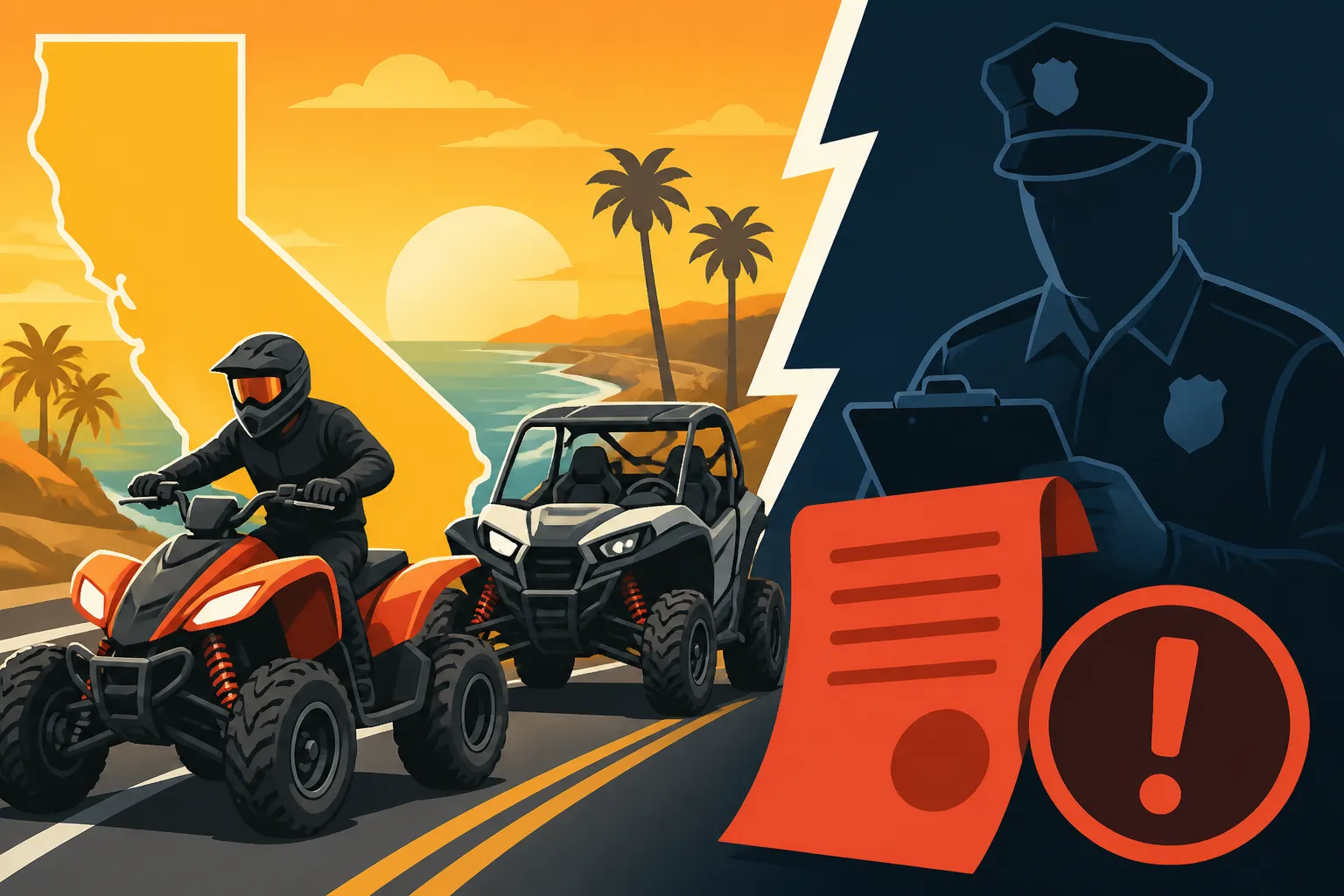
If a law enforcement officer, whether it's the California Highway Patrol, a Sheriff's Deputy, or even a local police officer, spots you operating an OHV on a public highway, they will likely pull you over. The primary citation you'll face is almost certainly for violating CVC 38025, which prohibits OHVs on highways. This is typically classified as an infraction.
While an infraction might sound minor, the base fine for this violation can be substantial, often in the hundreds of dollars. But that's just the starting point. California adds a complex array of "penalty assessments," court surcharges, state and county fees, and other charges to the base fine. What starts as a few hundred dollars can easily mushroom into a total bill that is well over a thousand dollars by the time all the add-ons are included. It's not uncommon for a simple traffic infraction to cost four to five times its base fine amount after all the assessments are applied. You might be shocked at [California Fines for Riding a Public Road] when you see the final tally.
Accumulating Additional Charges
The initial CVC 38025 violation is often just the beginning. Once you've been stopped, the officer will likely conduct a more thorough check of your vehicle and your compliance with other laws. This can lead to a cascade of additional citations, each carrying its own set of fines.
Common secondary violations might include:
- No Current OHV Registration: If your California Green, Red, or Tan sticker is expired or missing, that's another ticket. You need to ensure you have a current [Registering an OHV in California] and that the sticker is properly displayed.
- No Spark Arrester: Operating an OHV without a U.S. Forest Service approved spark arrester is illegal on public land and can lead to [California Spark Arrester Rules] violations, especially in brush-covered areas or during fire season.
- Loud Exhaust: If your OHV's exhaust system exceeds California's strict noise limits, particularly the 96-decibel limit for newer machines, you could also face [California Fines for a Loud Machine]. Aftermarket exhausts are a common culprit here.
- No Helmet: While riding on trails, adults have some waivers in certain vehicles, but on a public highway, you're expected to comply with general helmet laws, especially for ATVs. [California Helmet Law for ATV Riders] is strict.
- No Driver's License: Although you don't need a driver's license to operate an OHV off-highway on public land, operating any vehicle on a public highway typically requires a valid driver's license.
- No Insurance: While OHV insurance isn't universally mandated for all off-highway riding, using an OHV on a public road where vehicles are typically required to be insured can add this to your list of violations. Check [California OHV Insurance Requirements] for more details.
- Vehicle Impoundment: In more severe cases, or if you're deemed a repeat offender, the officer may have your OHV impounded. This means you'll be responsible for towing fees (which can be hundreds of dollars) and daily storage fees (which add up quickly). Recovering your machine can be a logistical and financial nightmare.
In rare, egregious circumstances, or for repeat offenders, what starts as an infraction could even escalate to a misdemeanor charge, carrying even harsher penalties, potentially including jail time or probation.
Are There Any Exceptions? California's Limited Road Use
It's not all doom and gloom for OHV riders who need to interact with roads. California does recognize a couple of extremely limited circumstances where OHVs can legally touch pavement, but these are narrow exceptions, not broad permissions.
Understanding Combined-Use Highways
The most commonly discussed exception is the "combined-use highway." This refers to specific segments of public roads that local authorities (like a county or city) have formally designated for shared use by both highway-legal vehicles and OHVs. The catch? These designations are rare, typically very short, and must be approved by the California Highway Patrol (CHP).
The law that allows for this is [California's CVC 38026 Lets an Agency Designate]. This code section permits local agencies to designate specific segments of highways for OHV use, but there are strict criteria. These segments are usually meant to connect two established OHV riding areas, provide access to services like fuel or food, or allow OHVs to get from a staging area to a trailhead. They are not for general commuting or joyriding. Crucially, [California's 3-Mile Combined-Use Cap] limits the length of these segments, meaning you're unlikely to find long stretches of road open to OHVs. Even on these designated segments, OHVs must still comply with basic rules like speed limits, stop signs, and yielding to traffic. You'll often see specific signage indicating these routes.
Crossing a Highway: A Brief and Direct Action
A separate, very specific exception allows for an OHV to cross a public highway. This is a crucial distinction: it's about traversing the road to get from one side to the other, not riding along it.
[California Rules for Crossing a Public Road] are precise. You must stop before crossing, yield to all traffic, cross at a right angle to the highway, and have an unobstructed view of traffic in both directions. The crossing must also be made at the safest and most direct route possible. This means you can't weave down the road for a block before crossing; it's a direct, perpendicular movement across the minimum distance of the pavement. This provision is typically for connecting trails where the road forms a natural barrier, not for creating your own routes.
Private Land and Exemptions
While OHV registration is required for public land, if you're riding exclusively on private property with the landowner's permission, the state's OHV registration rules don't apply. However, this exemption absolutely does not extend to accessing that private land by illegally riding on a public highway. You still need to trailer your machine to and from the private property. Owning a large ranch in the middle of nowhere doesn't grant you the right to drive your UTV on the county road to get to the back forty if that county road is a designated highway.
Avoiding the Fines: Smart Riding and Legal Alternatives
The best way to avoid California fines for riding on a highway is simple: don't do it. But beyond that obvious advice, there are practical steps you can take to ensure your riding adventures are fun, safe, and legal.
Trailer Up and Drive Smart
This might seem basic, but it's the most important piece of advice: always transport your OHV on a trailer or in the bed of a truck when traveling on public roads. [Trailering Instead of Riding in California] is not just a suggestion; it's a legal requirement for most situations. Ensure your trailer is properly registered, lit, and securely carries your machine. Don't overload it or use an improper hitch. Make sure your tow vehicle is capable of handling the weight. This completely removes the risk of those costly highway fines.
| Violation Type | Typical Penalty Structure | Secondary Impact |
|---|---|---|
| Operating OHV on Highway (CVC 38025) | Substantial base fine + court fees/assessments (e.g., $1000+) | Possible impoundment, points on driving record (minor) |
| Expired/No OHV Registration | Moderate base fine + court fees/assessments | Further delays and costs to recover impounded vehicle |
| No Spark Arrester | Moderate base fine + court fees/assessments | Fire hazard risk, possible vehicle inspection mandates |
| Excessive Noise (CVC 38370) | Moderate base fine + court fees/assessments | Required exhaust repair/modification |
| No Helmet (for ATVs) | Moderate base fine + court fees/assessments | Injury risk |
| No Driver's License | Significant base fine + court fees/assessments | Potential for misdemeanor charges |
| No Insurance | Significant base fine + court fees/assessments | Suspension of driving privileges |
| Vehicle Impoundment | Towing fees (hundreds) + daily storage fees (dozens) | Major inconvenience, financial drain, vehicle recovery |
Plan Your Ride: Know the Rules Before You Go
Before you even load up your machine, do your homework. Research your destination thoroughly. Start by identifying designated [California OHV Areas] like State Vehicular Recreation Areas (SVRAs), or Bureau of Land Management (BLM) and U.S. Forest Service (USFS) lands that permit OHV use. For federal lands, look up Motor Vehicle Use Maps (MVUMs) which clearly show which roads and trails are open to specific types of vehicles. Never assume a dirt road or fire road is open to OHVs unless explicitly marked as such on an official map or by signage. These maps are invaluable for understanding exactly where you can ride legally.
Always carry your valid OHV registration paperwork with you, and ensure your sticker is current and properly displayed. It’s also a good idea to have proof of your [California ATV Safety Certificate Requirements], especially if you're under 18 or supervising someone who is. Taking the time to prepare beforehand can save you massive headaches and expenses down the line.
Consider a Street-Legal Vehicle (If You Need Road Access)
If your primary need is to connect trails or access areas via public roads, and the extremely limited combined-use highways aren't sufficient, then the most definitive solution is to use a vehicle that is actually street-legal. This means a car, truck, or motorcycle that is fully compliant with California's rigorous Vehicle Code for on-road operation.
While it's possible to purchase vehicles that are advertised as "street-legal UTVs" in some states, California's rules for converting true OHVs for full highway use are incredibly stringent and, for most factory-built ATVs and UTVs, effectively impossible for unrestricted road access. The street-legal designation for these types of vehicles is often limited to very specific local ordinances (like neighborhood electric vehicles or golf carts on certain low-speed streets) rather than general highway permission. If you genuinely need to use public roads regularly as part of your riding experience, a dedicated, properly registered, and insured street-legal vehicle is the only truly safe and legal answer.
Disclaimer
This article is for general informational purposes only and does not constitute professional advice. Laws, prices and regulations vary by location and change over time. Consult a qualified professional for guidance on your specific situation.