California’s 3-Mile Combined-Use Cap
One of the biggest head-scratchers for us off-road enthusiasts in California is the tangled mess of rules surrounding taking our beloved ATVs and UTVs onto any kind of paved or public road. You've probably heard whispers, maybe even seen a few machines on short stretches, but the question always remains: how far can you actually go? This guide is here to untangle the confusion around California's "combined-use highway" segments, especially that tricky 3-mile cap, so you can ride confidently and legally, connecting those awesome trails without fear of a citation.
Understanding California's Combined-Use Highways: More Than Just a Dirt Road
California, with its vast and varied landscapes, offers incredible off-road opportunities, from the sprawling deserts to the winding mountain trails. However, getting to these trails often involves navigating a complex web of public roads. For years, this has been a major point of frustration for riders. Our machines are designed for dirt, but sometimes a small stretch of pavement, a county road, or even a short highway segment stands between us and the next adventure, or simply a gas station. This is where the concept of "combined-use highways" comes into play, offering a very specific, limited solution. It’s not about making your UTV street legal for cruising downtown; it’s about providing critical connectors for true off-highway recreation.
What Exactly is a "Combined-Use Highway" in California?
Imagine you’re out on the trails, and to get from one section of an off-highway vehicle (OHV) park to another, or perhaps from your campsite to a nearby designated riding area, there's a paved road in the way. In many states, that's a hard stop. In California, however, certain segments of public roads can be designated as "combined-use highways." What this means is that, under very specific conditions and for a limited distance, properly equipped and registered OHVs can legally share these segments with conventional vehicles. It's a lifeline for riders who might otherwise have to trailer their machines for a mere mile or two. Think of it as a bridge, not a highway for regular travel. It’s a carefully crafted exception to the general rule that OHVs are not permitted on public streets.
The term "combined-use highway" itself can be a bit misleading because it suggests a broader application than what actually exists. These aren't just any roads; they are specific, designated segments where a local agency – usually a county or the California Department of Parks and Recreation’s OHMVR Division – has gone through a rigorous process to permit OHV use. Without that official designation and signage, even if it looks like a quiet dirt road, it's off-limits to your OHV as a connector. The intent is to facilitate access to and egress from OHV recreation areas, not to open up general road use. The state is very clear: these are for connecting trails, not for daily commuting or joyriding on pavement.
The Underlying Philosophy: Bridging Gaps, Not Opening Freeways
The whole idea behind [California's Combined-Use Highways] is rooted in practical necessity for off-road enthusiasts, balanced against public safety and environmental concerns. The state recognizes that some of the most spectacular riding areas aren’t seamlessly connected by dirt trails alone. Sometimes, a short section of paved road, a county road, or a specific highway segment can act as a barrier, forcing riders to load up their machines onto trailers, drive a short distance, and then unload – a process that's not only inconvenient but also adds to traffic on main roads. The philosophy isn't to convert OHVs into street-legal vehicles, which is a different, much more complex, and often impossible endeavor in California. Instead, it’s about creating controlled, limited pathways for legitimate recreational purposes.
This bridging concept is critical. It allows riders to access services like gas stations, local stores, or different trailheads without completely disrupting their riding experience. Imagine being deep in the desert, running low on fuel, and the only gas station is just across a 1-mile stretch of state highway. Without combined-use designation, that quick hop for gas becomes a logistical nightmare. The state's intent is to make the OHV experience more user-friendly and accessible, particularly for those who explore vast areas like the Imperial Sand Dunes or the extensive trail networks in the national forests. It's a pragmatic approach to land management, aiming to maximize recreational opportunities while still maintaining stringent control over where OHVs operate.
Why the Cap? The Rationale Behind [California's 3-Mile Combined-Use Cap]
The 3-mile cap isn't an arbitrary number plucked out of thin air; it's a carefully considered limitation designed to serve the "bridging" purpose without opening the floodgates to widespread OHV road use. The state legislature, through Vehicle Code Section 38026, allows for these designations, but with clear boundaries. The primary reason for the cap is safety. OHVs are built for off-road conditions – they handle differently on pavement, often lack the full suite of safety equipment found on street-legal vehicles (like turn signals, specific mirrors, or even full lighting for nighttime use), and can present challenges in high-traffic environments. Limiting the distance to three miles helps minimize the exposure of OHVs and their riders to the hazards of public roads.
Furthermore, the cap reinforces the idea that these are strictly connector segments, not routes for extended travel. If the cap were, say, 10 or 20 miles, it would fundamentally change the nature of OHV road use, blurring the lines between off-highway recreation and general transportation. This could lead to demands for further street-legal conversions and greater integration onto public roads, which California has historically resisted due to unique environmental regulations and safety concerns. The 3-mile limit acts as a practical safeguard, ensuring that OHVs primarily remain in their intended off-highway environment while still providing necessary, short-distance utility. It’s a compromise that attempts to balance rider convenience with the state's broader regulatory framework for vehicle safety and emissions. It means you can usually get to the next section of trail, but don't plan on riding your side-by-side all the way into town for dinner.
The Intricacies of the 3-Mile Limit: How it Works on the Ground
Understanding that 3-mile limit is crucial because misinterpreting it can lead to serious fines and even impoundment of your machine. It's not a suggestion; it's a hard and fast rule that rangers, sheriff's deputies, and CHP officers are keenly aware of. Many riders get into trouble because they think "a little over" won't matter, but on these designated routes, every foot counts. The spirit of the law is to provide minimal access, not open-ended freedom. This isn't about trying to push the boundaries, but about understanding where those boundaries firmly stand.
Measuring the Distance: What Counts in the 3 Miles?
The 3-mile limit is the maximum continuous distance an OHV can operate on a designated combined-use segment. This means that if an agency has designated a road for combined use, your OHV can travel up to three miles on that specific segment. It's not cumulative for your entire ride; it's per designated segment. So, if you exit a trail system, travel 2 miles on a combined-use road to reach another trail system, you're fine. If that designated road then continues for another 4 miles, you cannot continue on it past the 3-mile mark. It doesn't reset if you turn onto a different street unless that new street is also a separately designated combined-use segment, which would typically be signed as such.
Think of it like this: if you're pulling your rig from the campground at Oceano Dunes to the entrance gate at the pier, and there's a designated combined-use path, you can traverse it for a maximum of three miles. If the path to the gas station is 3.5 miles, you still have to stop at 3 miles and find another way. The clock starts ticking as soon as your wheels hit the designated combined-use segment. Agencies often install specific signage at the beginning and end of these segments, sometimes even indicating the mileage. Without such clear signage, assuming a road is combined-use, especially for more than a quick crossing, is a gamble you don't want to take. Always look for official markings; don't rely on guesswork or what another rider thinks is allowed.
Real-World Scenarios: From Trailhead to Town
Let's imagine some common scenarios where this 3-mile cap comes into play. You're deep in the Inyo National Forest, enjoying the trails, and realize you're almost out of gas. A quick check of your map, or better yet, a Motor Vehicle Use Map (MVUM) from the Forest Service, shows a designated combined-use road that could take you directly to a small gas station in a nearby town, roughly 2.5 miles away. In this instance, assuming your OHV meets all the other requirements (registration, spark arrester, helmet, etc.), you could legally ride that 2.5 miles, fill up, and return. This is the ideal application of the law – a practical connection for essential services or continuing your ride. [Riding a California Forest Service Road] can often involve these kinds of short connections.
Another scenario might involve linking two distinct trail networks in a place like Hungry Valley SVRA, where a short county road separates them. If that county road has been designated for combined use, you could traverse the necessary distance, up to three miles, to seamlessly move from one section to another without the hassle of trailering. Or perhaps you're camping near Ocotillo Wells and want to grab some ice from a convenience store just outside the park boundary, requiring a 1.5-mile trip on a designated county road. These are the "bridging" moments that the 3-mile cap is designed to facilitate. However, it's never meant for an extended journey. You wouldn't, for example, ride your quad 10 miles into a larger town to do grocery shopping, even if parts of that route had combined-use designation – you'd quickly exceed the allowed distance. The goal is convenience for recreation, not general purpose travel.
The Harsh Reality of Exceeding the Limit
Let’s be blunt: going over the 3-mile limit, even by a short distance, can have severe consequences. Law enforcement in California, whether it's the CHP, a county sheriff, or a local ranger, takes OHV regulations very seriously. They understand the nuances of the combined-use law, and they will enforce it. If you're caught exceeding the 3-mile cap, you could be facing a hefty citation for operating an OHV illegally on a public highway. These aren't just minor traffic tickets; they can be significant fines, often in the hundreds of dollars. The officer may also deem your vehicle "unlawful" on the roadway, potentially leading to impoundment. Imagine your UTV being towed away from the middle of your ride, leaving you stranded.
The penalties can also include points on your driving record, depending on how the citation is written. More importantly, riding illegally on a paved road exposes you to increased risk. OHVs, especially ATVs, are inherently unstable on pavement at higher speeds or during emergency maneuvers. A collision while riding illegally on a combined-use road could lead to severe injuries, and your insurance might balk at covering damages if you were in violation of the law. It’s simply not worth the risk for a few extra feet or miles. Always err on the side of caution. If you're unsure if you've hit the limit, it's better to turn back or find an alternative. The state is not forgiving when it comes to these explicit limits, so don't test them.
Which Machines Qualify: ATVs, UTVs, and the Road Ahead
Not all off-highway vehicles are created equal when it comes to combined-use segments. While the primary distinction often centers on registration (Green Sticker vs. Red Sticker, etc.), there are also specific equipment requirements that your machine must meet to even consider riding on a combined-use highway. It’s not just about having a valid OHV registration; it's about making sure your machine is equipped to be as safe as possible for the brief periods it shares the road with cars and trucks. Even a minor oversight can render your ride illegal on these designated stretches.
Specifics for Your ATV: What You Need to Know
For your ATV to be legally allowed on a designated combined-use segment, it needs to meet several criteria beyond just the 3-mile cap. First and foremost, it must have a valid California OHV registration – that means a current Green Sticker, Red Sticker, or California OHV ID Plate. Out-of-state registrations generally do not qualify for combined-use segments in California unless they are from Oregon or Nevada, which have specific reciprocity agreements with California for general OHV use, but even then, the combined-use segment rules still apply. You also need to carry proof of this registration with you, often in a water-resistant bag on your machine.
Beyond registration, your ATV must be equipped for public road interaction. This typically means having at least one headlight (which must be on), at least one taillight (which must be on), and working brakes. While turn signals aren't usually required for ATVs on combined-use segments (due to the expectation of short, low-speed travel), hand signals are always a good idea. A mirror isn't usually mandatory for ATVs either, but having one (or two, if you've added them) significantly enhances safety. Don't forget your spark arrester – it's mandatory for all OHVs on public land, and that includes these combined-use segments. And of course, a DOT-approved helmet is non-negotiable for all ATV riders on public land in California, regardless of age, including these road sections. [California Helmet Law for ATV Riders] is very clear on this.
UTVs and the Combined-Use Maze: [Why California Will Not Convert a UTV]
UTVs, or side-by-sides, often present a slightly different set of expectations for combined-use segments. Because they are often larger, more stable, and more car-like than ATVs, some riders mistakenly believe they have more leeway on public roads. This is generally not true. The same 3-mile limit and most of the same equipment requirements apply. Your UTV must also have a valid California OHV registration (Green, Red, or ID Plate). Headlights, taillights, and working brakes are absolute musts. Seatbelts, if equipped, must be worn by all occupants.
However, UTVs often have more stringent requirements when it comes to certain safety features that mimic street vehicles. For example, some interpretations and local designations might require a rearview mirror for UTVs, and while not strictly mandated for combined-use, turn signals are definitely a good idea if you have them. Aftermarket accessories from companies like SuperATV that enhance visibility, like side mirrors or upgraded lighting, can contribute to safety even if not strictly required by law for these limited segments. It's important to remember that even with all these upgrades, your UTV is still not street legal in the broader sense. California has made it abundantly clear that converting an OHV, including a UTV, to full street-legal status is generally not possible. The combined-use law is a specific, narrow exception, not a pathway to street legality. The rules for [California OHV Registration for a UTV] still apply, whether you're on the trail or a designated combined-use road.
Essential Equipment for Road Segments
Regardless of whether you ride an ATV or a UTV, there’s a basic checklist of essential equipment you should have when venturing onto any combined-use segment. This isn't just about legality, but about your safety and the safety of others sharing the road.
| Equipment Type | ATV Requirement | UTV Requirement | Notes |
|---|---|---|---|
| Registration | Current CA OHV Plate/Sticker | Current CA OHV Plate/Sticker | Must be visible and paperwork carried. |
| Headlights | At least one, on | At least one, on | Required for visibility, day or night. |
| Taillights | At least one, on | At least one, on | Required for visibility, day or night. |
| Brakes | Working rear & front | Working all wheels | Essential for stopping safely. |
| Spark Arrester | USFS approved | USFS approved | Mandatory on all public lands. |
| Helmet | DOT approved (all riders) | DOT approved (ATV riders), often waiver for ROHVs | Mandatory for ATV operators/passengers; ROHV operators/passengers 16+ in enclosed cab may be exempt. Always check specific regulations. |
| Seatbelts | N/A | Worn by all occupants | Mandatory if equipped in UTVs. |
| Whip Flag | N/A, but highly recommended in dunes | N/A, but highly recommended in dunes | Not specifically for combined-use, but if connecting dune areas, still needed. |
| Muffler | Must meet sound limits | Must meet sound limits | Check local sound regulations. |
Beyond this, consider adding a small first-aid kit, a tool kit for minor repairs, and perhaps a small air compressor to adjust tire pressure if you're transitioning from soft sand to pavement. While not always legally required for combined-use segments, items like a horn and mirrors significantly improve your ability to communicate with and be aware of other traffic, making your brief road journey much safer. Think about what a company like SuperATV offers in terms of safety accessories – often, these products go beyond the minimum legal requirements to provide a much safer and more enjoyable riding experience.
Locating and Legally Using Combined-Use Routes
The biggest mistake riders make with combined-use highways is assuming they know which roads are open. You can’t just eyeball a paved section between two trails and decide it’s fair game. This kind of access is highly regulated and specifically designated. If you're caught on an undesignated public road, even for a short distance, you're looking at fines and potential impoundment. The onus is entirely on the rider to know where they can and cannot legally operate. It's not a "ask for forgiveness" situation; it's a "know before you go" requirement.
The Designation Process: Who Decides Which Roads Are Open?
The power to designate a road segment as a combined-use highway rests primarily with two entities in California: local governmental agencies (like county boards of supervisors) and the California Department of Parks and Recreation, specifically the Off-Highway Motor Vehicle Recreation (OHMVR) Division. This isn't a federal decision or something that individual rangers can decide on the fly. For a road to become a combined-use segment, it typically involves a formal process, including public hearings, environmental reviews, and a resolution or ordinance from the designating authority. The local agency must determine that OHV use on that specific road segment is compatible with public safety and the local environment.
The designation also requires approval from the California Highway Patrol (CHP) or other appropriate law enforcement agencies to ensure that traffic safety standards are met. This means things like sightlines, traffic volume, speed limits, and the presence of other vulnerable road users (pedestrians, cyclists) are all taken into account. Only after this thorough review and approval process can a road legally be designated. This rigorous process is why you don't see combined-use segments popping up everywhere; they are carefully considered and implemented solutions for specific access needs. So, if you're thinking of riding [Riding a County Dirt Road in California] that looks quiet and rural, make sure it’s officially designated.
Your Go-To Resources for Finding Legal Routes: Maps and Signage
Given the specific and limited nature of combined-use highways, relying on official resources is paramount. Your best bet for finding these legal segments includes:
- Motor Vehicle Use Maps (MVUMs): For routes within national forests or on BLM land, MVUMs are gold. These maps clearly mark which roads are open to different vehicle types, including OHVs, and often indicate combined-use segments. They are legally binding, so carry the most current version. You can usually find these online on the Forest Service or BLM websites for the specific area you plan to visit, or pick up a physical copy at a ranger station.
- Local County Websites and Ordinances: If you're exploring areas managed by specific counties, check their public works or transportation department websites. Some counties will have maps or lists of designated combined-use roads. This is especially important for [Riding Unincorporated County Roads in California].
- California State Parks OHMVR Division: The OHMVR Division sometimes publishes maps or information related to combined-use connectors, particularly those linking State Vehicular Recreation Areas (SVRAs) or other state-managed OHV lands. Their website is a good starting point for general information.
- On-Site Signage: Always, always, always look for official signage. Designated combined-use segments will typically have signs clearly indicating that OHV use is permitted, often with speed limits or other restrictions. The absence of such signage should be a red flag. Do not rely on old faded signs or word-of-mouth.
Without clear, current, and official information, assume a road is not a combined-use highway. It’s far better to be safe and avoid a fine than to guess wrong.
Local Ordinances and [Riding Unincorporated County Roads in California]
While the state law (CVC 38026) provides the framework for combined-use highways, the actual implementation often happens at the local level. Counties, in particular, play a significant role in designating these routes within their jurisdictions, especially on roads that aren't state highways or within federal lands. This means that what's allowed in one county might be completely prohibited in another. For example, a county might have a specific ordinance allowing OHVs on certain remote, low-traffic roads to connect to forest trails, while a neighboring county might have no such provisions.
This localized approach can create a patchwork of rules, making it challenging for riders to navigate. It underscores why checking specific county ordinances or maps is so important before you ride. An unincorporated county road that appears to be just a dirt access road could still technically be a "highway" in the eyes of the law, and thus off-limits to OHVs unless specifically designated for combined use. Even on a designated combined-use segment, local rules might impose additional restrictions, such as specific hours of operation, noise limits, or even unique equipment requirements. Always be aware that "combined-use" isn't a blanket permission; it's a precisely defined local allowance.
Staying Safe and Legal: Rules, Gear, and Consequences
Riding on a public road, even a short combined-use segment, inherently carries more risk than riding on a dedicated trail. You're now sharing space with cars, trucks, and potentially pedestrians or cyclists who might not be expecting an OHV. This heightened risk means that adhering to safety protocols and equipment requirements isn't just about avoiding a ticket; it's about safeguarding your life and the lives of others. Compromising on safety in these situations is simply not an option.
Mandatory Safety Equipment: Beyond the Trail
While we've touched on some equipment already, it's worth emphasizing the mandatory items that go beyond what you might strictly use for pure off-road riding. When you hit a combined-use segment, you're transitioning into a quasi-street environment, and your gear needs to reflect that.
- Helmet: As mentioned, a DOT-approved helmet is absolutely mandatory for ATV riders of all ages. For UTV (ROV) operators and passengers aged 16 and older, the law allows for a helmet waiver if the vehicle is equipped with a roll cage and seatbelts, and those seatbelts are being worn. However, many seasoned riders and safety experts will tell you that wearing a helmet even in a UTV with a cage offers an additional layer of protection that could save your life in a collision, especially on pavement. When in doubt, wear the helmet.
- Eye Protection: Goggles or a face shield are critical. Dust and debris are common on trails, but on a paved road, flying gravel from other vehicles or even bugs can severely impair your vision, leading to dangerous situations.
- Lighting: Your headlights and taillights must be fully functional and on during operation on combined-use segments, regardless of the time of day. This is crucial for your visibility to other motorists. Many aftermarket lighting options, like those offered by SuperATV, can significantly improve your visibility beyond stock, which is a smart investment for any machine that might see road time.
- Brakes: Your brakes must be in excellent working order. Being able to stop quickly and effectively is non-negotiable when sharing the road with other vehicles, especially since OHVs can have longer stopping distances on pavement than street vehicles.
- Spark Arrester: This is universal for all OHVs on public land, including combined-use roads. It prevents sparks from your exhaust from igniting dry vegetation, a critical concern in California's often-arid environments.
Remember, the goal is to make yourself as visible and predictable as possible to other road users for the short duration you're on these segments.
The Role of Law Enforcement on Combined-Use Routes
When you're on a combined-use highway, you're under the jurisdiction of standard law enforcement agencies, just like any other vehicle operator. This means the California Highway Patrol (CHP), county sheriff's departments, or local police (if the segment is within city limits) can pull you over. They are specifically trained to enforce OHV laws, and they know the designated combined-use segments in their area. Unlike some remote trails where you might only encounter a ranger, on these roads, you're fair game for any patrol unit.
Law enforcement officers will be checking for several key things:
- Valid OHV Registration: Is your sticker current and properly displayed? Do you have your paperwork?
- Equipment Compliance: Are your lights on? Do you have a spark arrester? Is your helmet on (if required)?
- Operator Conduct: Are you driving safely? Are you speeding? Are you riding recklessly?
- The 3-Mile Limit: Are you still within the designated segment and under the mileage cap? This is often the trickiest part to prove on the spot without GPS evidence, which is why official signage is so important for riders.
Don't engage in risky behavior or give officers a reason to stop you. Ride predictably, obey all traffic laws (speed limits, stop signs, yielding, etc.), and be courteous if you are pulled over. Remember, you're representing the entire OHV community during these brief interactions on public roads.
The Price of Non-Compliance: [California Fines for Riding on a Highway]
The penalties for violating combined-use highway rules are not minor. If you're caught operating an OHV illegally on a public road, whether it's because you weren't on a designated segment, exceeded the 3-mile limit, or lacked the proper equipment, you're looking at a citation. These fines can be substantial. For example, riding an unregistered OHV on a public highway can easily result in a base fine of several hundred dollars, which then increases significantly with court fees and assessments. Operating an OHV without a spark arrester can also incur a hefty fine.
Beyond the immediate financial hit, there are other potential consequences:
- Vehicle Impoundment: Law enforcement has the authority to impound your vehicle if it's being operated unlawfully. The cost of towing and impound fees can quickly add up, often exceeding the fine itself.
- Insurance Issues: If you're involved in an accident while illegally operating your OHV on a public road, your insurance company may deny coverage for damages or injuries, leaving you personally liable for potentially astronomical costs.
- Driver's License Points: Depending on the nature of the violation, it could even result in points on your state driver's license, affecting your insurance rates or even leading to license suspension if you accumulate too many points.
The bottom line is that the risk far outweighs any perceived convenience of bending the rules. Always adhere to the law precisely when operating your OHV on combined-use segments.
Broader Context: When OHVs and Public Roads Intersect
While the 3-mile combined-use cap is a specific legal provision, it's essential to understand it within the larger framework of how California views OHV interaction with public roads. This isn't the only time an OHV might touch pavement, but each instance comes with its own set of very strict rules and limitations. The state's overarching policy leans heavily towards keeping OHVs off conventional roads, primarily for safety and environmental reasons.
Quick Crossings: A Different Set of Rules
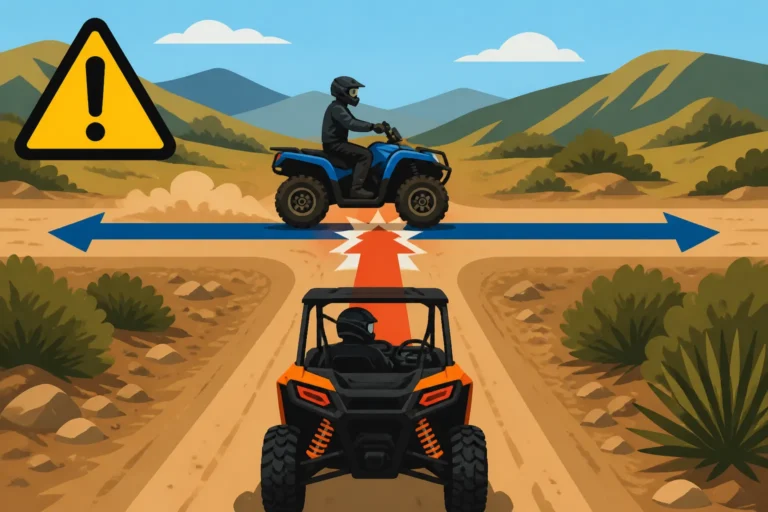
The 3-mile combined-use cap applies to traveling on a designated road segment. However, there's a separate, very limited provision that allows OHVs to cross a public highway. This is typically found in California Vehicle Code (CVC) Section 38025. This section allows an OHV to cross a highway, road, or paved trail if it's done at an angle of approximately 90 degrees to the roadway, at a place where the highway intersects with a designated OHV trail, and after coming to a complete stop and yielding to all traffic. The intent is solely to move from one side of a trail to the other when a public road bisects it, not to travel along the road.
This is a critical distinction. You cannot use the "crossing" rule as an excuse to travel any distance down a road. It must be a direct crossing, usually at a clearly marked intersection with an OHV trail. Think of it as literally driving across a street, not turning onto it. Speed is typically limited to the lowest safe speed for the crossing. Any deviation from this direct, perpendicular crossing, or any attempt to travel along the road, would put you in violation of the law, with the same potential penalties as riding an undesignated combined-use segment. So, if you're on a trail and a paved road cuts through it, you can probably make a quick, safe crossing, but don't assume you can then turn right or left and ride for a block. [California Rules for Crossing a Public Road] are extremely precise.
Other Road-Use Exceptions: Farm Quads and Special Permits
There are a few other, highly specific exemptions where an OHV might legally operate on a public road, but these are very niche and rarely apply to recreational riders.
- Agricultural Operations: OHVs, particularly ATVs, used for legitimate agricultural purposes (e.g., on a farm, ranch, or in certain forestry operations) may have exemptions allowing them to operate on public roads adjacent to or connecting their properties. These exemptions are typically tied to very strict conditions, such as specific times of day, speed limits, and the requirement for the machine to be actively engaged in farm work. They are not for recreational use, and a recreational rider simply claiming to be "on the way to the farm" would not qualify.
- Government/Utility Vehicles: OHVs operated by government agencies (like law enforcement, fire departments, or public utilities) for official duties may also have exemptions to use public roads. This is because their work often requires them to access remote areas and quickly move between sites, and their machines are part of their official fleet.
- Special Event Permits: For very specific, organized events like parades, charity rides, or official races, a special event permit might be issued by a local authority or the state. These permits are temporary, highly regulated, and specify exact routes, times, and safety protocols. This is not something an individual rider can apply for to go on a personal ride; it's for large-scale, pre-approved events.
These exceptions are extremely limited and do not extend to the average recreational OHV enthusiast. Don't assume you qualify for any of them without explicit, written permission or clear legal backing.
Why a Full Street-Legal Conversion Remains Elusive for Most
Despite the desire of many riders to make their ATVs or UTVs fully street legal, California's stringent vehicle codes and environmental regulations make this virtually impossible for machines designed solely for off-highway use. Unlike some other states that have more relaxed laws for "street-legal UTVs," California does not generally recognize or allow this conversion. The core issue often comes down to:
- Emissions Standards: California has some of the strictest emissions regulations in the nation. Most OHVs do not meet these on-road standards, and modifications to do so are often prohibitively expensive or simply impossible.
- Federal Motor Vehicle Safety Standards (FMVSS): OHVs are not manufactured to meet FMVSS requirements for on-road vehicles. This includes things like specific lighting, braking systems, crashworthiness, windshields (or lack thereof), and tire standards. Retrofitting an OHV to meet all these standards is a monumental, if not impossible, task.
- Vehicle Classification: California's Vehicle Code categorizes OHVs separately from conventional highway vehicles. There isn't a legal pathway to reclassify an OHV as a street-legal vehicle for general highway use. This is why [Why California Will Not Convert a UTV] is such a consistent answer from the DMV.
The combined-use highway provision is a testament to the state's reluctance to open up broader OHV road access. It's a tiny window of opportunity, not a wide-open door. For riders wanting to drive their machines on public roads for anything more than these very short, designated connections, the only true "street-legal" options are purpose-built vehicles like motorcycles, cars, or trucks, not converted OHVs.
The Evolving Landscape of California OHV Road Access
The rules governing OHV access in California are not static; they are the result of ongoing legislative efforts, pilot programs, environmental pressures, and the constant advocacy of the riding community. While the 3-mile combined-use cap has been a long-standing feature, understanding its history and the discussions around it can provide insight into what the future might hold, or why certain changes are unlikely.
Lessons Learned from [California's Inyo County Pilot Ended in 2025]
For a period, Inyo County in the Eastern Sierra Nevada had a unique pilot program that allowed OHVs on certain designated county roads for distances greater than the standard 3-mile cap, up to 10 miles. This was a significant departure from the statewide rule and was born out of the unique needs of a vast, rural county with extensive OHV recreation and dispersed communities. The idea was to study the impact of expanded OHV road access on public safety, local economies, and the environment.
However, this pilot program had a sunset date, and [California's Inyo County Pilot Ended in 2025]. The cessation of this program, despite its apparent popularity among riders and some local businesses, highlights the challenges of expanding OHV road access in California. Factors such as environmental concerns, public safety debates, and differing opinions among various stakeholders often lead to conservative approaches. The lessons learned from Inyo County will likely inform future discussions, but they also reinforce that any expanded road access will be hard-won, highly scrutinized, and likely come with its own set of strict limitations and sunset clauses. It demonstrates that even a successful pilot program doesn't automatically translate into permanent, statewide changes.
Advocacy and the Potential for Future Changes
The OHV community in California, through organizations and individual riders, consistently advocates for more reasonable and expanded access. This includes pushing for more combined-use segments, clarifying existing laws, and exploring new avenues for connecting trails and services. These efforts are vital, as they bring rider perspectives to the attention of lawmakers and land managers. However, advocacy for road access faces significant hurdles:
- Environmental Groups: Many environmental organizations are wary of expanded OHV access, citing concerns about noise, dust, erosion, and potential impacts on wildlife and sensitive habitats.
- Public Safety Concerns: Local communities and law enforcement often raise concerns about vehicle compatibility, rider safety, and the potential for increased accidents when OHVs share roads with conventional traffic.
- Regulatory Complexity: California's legal and environmental framework is notoriously complex, making any legislative change a slow and arduous process.
Despite these challenges, continued advocacy is essential to ensure that the needs of the OHV community are heard. Future changes, if they occur, are more likely to be incremental—perhaps the designation of more combined-use segments in specific, low-impact areas—rather than a wholesale overhaul of the state's street-legal policies. Riders should stay informed and support organizations that work to protect and expand responsible OHV access.
Understanding the Agencies: From BLM to CHP
Navigating California's OHV regulations means understanding the roles of the various agencies involved. They each have a piece of the puzzle, and knowing who is responsible for what can help you get accurate information and understand the rationale behind the rules.
- California Department of Parks and Recreation, OHMVR Division: This is the primary state agency responsible for managing OHV recreation, including the SVRA parks and administering the Green Sticker program. They are instrumental in designating combined-use segments on lands they manage or in collaboration with local agencies. They also oversee the OHV Trust Fund, which provides grants for OHV projects. [What the OHMVR Division Actually Does] is crucial to understanding the big picture of OHV management in California.
- Bureau of Land Management (BLM) & U.S. Forest Service (USFS): These federal agencies manage vast tracts of land in California, including many popular OHV areas. They are responsible for designating routes (including combined-use segments) on their lands through Motor Vehicle Use Maps (MVUMs) and land-use plans.
- California Highway Patrol (CHP): The CHP is the primary law enforcement agency for state highways and many county roads in unincorporated areas. They play a critical role in approving combined-use designations and enforcing OHV laws on these segments.
- County Sheriff's Departments & Local Police: These agencies enforce OHV laws on county roads and within city limits, including any locally designated combined-use segments.
Each of these agencies operates under its own mandates and priorities, which can sometimes lead to differing interpretations or implementation details at a local level. Staying informed by consulting the specific agencies relevant to your riding area is the best way to ensure compliance and enjoy your ride without legal headaches.
Disclaimer
This article is for general informational purposes only and does not constitute professional advice. Laws, prices and regulations vary by location and change over time. Consult a qualified professional for guidance on your specific situation.