California’s Two-Year Nonresident OHV Permit Explained
Bringing an ATV, UTV, dirt bike or other off-highway vehicle to California can raise a basic question: does your home-state registration let you ride, or do you need a California permit? The answer depends on your vehicle’s identification and whether California recognizes your state’s credentials. Here’s how the two-year nonresident permit works, what to check before buying one and how to avoid relying on the wrong paperwork.
What the two-year permit is for
California’s nonresident OHV use permit is an identification option for eligible off-highway vehicles registered to people who live outside California. It allows a qualifying machine to meet California’s OHV identification requirements when it is used in places where those requirements apply, such as many public off-highway riding areas.
The permit is for the vehicle, not a personal riding license. If your group brings several machines, check the requirements for each one. A permit for one ATV does not cover a companion’s UTV, and a tow vehicle’s license plate does not identify the OHV it is hauling.
The permit also isn’t a general pass to ride anywhere. It does not grant access to closed routes, replace land-use rules or make an OHV street legal. You still need to follow the rules for the specific area, along with applicable safety, sound and equipment requirements. For a broader explanation of how visiting riders’ documents are treated, see California’s Nonresident OHV Use Permit and California OHV Permit for Out-of-State Riders.
Before arranging a permit, sort out which description fits your machine:
| Your situation | What to check |
|---|---|
| Your OHV has valid registration or an off-highway permit from another state | Check whether California recognizes that state’s credentials under its reciprocity rules. |
| Your OHV has paperwork from a state California does not recognize for this purpose | Determine whether you need California’s nonresident OHV use permit before riding. |
| Your machine has a street-legal plate from another state | Confirm what applies on the road and what identification is required at the OHV riding area. A plate alone may not settle both questions. |
| Your machine is rented or belongs to someone else | Ask who is responsible for the vehicle’s identification and confirm the machine is properly documented before riding. |
| You are attending an organized event | Check whether the event has separate permit requirements. An event permit is not automatically a substitute for ordinary machine identification. |
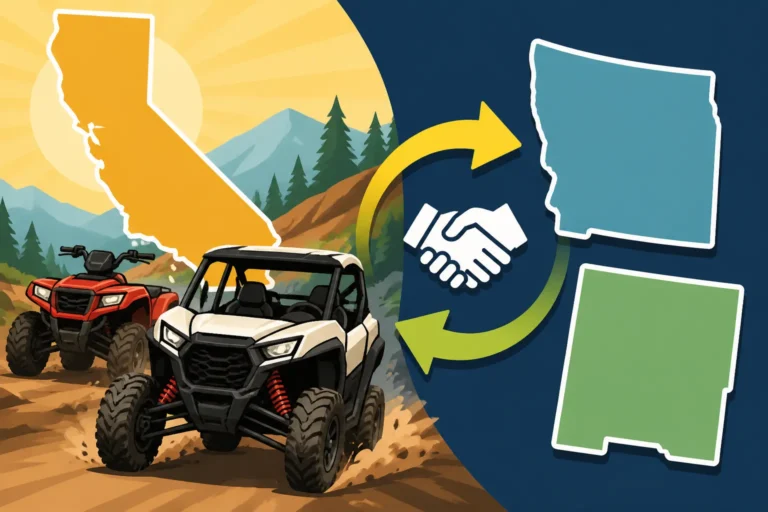
The table is a starting point, not a decision from the name on a document alone. Vehicle type, where you plan to ride and the exact credential displayed can all matter. California’s recognition of out-of-state credentials is limited, so don’t assume a registration or decal that works in your home state will automatically work at a California riding area. The details are covered in California OHV Reciprocity: Only Two States and Why Only Oregon and Nevada Count in California.
Why “two-year” does not necessarily mean 24 months
The two-year description refers to the permit’s term, but it may not mean you receive two full years from the day you buy it. Pay attention to the expiration date printed on the permit and the way California sets its validity period. A permit issued late in its term can provide less riding time than one obtained earlier.
This distinction matters if you’re planning trips around a particular season. Don’t calculate the end date by adding two years to your purchase date unless the permit terms explicitly say to do so. Instead, check the official purchase information and the permit itself before you rely on it. The calendar-year issue is explained further in A Permit That Expires December 31.
When comparing purchase timing, check these details:
- The printed expiration date: Treat the date on the permit as the controlling date for your planning, and confirm it is legible.
- The validity period for a newly issued permit: Read the current terms before paying, especially if you are buying near a seasonal cutoff.
- Whether a permit is required for your machine: Reciprocity may mean you can use recognized home-state credentials instead.
- Whether the permit will cover your planned riding dates: A permit that expires during your trip may leave you without valid identification for the remainder of your stay.
- Whether you need a new permit for another machine: Do not assume a permit is transferable between vehicles.
The permit’s cost and purchase conditions can change. Check the current official information before buying rather than relying on an old receipt, an online discussion or a friend’s recollection. For a focused explanation of the permit’s price, see California’s $30 Nonresident Permit, but verify the amount with the current issuing source.
If you already have a permit, inspect it before loading the machine. Make sure the identifying information matches the vehicle, the permit has not expired and it is displayed as required. If the date or vehicle information is hard to read, resolve that before riding rather than waiting for a checkpoint or ranger contact.
Reciprocity, street plates and common misunderstandings
Reciprocity is the reason some visiting riders may not need to buy California’s nonresident permit. California recognizes certain out-of-state OHV credentials, but that does not mean every state’s registration, sticker or plate counts. Check the current list and the rules for your vehicle before travel. A state’s own permission to ride is not, by itself, proof that California will accept it.
A road registration and an OHV permit also serve different purposes. A street-legal plate may authorize a vehicle to travel on roads under the rules that apply to that registration. It does not automatically answer what identification the vehicle needs when it is being used as an OHV on a trail, at an off-highway recreation area or on other public land. Review Why a Street-Legal Plate Does Not Substitute if your machine has an out-of-state road plate.
A few assumptions are especially risky:
- “It’s registered at home, so it must be fine in California.” Not necessarily. Confirm that the specific credential is recognized for the type of riding you plan to do.
- “It has a license plate, so it needs no other identification.” A road plate and OHV identification may not be interchangeable. Check what applies at your destination.
- “The permit belongs to the rider.” The permit identifies a machine. Check each vehicle in the group.
- “A two-year permit lasts exactly two years from purchase.” Use the printed expiration date and current permit terms instead of making that assumption.
- “The permit lets me ride on any road or trail.” It does not override closures, route designations, land-manager restrictions or road-use rules.
- “A rental shop’s paperwork means I can skip checking.” Ask what documentation is on the rental machine and whether it is valid for your planned location. Don’t mistake your own driver’s license or safety certificate for the machine’s registration or permit.
If your trip involves both public roads and designated OHV routes, treat those as separate questions. Confirm that the machine may be operated on each route and that it carries the identification required for that use. California’s rules for a particular road, crossing or recreation area may add requirements beyond the nonresident permit.
Buying, displaying and checking the permit
Use the official purchasing information to determine whether your vehicle needs the permit and how to obtain it. Buying online may be convenient, but confirm that the source is authorized, the vehicle details are entered correctly and you understand how the permit must be provided or displayed. The steps and current purchasing options are covered in Buying a California Nonresident Permit Online.
Before you ride, use this checklist:
- Identify the machine. Note its vehicle identification details and the state credentials it currently carries.
- Check reciprocity. Confirm whether California accepts the exact credential for your machine and planned use. Do not infer eligibility just from where the vehicle was bought or registered.
- Check the official permit terms. If reciprocity does not apply, confirm whether the California nonresident permit is the right option and review its validity period.
- Enter and verify the vehicle information. Check the permit against the machine before leaving home. A typo or a mismatch can create an avoidable problem.
- Follow the display instructions. Put the permit where California requires it, in the required orientation and position. See Displaying a Permit on the Left Side for the relevant display guidance.
- Carry supporting documents. Keep the paperwork you need with you, and make sure you can show it if asked. What a Ranger Accepts as Proof explains why having an image or receipt may not answer every identification question.
- Recheck before each trip. Confirm the permit is still valid and visible, and check for closures or additional rules at the destination.
The display requirement is not just a formality. A permit that is valid but hidden, damaged or difficult to read can be harder to verify. Mount it as instructed and avoid placing it where equipment, mud or a strap will cover important information. If it becomes detached or unreadable, contact the issuing authority for guidance before riding.
Keep a copy of the purchase confirmation and any related vehicle documents, but don’t assume a phone image replaces the required physical permit or display. Follow the official instructions for what must be attached to the machine and what should be carried by the rider. When in doubt, check the current information from the issuing agency and the rules of the specific riding area.
The safest approach is to resolve the paperwork before travel: identify the machine, confirm whether reciprocity applies, check the printed expiration date and display the correct credential. That small amount of preparation is easier than trying to sort out an eligibility question at the trailhead.
Disclaimer
This article is for general informational purposes only and does not constitute professional advice. Laws, prices and regulations vary by location and change over time. Consult a qualified professional for guidance on your specific situation.