Why Your Tow Vehicle Needs a California Dune Permit
A tow vehicle can be street legal, stay on the pavement, and still need its own permit at California’s Imperial Sand Dunes Recreation Area. The confusing part is that a dune-use permit is separate from state OHV registration and from the permit for the quad or UTV it hauled in. Here’s when the tow rig needs one, what it covers, and how to avoid a preventable checkpoint problem.
Why the tow vehicle needs a permit
The Imperial Sand Dunes Recreation Area (ISDRA) is managed for off-highway recreation, but a street-legal truck does not automatically fall outside its permit rules. If you bring the tow vehicle into the recreation area, it may need an ISDRA permit even if its job is only to haul your quad or UTV and it never climbs a dune.
The practical distinction is where the vehicle goes. A truck that remains on a public highway outside the recreation area is different from one driven into the area to reach a campsite, staging location, or other destination inside it. A permit for the OHV does not cover the tow vehicle as a second vehicle.
That can feel like paying twice for one trip, but the permits serve different purposes. The OHV permit covers the machine being ridden. The ISDRA permit is an area-use requirement for a qualifying vehicle entering the recreation area. It is not a replacement for the machine’s registration or other required identification.
The same general point applies whether you tow a dirt bike, quad, UTV, or another OHV: count the vehicles that will enter the recreation area, not just the ones you plan to ride in the sand. If you are unsure whether your route crosses into the permit area, check the current BLM map and entry guidance before you travel. Boundaries and access instructions matter more than what you call the truck’s role on the trip.
A permit for the OHV does not automatically cover a tow vehicle, and a permit for the tow vehicle does not register the OHV. Treat each vehicle as its own item to check.
The truck may be street legal but still count
A truck’s ordinary registration and license plate allow it to be driven on public roads, subject to the usual rules. Those documents do not necessarily satisfy an area-use permit requirement. The permit question is not simply whether the truck can legally drive on a highway; it is whether that vehicle is entering the recreation area under the applicable rules.
Likewise, calling a vehicle a “tow rig” does not create an exemption by itself. If it enters the area, check whether it needs an ISDRA permit. Do not assume that only machines with OHV registrations or only vehicles that drive on sand are covered.
The reverse is also important: merely owning a truck that tows an OHV to the region does not mean it needs an ISDRA permit if it never enters the recreation area. If it stays outside the area while the OHV is transported onward by another permitted vehicle, the facts are different. Confirm your specific access and parking plan against the current official instructions.
A tow vehicle and its trailer are separate things
The vehicle pulling the trailer is motorized and driven into the area; the trailer itself is not driven under its own power. In ordinary trip planning, focus on the tow vehicle and each motorized machine that will enter, rather than assuming one permit covers the whole rig. If your setup includes a motorized trailer or another unusual vehicle, ask the managing agency how it is classified.
For broader context on permits for the dunes, see ISDRA Permits and California’s October Season. It explains the area permit system and why it is separate from the rules that apply to California OHV identification.
Which permit applies to each vehicle
A useful first step is to make a vehicle-by-vehicle list. Include the tow truck, every OHV, and any other vehicle you plan to drive inside the recreation area. Then check the current ISDRA permit options for each vehicle that needs one.
| Vehicle or document | What it generally covers | What it does not replace |
|---|---|---|
| ISDRA permit for the tow vehicle | The area-use requirement for that qualifying vehicle entering the recreation area | The truck’s road registration or permits for other vehicles |
| ISDRA permit for an OHV | The area-use requirement for that machine at the dunes | California OHV registration, identification, or a permit for the tow vehicle |
| California OHV registration or accepted state identification | The machine’s state registration or identification requirements | The separate ISDRA area-use permit |
| Trailer | The equipment used to transport vehicles | A permit for the truck or OHV carried on it |
This separation is easy to miss when permits are bought online or at different points in the trip. A rider may have the OHV paperwork in order and still arrive without the tow vehicle’s required area permit. Check each vehicle rather than relying on a single receipt or decal to cover the group.
The state OHV permit is not the dunes permit
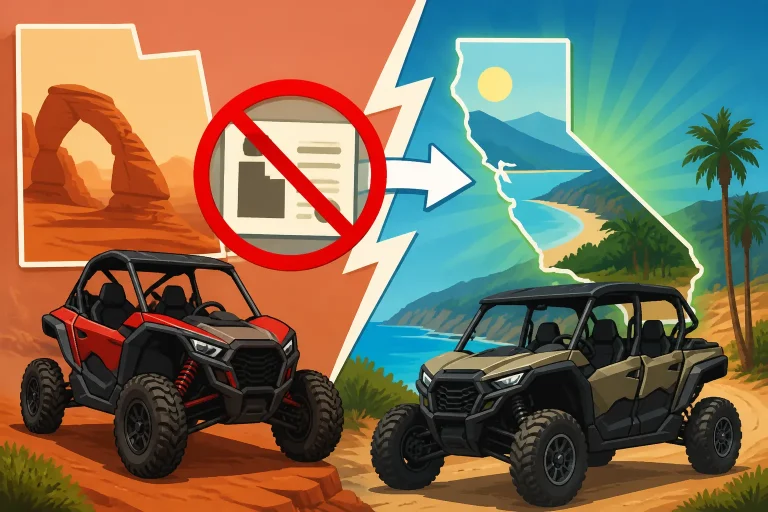
California’s nonresident OHV permit and state reciprocity rules concern whether an out-of-state OHV has acceptable state identification for use in California. They are separate from the ISDRA’s area-use permit. A state sticker or registration that satisfies one requirement does not automatically satisfy the other.
For the state-side rules, see California’s Nonresident OHV Use Permit and California OHV Reciprocity: Only Two States. Those topics can help you determine whether the OHV needs California’s nonresident permit or whether an eligible out-of-state credential is accepted. They do not remove the need to check the separate dunes permit for a vehicle entering the ISDRA.
This is true for California residents too. A California Green Sticker is not, by itself, the same thing as an ISDRA permit. The state identification and the area permit answer different questions: one concerns the machine’s state requirements, while the other concerns access to the recreation area.
A tow truck’s standard road registration is even further removed from the OHV’s state registration. It allows the truck to be used on public roads, but it does not act as an ISDRA permit or as registration for the quad or UTV on the trailer.
The permit may be weekly or seasonal
ISDRA permit options can vary by duration and purchase method. The best fit depends on how often you expect to visit and whether you buy before arrival or at an on-site location. Because prices, availability, and instructions can change, verify the current choices with the official permit provider before budgeting or setting off.
The important planning point is that the permit is associated with the vehicle it covers. If the tow vehicle and the OHV both need permits, do not assume that buying one permit for the trip covers both. Read the permit description carefully and check how it must be displayed.
For details on the available options, compare What the $55 Off-Site Weekly Dune Permit Covers, Where to Buy the $70 On-Site Weekly Dune Permit, and What the $185 Dune Season Permit Buys You. The figures in those titles refer to the subjects of those pages; confirm current prices and terms directly with the official provider before purchasing.
A seasonal option may make sense for repeated visits, while a shorter-duration option may be more practical for a one-time trip. The right comparison is not only the stated cost: consider how many vehicles need permits, how long you will stay, where you can buy them, and what happens if travel plans change.
When the tow vehicle needs a permit
The straightforward case is a tow vehicle driven into the ISDRA. If you plan to use the truck to reach a campsite or staging area inside the recreation area, check and obtain the required permit for it. The fact that the truck stays on a road or does not drive up a dune does not necessarily exempt it.
A more ambiguous case is a truck that drops off a trailer near the area and then leaves, or one that parks outside the recreation boundary while riders continue in another vehicle. Do not guess based on the distance from the sand or on whether the parking spot looks like a designated entrance. Confirm where the boundary lies and whether the truck’s planned route enters the permit area.
Common trip setups
- Truck and OHV both enter the recreation area: Check the permit requirement for each vehicle. The OHV’s permit does not cover the truck.
- Truck enters, but the OHV stays on the trailer: The truck still needs to be checked as a vehicle entering the area. The OHV may also need its own permit if it will be used there.
- Truck stays outside the area while the OHV is carried in by another vehicle: The truck may not need an ISDRA permit if it does not enter, but verify the boundary and the actual access plan.
- Truck enters only to reach a campsite: Do not assume camping or towing creates an exemption. Check the current rules for vehicles accessing the area.
- A friend drives a second truck into the area: Count that truck separately. A permit for your tow vehicle does not cover another vehicle.
- The OHV is street legal or has out-of-state registration: That may affect its state identification requirements, but it does not automatically settle the separate ISDRA permit question.
These examples are planning aids, not a substitute for the current official rules. The details of a route, location, vehicle type, and permit category can matter. If your plan depends on a special exception, get confirmation before you arrive rather than trying to resolve it at an entrance.
If the truck is only passing through
A vehicle traveling on a public road outside the recreation area is not the same as a vehicle using the ISDRA. However, the map and the official access instructions should be the deciding references—not an assumption that a road is outside the area because it is paved or appears to connect to a public route.
When comparing routes, note where you will park, unload, camp, and drive. A truck might enter the recreation area even if the driver intends to keep it on a firm access route. If your plan is to stop outside the boundary, make sure the spot is legal and suitable for unloading; roadside stopping or parking may be restricted for reasons unrelated to the permit.
If the route is unclear, contact the managing office with the vehicle type and a description of your intended access point. A short check before travel is better than buying the wrong permit or arriving with a vehicle that cannot proceed.
Buying, displaying, and checking the permit
Once you have identified each vehicle that needs an ISDRA permit, use the current official purchase instructions. Check that the permit category matches the vehicle and intended visit, and save the purchase confirmation. If you buy in advance, confirm whether the permit must be printed, attached, or displayed in another specific way.
Display instructions are not a minor detail. A valid permit that cannot be seen or matched to the vehicle can cause delays during a check. Follow the placement directions that come with the permit, and do not place it where glare, tint, a sunshade, or a dashboard object makes it hard to read. See Displaying a Permit on the Windscreen for practical placement information.
Some riders use a clear sleeve or holder to protect a permit from dust and weather. Generic holders may be available through retailers such as Amazon, but the holder is only useful if the permit remains visible and the installation follows the official display instructions. Do not obscure required information, alter the permit, or rely on a phone image as a substitute if the current rules require a physical display.
Keep purchase records accessible, too. A digital receipt can help you confirm the transaction, but it may not replace a required displayed permit. If the official instructions specify a particular proof or placement, follow that direction rather than relying on what worked for someone else on a previous trip.
Check before loading the trailer
A short pre-trip check can catch the common mistakes:
- List every motorized vehicle that will enter the ISDRA, including the tow vehicle.
- Confirm the current permit requirement for each one with the official provider.
- Match each permit to the correct vehicle and visit duration.
- Read the instructions for display and any required documentation.
- Confirm the recreation-area boundary and your planned route.
- Save receipts and keep required paperwork available during the trip.
This process is especially helpful when a group shares trailers or arrives in more than one truck. Assign one person to verify each vehicle, but have the driver of each vehicle know which permit belongs to it and where it is displayed.
Carry the relevant paperwork in a way that is easy to reach without unloading gear. For more on what to keep with you, see Carrying Paperwork on the Sand. The permit and paperwork should be treated as separate from the vehicle’s ordinary registration documents.
Avoiding common permit mistakes
Most problems come from treating the trip as one permit purchase rather than checking the vehicles individually. These are the assumptions worth avoiding.
“The OHV has a permit, so the truck is covered”
Not necessarily. The permits apply to different vehicles and may serve different purposes. If the truck enters the area, check its requirement separately.
“The truck is street legal, so it does not need an area permit”
Road legality and area access are different issues. A license plate does not automatically serve as an ISDRA permit. Check the rule for the vehicle’s actual use and location.
“The truck will not ride on a dune”
The relevant question may be whether it enters the recreation area, not whether it drives on soft sand. A vehicle used only to reach a camp or staging area still needs to be checked against the permit rules.
“My out-of-state decal covers every vehicle”
State reciprocity is not an all-purpose pass. It concerns whether an OHV’s state identification is accepted for California use. It does not automatically cover a tow vehicle, and it does not replace the area-use permit. See Why Only Oregon and Nevada Count in California for the state reciprocity distinction.
“I can sort it out when I get there”
You may be able to purchase a permit through an available on-site option, but do not assume that every permit type will be available at every point or that a purchase can be completed without delay. Check the current buying locations, hours, and instructions before departure, especially for a busy weekend or a late arrival.
“A photo of the permit is enough”
Proof requirements can depend on the permit and current display instructions. A phone photo may help you retrieve a receipt, but it may not satisfy a rule requiring a permit to be displayed on the vehicle. Follow the official instructions and carry any required documentation.
A little preparation prevents a common mismatch: one valid permit in the group, but not the one required for the vehicle being checked. If the truck, OHV, and any other vehicle each have the correct permits and their state documents are in order, you can focus on the ride instead of sorting out the paperwork at the dunes.
Frequently Asked Questions
Does a tow truck need an ISDRA permit if it never goes onto the sand?
It may. If the truck enters the recreation area to reach a campsite or another destination, check the permit requirement even if it stays off the dunes. The vehicle’s route and location are important.
Does the OHV permit cover the truck towing it?
Do not assume so. Check the requirements for the tow vehicle and the OHV separately. One permit should not be treated as covering both unless the official permit terms clearly say so.
Does California registration replace the ISDRA permit?
No. State registration or OHV identification and the ISDRA area-use permit address separate requirements. A street-legal plate or California OHV sticker does not automatically replace the dunes permit.
Does an out-of-state OHV decal mean the tow vehicle is covered?
No. A state decal may affect the OHV’s state identification requirements, but it does not automatically cover a separate tow vehicle or replace the ISDRA permit.
Disclaimer
This article is for general informational purposes only and does not constitute professional advice. Laws, prices and regulations vary by location and change over time. Consult a qualified professional for guidance on your specific situation.