Machines Built in 2003 and the Red Sticker
If you're like many off-road enthusiasts in California, you've probably heard the terms "Green Sticker" and "Red Sticker" tossed around for years, often leading to a good deal of head-scratching. It gets even more confusing when you start talking about specific model years, like those machines built in 2003. It's easy to feel lost in a sea of regulations that seem to shift and change over time. This guide is here to untangle the complexities of California's Red Sticker program, specifically focusing on what it means for your ATV or UTV manufactured in 2003, and how the rules have evolved to impact your riding today.
Understanding California's Red Sticker Program from the Beginning
California has always been at the forefront of environmental regulations, and that extends to our beloved off-highway vehicles (OHVs). For decades, the state has grappled with how to balance the thrill of off-road riding with the crucial need to protect air quality, especially in sensitive areas. This is where the whole concept of stickers came into play, and it's a story rooted deeply in environmental stewardship.
What is the Red Sticker and Why Does it Exist?
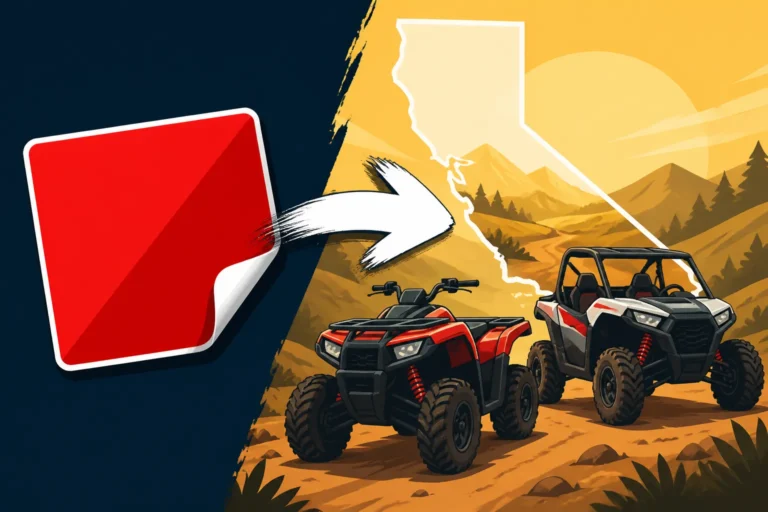
At its core, the Red Sticker program was designed by the California Air Resources Board (CARB) to identify off-highway vehicles that do not meet California's stringent emission standards for year-round use in all designated OHV riding areas. Think of it as a way to categorize machines based on their exhaust emissions. While it might feel like a hurdle, the intention behind it was genuinely aimed at mitigating air pollution, particularly from older or less environmentally compliant engines that produce more pollutants. These machines, while still perfectly fun to ride, were identified as needing some restrictions to help keep our air cleaner.
The Red Sticker essentially signifies that your vehicle, whether it's an ATV, dirt bike, or UTV, was originally manufactured for competition or for sale in states with less strict emission controls. It doesn't mean your machine is "dirty" in a derogatory sense, but rather that its engine configuration and exhaust system didn't meet the same specific benchmarks required for a Green Sticker. This distinction became incredibly important as California's population grew and more people flocked to popular riding spots, increasing the collective environmental impact. The state needed a clear system to manage this, and the Red Sticker was born out of that necessity.
The Original Intent: Seasonal Riding Restrictions
When the Red Sticker program was initially rolled out, its primary function was to implement a seasonal riding schedule. For riders, this meant that machines with Red Stickers were restricted from operating in designated OHV areas during certain months of the year, typically from May 15th to September 30th. This period was chosen because it generally aligns with warmer weather, which can exacerbate smog formation, and with higher rider activity, leading to greater emissions. The idea was to give the air a break, especially in areas prone to inversions or high-ozone days.
This seasonal restriction created a distinct "Red Sticker season" and "Green Sticker season." If you had a Red Sticker machine, you might have found yourself making tough choices about when and where you could ride. Imagine planning a trip to your favorite desert spot in July, only to realize your machine wasn't allowed due to its Red Sticker designation. It was a common frustration among riders who just wanted to enjoy their sport. These restrictions applied to most public lands managed by the California Department of Parks and Recreation, including the State Vehicular Recreation Areas (SVRAs), as well as lands managed by the Bureau of Land Management (BLM) and the U.S. Forest Service that adopted the state's rules. The distinction was often made between "emission-controlled" and "non-emission-controlled" areas, with the seasonal limits primarily enforced in the former.
The Significance of the 2003 Model Year for Red Stickers
When we talk about specific model years and the Red Sticker, 2003 is a date that often comes up in conversation. It represents a significant point in time for California's OHV regulations, a kind of watershed moment that changed how many machines were categorized.
The CARB Cutoff and Why 2003 Was a Turning Point
The California Air Resources Board (CARB) is the state agency responsible for setting and enforcing air pollution standards. They're the ones behind the Green and Red Sticker regulations. For machines manufactured in 2003 and later, CARB introduced stricter emissions requirements for off-highway vehicles that wished to qualify for a Green Sticker. Essentially, if an ATV or UTV (or dirt bike, for that matter) was a 2003 model year or newer and did not meet the then-current California emission standards for OHVs, it was automatically designated as a Red Sticker machine.
This distinction is critical because machines built before January 1, 2003, were generally grandfathered in and issued Green Stickers, regardless of their emissions profile. This is why you might see a much older, two-stroke dirt bike, for instance, proudly displaying a Green Sticker, while a much newer, seemingly "cleaner" 2003 four-stroke machine might have a Red Sticker. The cutoff wasn't about the age of the machine itself, but about the model year of its manufacture relative to CARB's evolving regulations. This created a clear dividing line: [Machines Built Before 2002 and the Green Sticker] generally received a Green Sticker, while many 2003 and newer machines that didn't meet the new criteria fell into the Red Sticker category. This transition often caught new buyers by surprise, as they assumed a newer machine would automatically be more compliant.
What a 2003 Red Sticker Meant for Riders
If you owned a 2003 ATV or UTV with a Red Sticker, it meant you were subject to those seasonal riding restrictions we discussed earlier. You couldn't just load up your rig and head to the dunes or mountains anytime you pleased if you were planning to ride in a designated OHV park. This was a real bummer for many, especially those who loved riding during the summer months when many families are on vacation and trails are often less crowded.
For example, a rider with a 2003 Red Sticker quad couldn't take their machine to Hungry Valley SVRA in July, even if the weather was perfect. They'd have to wait until October 1st to legally ride there. This naturally led to a lot of frustration and sometimes even costly citations for those who either didn't know or chose to disregard the rules. It often meant planning your riding calendar around the Red Sticker season, which could be quite limiting if your preferred areas were subject to the restrictions. Many riders had to buy a second, Green Sticker compliant machine, or simply shift their riding plans to private land or out-of-state during the "closed" season. Understanding [California's Green Sticker Explained] was paramount for making informed riding decisions.
Navigating the Changes: Red Sticker Rules Today and Beyond
The world of OHV regulations isn't static, and California has certainly seen its share of evolution. What was true for Red Stickers in 2003 isn't entirely true today, and it's important for owners of these machines to understand the current landscape.
The End of the Seasonal Riding Schedule
Here's the good news for many 2003 Red Sticker owners: the seasonal riding schedule for Red Sticker machines has largely come to an end in California's State Vehicular Recreation Areas (SVRAs) and many other public lands. This was a significant shift, taking effect years ago, and it changed the game for countless riders. The frustration of being told you couldn't ride your machine during prime weather months is, for the most part, a thing of the past. [Why the Seasonal Riding Schedule Ended] is a topic that many riders celebrate, and it means more freedom for those with Red Sticker machines.
Now, a Red Sticker machine can generally be ridden year-round in most SVRAs and designated public OHV riding areas managed by California State Parks, BLM, and the Forest Service. This means that 2003 ATVs and UTVs with Red Stickers are no longer automatically benched for the summer. You can plan that July trip to Glamis or that August run at Ocotillo Wells without worrying about the Red Sticker seasonal restrictions. This was a huge win for the off-road community, offering more flexibility and making it easier to enjoy your vehicle whenever you choose. However, it's crucial to remember that while the seasonal schedule is gone, the Red Sticker itself still signifies that the machine does not meet the latest emissions standards. This can be relevant for other specific rules, though generally not for basic access anymore.
Modern Implications for Your 2003 OHV
So, what does all this mean for your 2003 ATV or UTV with a Red Sticker right now? Primarily, it means you have much greater flexibility to ride year-round in most designated public OHV areas. The old seasonal lockout is gone. This is fantastic news for riders who, for years, felt limited by their machine's sticker color. You can now generally enjoy [Riding a Red Sticker Machine Year Round in California] with peace of mind regarding the access schedule.
However, while the seasonal restrictions have been lifted, the fundamental identification of your machine as a Red Sticker vehicle remains. This means that while you can ride year-round, there are still some nuanced situations where the Red Sticker designation is relevant. For instance, specific, highly localized rules or special events might occasionally have different requirements. For most general riding in SVRAs and open BLM/Forest Service lands, your 2003 Red Sticker machine is good to go.
It's always a good practice to check the specific rules of any riding area you plan to visit, as local regulations can sometimes vary, and there can be closures due to weather, fire, or other environmental factors completely unrelated to your sticker. For example, if you're participating in a very specific type of organized event, you might encounter other permit requirements, like a [California's Sanctioned Event Permit Explained], which may have its own set of rules. Keep in mind that [Red Stickers and What Changed in California] is an ongoing conversation, but for 2003 machines, the biggest change has been the elimination of the old seasonal riding calendar.
Here's a quick comparison of California OHV sticker types for clarity, keeping in mind that the Red Sticker seasonal restrictions have been lifted:
| Sticker Type | Eligibility (General) | Emissions Compliance | Riding Privileges (Today) |
|---|---|---|---|
| Green | 2002 Model Year & Older OR 2003 & Newer That Meet CA Standards | Meets CA emissions standards | Year-round access to all public OHV areas |
| Red | 2003 Model Year & Newer That DO NOT Meet CA Standards | Does NOT meet latest CA standards | Year-round access to most public OHV areas (seasonal restriction lifted) |
| Tan | Certain competition-specific machines or those with a Sanctioned Event Permit | N/A (Focus on sanctioned event use) | Limited to sanctioned events or specific permitted uses (e.g., [California's Tan Sticker Eligibility]) |
Registration and Compliance for Your 2003 Red Sticker Machine
Regardless of its sticker color or model year, if you're riding your OHV on public lands in California, it absolutely needs to be registered. This isn't just a suggestion; it's a legal requirement that helps fund the very trails and facilities we all enjoy.
Essential Registration Steps
For your 2003 Red Sticker ATV or UTV, the registration process is essentially the same as for any other OHV. You'll need to make sure you have the proper documentation, which typically includes proof of ownership (like a title or bill of sale), and you'll have to complete the necessary forms. One of the key documents you'll encounter is [What California's Form REG 343 Asks For], which is the Application for Title or Registration. This form collects all the vital information about your vehicle and you as the owner.
Another crucial step is vehicle verification, often done on [California Vehicle Verification on Form REG 31]. This is where a certified verifier (often DMV staff, AAA, or a licensed vehicle verifier) confirms that the vehicle's identifying information, like the VIN, matches your documentation. Once all your paperwork is in order and submitted, along with the appropriate fees, you'll receive your ID plate and the current year's sticker. Remember, [Registering an OHV in California] is an ongoing responsibility, and you'll need to renew it every two years. Keeping your registration current ensures you're riding legally and contributing to the maintenance and development of our state's fantastic OHV resources. If you ever need to [Renewing California OHV Registration], the process is usually straightforward.
Legal Documentation and Transfers
Buying or selling any OHV, including a 2003 Red Sticker machine, requires meticulous attention to legal documentation. This is where clarity and accuracy are paramount to protect both the buyer and the seller. When you purchase a used OHV, ensuring you receive a properly signed title and a detailed bill of sale is critical. This helps establish a clear chain of ownership and prevents headaches down the road.
A well-drafted [California OHV Bill of Sale Requirements] outlines the terms of the sale, the vehicle's identifying information, and confirms the transfer of ownership. For a smooth transaction, both parties should sign and date it. If you're selling your 2003 machine, you'll need to endorse the Certificate of Title and provide it to the new owner. Missing or incorrect paperwork can lead to delays or even prevent the new owner from successfully transferring the registration into their name. For those who want to ensure they have robust legal documents for such transactions, resources like LawDepot can be invaluable. They offer templates and guidance for creating legal forms, including bills of sale and other agreements, which can give you peace of mind during a private sale. Whether you're navigating [Selling an OHV and Signing the California Title] or handling a [Transferring a California OHV Registration], having the correct, legally sound paperwork is your best defense against future disputes. LawDepot can help ensure you have professional, clear documents ready.
Disclaimer
This article is for general informational purposes only and does not constitute professional advice. Laws, prices and regulations vary by location and change over time. Consult a qualified professional for guidance on your specific situation.