California Riding Areas That Allow Night Riding
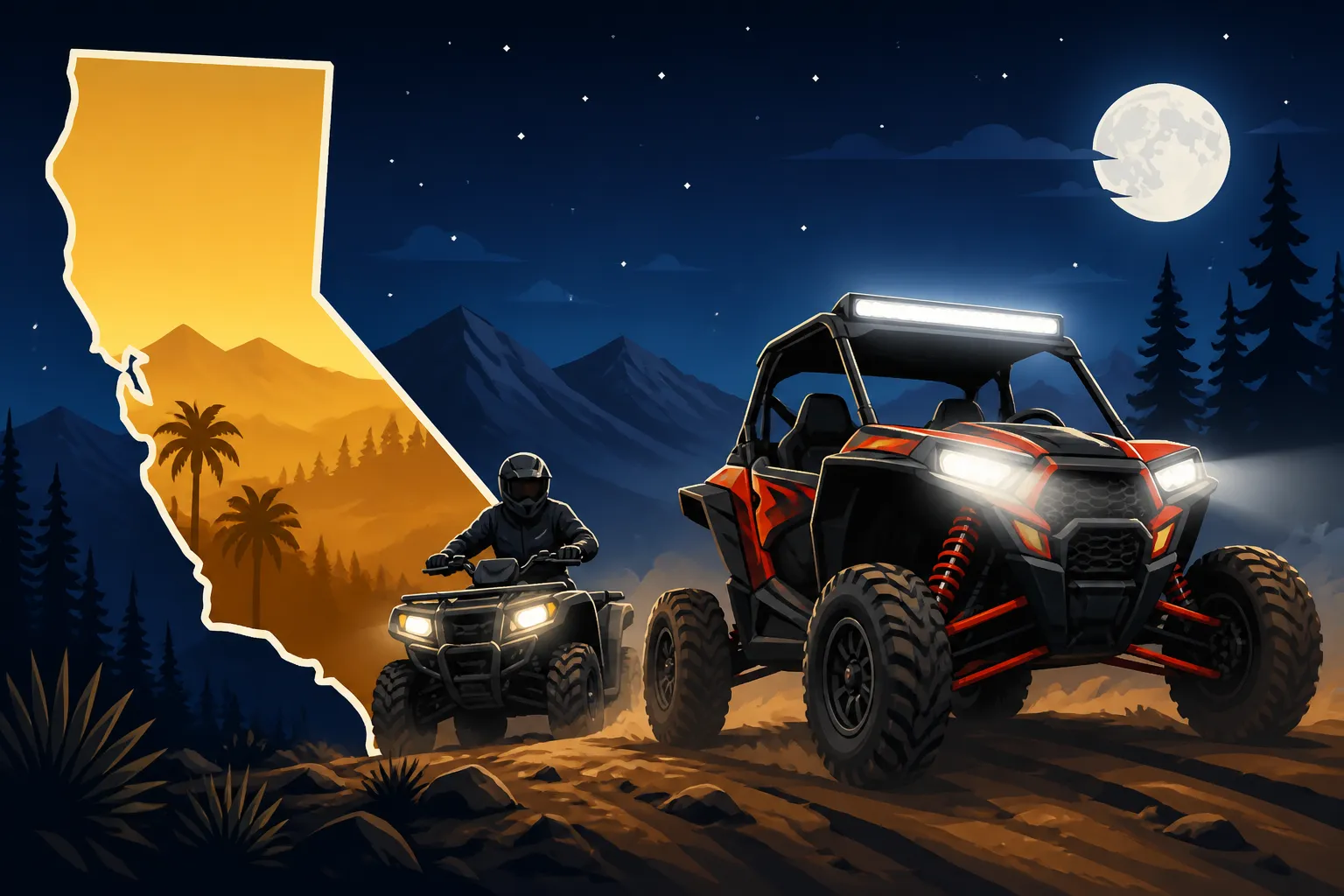
A night ride can sound perfect until the sun drops, the landmarks disappear, and you realize the route you followed in daylight looks completely different after dark. California has several popular places where riders may be able to ride at night, but access, closures, and local rules vary. This guide explains where to start, what to verify, and how to plan a safer ride.
California areas to consider for night riding
Night riding is not a blanket permission that applies across every California OHV area. A public desert may have different access rules from a state recreation area, and an open camping area does not automatically mean every nearby route is open to vehicles after dark. Treat the locations below as places to investigate, then confirm conditions with the land manager before unloading.
Imperial Sand Dunes and Glamis
The Imperial Sand Dunes Recreation Area, commonly called Glamis, is one of California’s best-known destinations for dune riding. Riders may plan after-dark outings here, but the experience is different from following a marked trail: dunes shift, familiar lines can disappear, and other machines may approach from directions that are hard to predict. A route that felt obvious in afternoon light can become difficult to read at night.
Before heading out, check current BLM information for the area you plan to use, including any closures, seasonal restrictions, and permit requirements. Verify whether your intended route is open and whether there are limits on nighttime activity. Do not assume that an open camping area means every dune or access route is open all night. For a broader overview of the region, see [Glamis and the Imperial Sand Dunes] and [California Dune Riding Areas].
Plan your first night ride on terrain you already know, and avoid cresting a dune at speed when you cannot see what lies beyond it. A steep drop, another rider, a camp, or a vehicle can be hidden just over the crest. If you are traveling with a group, agree on a meeting point and a simple plan for what to do if someone gets separated. Riders new to the dunes may want to start with a daylight ride before considering a short night outing.
Ocotillo Wells State Vehicular Recreation Area
Ocotillo Wells SVRA is a large desert riding area in San Diego County, known for open terrain and varied natural features. It attracts riders who want to explore beyond a conventional network of narrow trails. That same openness makes navigation and visibility especially important after sunset. Washes, soft sand, rocky ground, and changing slopes can be harder to spot in low light.
Check the park’s current operating information and posted notices before you go. Confirm whether the area you intend to ride is open at the time you plan to be there, and ask about any restrictions that apply after dark. Park access, camping access, and vehicle operation are separate questions, so verify each one instead of relying on a general statement that the area is open. You can read more about the location in [Ocotillo Wells: California's Free SVRA].
A useful approach is to arrive early, ride the route in daylight, and save a familiar section for a short nighttime outing. That gives you a chance to notice loose sand, steep transitions, or confusing junctions before visibility drops. If you are visiting with a mixed-experience group, keep the route conservative and make sure every rider knows where the group will stop and regroup.
Johnson Valley and other desert areas
Johnson Valley is a large public-land OHV destination in San Bernardino County. Its scale can be appealing to experienced riders, but it also makes preparation essential: distances are substantial, terrain can be rugged, and access may be affected by land-use restrictions or special closures. Check BLM notices before planning a trip, especially if your visit overlaps with a major event or a period when access is restricted. For background, see [Johnson Valley and California's King of the Hammers].
Other desert riding areas may offer a nighttime opportunity under the right conditions, but do not assume the same rules apply everywhere. A BLM route, a state recreation area, a privately managed campground, and a nearby county road can all have different rules. If you are considering another location, contact the agency or land manager responsible for the exact parcel and route you intend to ride.
| Area to investigate | What makes it worth checking | What to confirm before riding after dark |
|---|---|---|
| Imperial Sand Dunes and Glamis | Extensive dune terrain and established OHV use | Current closures, permitted riding areas, access rules, and any nighttime restrictions |
| Ocotillo Wells SVRA | Broad desert terrain with a range of riding conditions | Park operating rules, area-specific closures, and whether the planned route is open after dark |
| Johnson Valley | Large public-land riding area with varied terrain | BLM notices, temporary closures, permitted routes, and event-related access limits |
| Other nearby OHV areas | Rules and terrain vary by managing agency | The precise land boundary, route status, posted hours, and applicable local rules |
How to confirm night riding is allowed
The most frustrating planning mistake is driving for hours, setting up camp, and then learning that the route you expected to ride is closed or restricted. A little advance checking can prevent that, but the information needs to come from the agency responsible for the actual place you will ride.
Check the land manager and the specific route
Start with the official land manager for the destination: for example, the California State Parks agency responsible for an SVRA or the Bureau of Land Management for a public-land riding area. Look for operating hours, alerts, closures, maps, and rules about motor-vehicle use. If the posted information does not clearly address nighttime riding, contact the office or visitor information line and ask about the exact area or route.
Be precise when you ask. “Is the park open?” may only confirm that visitors can enter or camp. Instead, ask whether you may operate an OHV on the route you have in mind after dark, whether any curfew or quiet-hour rule applies, and whether temporary closures affect the location. If you plan to ride from a campground, also ask whether the route between camp and the riding area is open to vehicles at night.
Keep an eye out for temporary restrictions. Fire danger, weather, habitat protection, maintenance, special events, and military use can change access. A route that was open on a previous trip may not be open for your next one. Before leaving home, review [California Trail Closures to Check First] and [California Fire Closures That Shut Trails] when relevant.
Use maps as planning tools, not permission
An offline map can be valuable when cell coverage is unreliable. Apps such as onX Offroad can help you prepare a route, save map information ahead of time, and orient yourself when the landscape is unfamiliar. Use the map to understand where you are and what lies around you, not as proof that riding is allowed. A line shown on a map does not override a closure, a gate, a posted restriction, or a land boundary.
Download or save the information you need before entering an area with limited service. Check that your phone or navigation device can still show your location offline, and carry a backup plan in case a device fails. If you use onX Offroad, compare what you see with the land manager’s official notices and maps. The official source should guide your decision about access and closures.
It helps to mark a turnaround point and a route back to camp before the ride begins. Keep the plan simple enough that everyone in the group can remember it without relying on a single rider’s phone. More guidance on route preparation is available in [California Trail Maps and Where to Get Them].
Prepare your ATV or UTV for a ride after dark
A powerful headlight does not solve every night-riding problem. It helps you see some of the ground ahead, but it cannot guarantee that other riders see you, reveal every obstacle, or make unfamiliar terrain safe. Preparation should cover visibility, equipment, rider communication, and a clear decision to turn back when conditions are not right.
Check lights, visibility, and required equipment
Before leaving camp, inspect the headlights, tail lights, and brake lights. Make sure they are working, secure, and not blocked by dust or gear. Clean lenses can make a noticeable difference in how well your lights perform. Carry a backup light source, such as a headlamp or flashlight, so you are not left in darkness if a vehicle light fails.
For a UTV, check that the driver and passengers can see clearly from their seats and that the vehicle’s safety equipment is in place. For an ATV, confirm that your riding gear allows you to move naturally while still keeping you protected. Secure loose items so they cannot fall onto the route or become tangled with the machine.
At dune areas, visibility equipment such as a whip and flag helps other riders spot you, but it does not replace safe speed or awareness. Check the requirements for the specific area before you ride. [California Dune Flag Requirements] covers the subject in more detail, and [Night Riding With Whips and Lights] offers related guidance for planning visibility after dark.
Choose a route that matches the least experienced rider
Night riding is not the time to test a difficult line, chase a faster group, or explore an unfamiliar wash at speed. Choose a short route with manageable terrain and make sure every rider can comfortably handle the conditions. If one person is new to the area, has limited night-riding experience, or is on a machine that handles differently from the others, plan around that person’s pace.
Keep the group together without crowding. Agree on a lead rider and a sweep rider, and decide in advance where you will stop. Use a simple communication plan if someone falls behind or needs help. A rider who is separated should know whether to stop in a safe place, return to the last meeting point, or follow another agreed procedure rather than improvising in the dark.
Do not let the group’s enthusiasm override warning signs. If someone’s lights fail, visibility becomes poor, a machine is overheating, or riders are getting tired, shorten the outing or return to camp. Fatigue can creep up on a long desert day, and darkness makes small errors harder to correct.
Make the ride safer and more comfortable
Night riding can be memorable, but it asks more of riders than a casual daytime loop. You need to read terrain with less information, watch for other users, and make decisions before fatigue or poor visibility narrows your options. A conservative plan can make the outing more enjoyable without turning it into a test of endurance.
Plan for weather, terrain, and emergencies
Check weather and surface conditions before the trip. Wind can move dust across a route, while recent rain may change the surface or leave some areas unsuitable for riding. The desert can also feel very different after sunset than it did during the day, so bring clothing appropriate for cooler conditions and keep water accessible. See [California Desert Riding Safety] for broader planning considerations.
Carry basic recovery and emergency supplies suited to your machine and destination. Make sure someone outside the riding group knows where you will be and when you expect to return. If you have no signal, do not count on a quick call for help. A basic plan should include what the group will do if a machine breaks down, a rider is injured, or the route back becomes difficult to identify.
Before you start, take a moment to check the group’s condition and the machines. Confirm that everyone has protective gear, enough fuel for the planned route, and a working way to communicate. For a UTV group, talk through passenger expectations and make sure everyone is seated and secured before moving.
Know when daylight riding is the better choice
Some areas are simply easier to enjoy in daylight, especially for first-time visitors, new riders, families, or groups with a wide range of experience. If you have not ridden a location before, use daylight to learn the terrain and identify safe stopping points. A short night loop afterward may be more comfortable than trying to navigate a long route you have never seen.
Choose daylight instead if the group is already tired, dust or fog is reducing visibility, the route is unfamiliar, or the posted rules are unclear. It is also sensible to stop if you cannot confidently identify the way back or if other riders are behaving unpredictably. Turning around is not a failed ride; it is a good decision made before a manageable problem becomes an emergency.
Before the trip, confirm the destination’s current rules, identify the specific land manager, and save an offline map for orientation. Once you arrive, recheck posted notices and stay within the routes and areas that are open. That combination of preparation and flexibility gives you the best chance of enjoying California’s night riding opportunities without assuming that every area follows the same rules.
Disclaimer
This article is for general informational purposes only and does not constitute professional advice. Laws, prices and regulations vary by location and change over time. Consult a qualified professional for guidance on your specific situation.