California Riding Areas Reachable Without a Trailer
Planning a California ride without a trailer can feel like a puzzle: the riding area may be close, but your quad or UTV usually cannot legally use the public roads between town and the trail. This guide explains what “trailer-free” really means, which areas are practical to reach, and how to plan transport without an expensive towing setup.
What trailer-free riding means in California
Getting to the riding area is not the same as riding there
For most people, a California riding area “reachable without a trailer” means the destination is close enough to reach with a tow vehicle, rental vehicle, or other transport plan—not that you can ride an ordinary ATV or UTV there from a nearby town. An off-highway vehicle generally cannot be driven on public roads just because the trailhead or park is nearby.
Some vehicles are built and registered for both on-road and off-road use, but that does not make every road or trail legal for them. A route must be open to the type of vehicle you are operating, and access rules can differ between a park, a county road, and nearby public land. Before planning to ride directly from a campground or lodging, check the specific route and the machine’s legal status. [Are ATVs Street Legal in California?] covers the distinction in more detail.
Your practical trailer-free options
If you do not own a trailer, you still have several ways to get a machine to a ride. You might rent a vehicle with enough space or towing capacity, borrow a properly equipped truck, rent an ATV or UTV near the destination, or choose a street-legal dual-sport motorcycle and a route where that motorcycle is allowed. Each option has trade-offs: rental availability may be seasonal, a truck rental may restrict towing, and a street-legal machine still cannot enter closed or OHV-only routes.
Some riders also choose a riding area they can reach in a regular vehicle and rent a machine nearby. That avoids hauling your own quad, but you will need to confirm the rental shop’s location, operating area, age requirements, and what protective equipment is provided. Do not assume a rental can be taken anywhere in the park or surrounding desert.
| Plan | What it solves | What to check before leaving |
|---|---|---|
| Rent a machine near the riding area | Avoids transporting your own ATV or UTV | Rental location, permitted riding area, age rules, gear, booking availability |
| Borrow or rent a tow vehicle | Lets you bring your own machine without owning a truck | Tow rating, hitch and wiring, rental restrictions, trailer compatibility |
| Use a pickup or van with enough cargo space | Can work for a smaller machine if it fits and is secured safely | Interior dimensions, payload, loading equipment, tie-down points |
| Ride a street-legal machine | May allow road travel on specifically permitted routes | Registration, equipment, route designation, local access rules |
| Choose a nearby riding area | Reduces drive time and transport complications | Whether the area is open, vehicle types allowed, parking and site rules |
Check access before treating a route as a connection
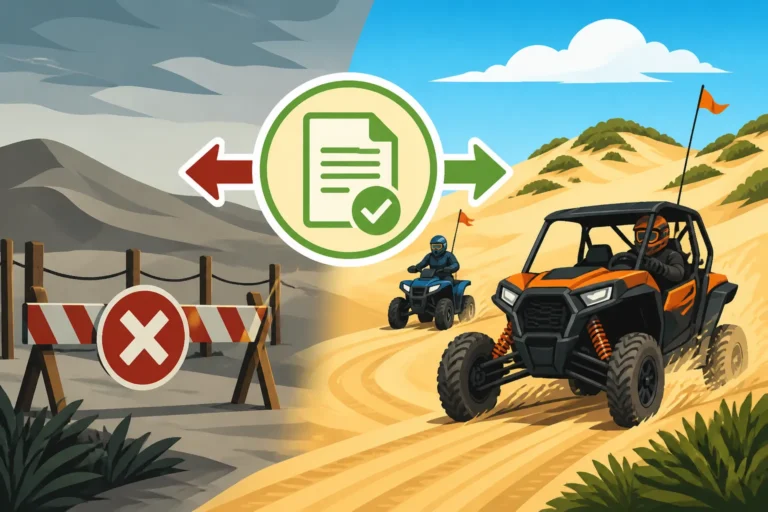
A map can make a route look continuous even when a gate, private parcel, road restriction, or seasonal closure breaks the connection. This is especially easy to miss when a trail system sits near a town or campground. Use park and land-manager information to confirm legal access, then check the latest route conditions before you travel.
Mapping tools such as onX Offroad can help you review trails and nearby access points while planning, but a displayed line is not permission to ride it. Compare the map with the relevant agency’s rules, posted signs, and route designations. If you are unsure whether a specific road is open to your machine, do not assume it is legal simply because another rider used it.
California riding areas to consider
Prairie City and Sacramento
Prairie City SVRA is a practical option for riders in the Sacramento region who want a relatively local day trip. Its proximity to the city can reduce the distance you need to drive with your machine, which may make borrowing a truck or arranging a short vehicle rental more manageable. It is still a destination you should plan to reach by road in a suitable vehicle, rather than by riding an unplated quad through town.
Before setting out, confirm the current operating information and the rules for the type of machine you plan to bring. A nearby location does not guarantee every area is open to every vehicle, and conditions can affect which routes or riding zones are available. For other choices in the region, see [California OHV Areas Near Sacramento] and [Prairie City SVRA Near Sacramento, California].
Hollister Hills and the Bay Area
Hollister Hills SVRA is a popular option for riders looking for an organized riding area in the broader Bay Area region. The park’s location can make it more convenient than a long desert drive for some riders, but convenience does not eliminate the need to transport the machine legally. If you do not have a trailer, consider whether you can borrow a suitable vehicle, rent a machine nearby, or plan a day around a street-legal motorcycle on permitted routes.
Hollister Hills includes different riding areas and route types, so check which parts suit your machine and experience level. A wide side-by-side, a youth quad, and a dirt bike may not have the same access or handling needs. Review [Hollister Hills, California's Oldest SVRA] and [California OHV Areas Near the Bay Area] as you compare the drive, riding options, and transport logistics.
Hungry Valley and the Los Angeles region
Hungry Valley SVRA, near Gorman, can be a reasonable choice for riders coming from parts of Southern California who want a designated OHV area without driving all the way to the Imperial sand dunes. It is not a place to reach by riding an ordinary ATV or UTV along public roads from nearby communities. Plan on transporting your machine to the riding area or arranging a rental that is authorized for the park.
The distance from home is only one part of the decision. Think about the type of terrain you want, whether your vehicle fits the trails you plan to ride, and whether you have a reliable way to bring it back if something breaks. See [Hungry Valley SVRA North of Los Angeles] and [California OHV Areas Near Los Angeles] when comparing this option with other destinations.
Ocotillo Wells and the desert
Ocotillo Wells SVRA can suit riders who want a large desert riding experience, but the desert setting makes transport and preparation particularly important. A nearby highway or settlement does not mean an OHV can legally travel from there to the riding area. Bring your machine in a suitable vehicle, or arrange a rental that clearly identifies where the machine may be used.
Desert rides also require more planning than a quick local outing. Carry water, fuel, navigation, and basic recovery supplies, and agree on a turnaround plan before anyone heads out. Conditions and access can vary, so verify current area information before you leave. For regional comparisons, see [Ocotillo Wells: California's Free SVRA] and [California OHV Areas Near San Diego].
How to plan when you do not own a trailer
Decide whether to bring your machine or rent one
Start with the machine you want to ride and the distance you are willing to travel. Bringing your own ATV or UTV may make sense if you already have access to a suitable truck and trailer, or if you need a particular setup. If you have no towing vehicle, renting near the destination may be simpler—especially for a short visit or a first ride.
Before booking a rental, ask where you are allowed to ride, whether the machine can be used in the riding area you have chosen, and what happens if it develops a problem. Find out what the rental includes and what you must bring yourself. A machine available in a nearby town is not automatically approved for use on every trail or public-land route.
Check transport capacity and loading safety
If you plan to borrow or rent a vehicle, check its owner’s manual and rental agreement rather than guessing from the vehicle’s appearance. Confirm its payload or towing capacity, hitch setup, and whether towing is permitted. A vehicle that can carry passengers and luggage may not have enough capacity for a machine, fuel, tools, and riding gear as well.
Loading matters too. Use suitable ramps, secure the machine at proper tie-down points, and make sure it cannot roll or shift during travel. If the machine is too heavy or awkward to load safely, that is a sign to choose another transport method. Avoid improvised ramps or tying down to parts that are not designed to handle the force.
Make a simple pre-trip checklist
A short checklist helps prevent the most frustrating failure: arriving with the right machine but missing a required document, piece of gear, or transport detail. Confirm the riding area’s operating information, the vehicle’s registration and identification requirements, and any permits that apply to your situation. Requirements can differ for California residents, visitors, and machines registered elsewhere.
Before departure, check the route to the staging area, expected weather, fuel range, and whether you will have mobile service. Save offline maps if you use a navigation app; do not count on a signal in remote areas. A tool such as onX Offroad may help with route planning, but verify access against official land-manager information and posted signs. For broader destination ideas, [California OHV Areas Within Reach of a City] can help you compare regional options.
Common mistakes to avoid
Assuming a nearby town creates legal OHV access
One of the most common planning errors is seeing a park close to a highway or community and assuming the quad can be ridden there. In California, an ordinary OHV cannot simply use public streets to bridge the gap. A park entrance, a designated route, and a road open to highway-legal vehicles are different things.
If a trip requires riding on a public road, verify that the specific machine is eligible and that the specific segment allows it. A registration plate from another state does not necessarily make a vehicle legal for every California route. When in doubt, transport the machine to the legal staging or riding area instead of risking a citation or an unsafe road crossing.
Confusing a map line with an open trail
Digital maps are useful for seeing terrain and planning a route, but they may not reflect a recent closure, private-land boundary, seasonal restriction, or vehicle-width limit. This can be a real problem when a route appears to connect a campground with a trail network. Check with the park or land manager and follow signs on the ground.
Use onX Offroad as one planning aid rather than your only authority. Compare its route information with agency maps and local notices, and keep a backup plan if the route you intended to use is closed. It is better to adjust your ride at the staging area than discover a restriction after entering a sensitive or prohibited route.
Underestimating the return trip
A trailer-free plan can feel easy on the way out and become complicated at the end of the day. Rental counters may close, a borrowed vehicle may have a time limit, or a minor mechanical problem may leave you without a simple way to get the machine home. Build enough time into your schedule to return the rental vehicle, refuel, and secure your equipment without rushing.
If you are renting a machine, keep the shop’s contact details accessible and understand the recovery procedure before you start riding. If you are using a borrowed truck, agree in advance on who is responsible for loading and transporting the machine if it will not run. A little planning makes a local ride much less stressful.
Disclaimer
This article is for general informational purposes only and does not constitute professional advice. Laws, prices and regulations vary by location and change over time. Consult a qualified professional for guidance on your specific situation.