California NEV Street Rules
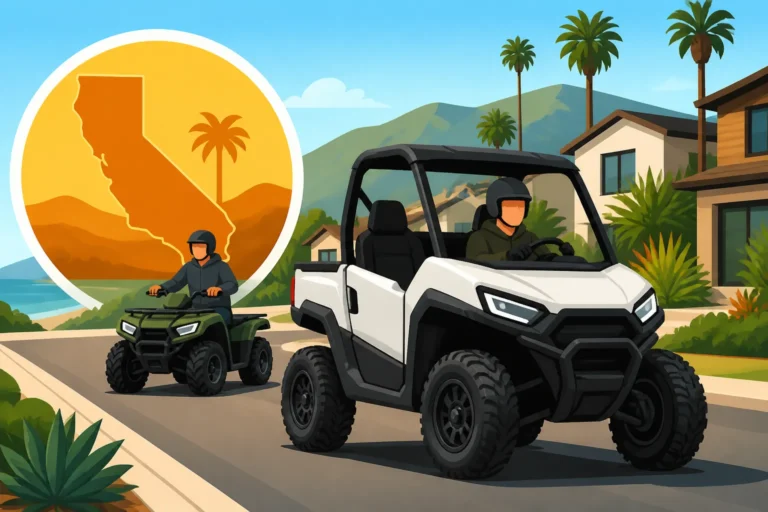
It's a familiar scenario: you live in a beautiful California community, and you've seen more and more of those quiet, compact electric vehicles zipping around. You love the idea of ditching the gas guzzler for quick trips to the grocery store or a friend's house, but the thought of getting pulled over or facing hefty fines because you misunderstood the rules is enough to make anyone stick to their car. This guide is here to untangle the specific ins and outs of California's Neighborhood Electric Vehicle (NEV) street rules, so you can ride with confidence and clarity.
What Exactly is a Neighborhood Electric Vehicle (NEV) in California?
When we talk about NEVs, we're not just talking about any electric vehicle. California has a very specific definition for these machines, and understanding it is the first step to riding legally and safely. It's easy to lump an NEV in with a golf cart, but the state sees them quite differently.
Defining an NEV by Speed and Purpose
First and foremost, an NEV is defined by its speed. These vehicles are designed and manufactured to go no faster than 25 miles per hour (mph) on a level surface. That's a crucial distinction, as it immediately sets them apart from your standard passenger car, which can obviously go much, much faster. This specific speed limitation is tied directly to their intended purpose: short-distance travel within residential communities, planned developments, and areas where lower speeds are the norm.
Think of it this way: an NEV isn't built for merging onto a busy highway or keeping up with freeway traffic. It's engineered for the leisurely pace of neighborhood streets, allowing you to run errands, visit local parks, or commute to nearby facilities without generating emissions or needing a large parking space. The focus is on convenience, sustainability, and community connectivity, not high-speed performance. This limited top speed is a primary factor in determining where and how these vehicles can legally operate, making them ideal for specific urban and suburban settings.
Key Characteristics and Legal Classification
Beyond speed, NEVs boast a suite of standard safety features that elevate them above a typical golf cart and enable them to be legally operated on certain public roads. To be classified as an NEV in California, these vehicles must come equipped from the manufacturer with essential safety components: headlamps, tail lamps, stop lamps, turn signals for both front and rear, an exterior mirror on the driver's side (and often a passenger side or rearview mirror too), a windshield, and seat belts for every seating position. These aren't optional add-ons; they're mandated features that contribute to the vehicle's roadworthiness.
In the eyes of the law, NEVs are formally classified as "low-speed vehicles" (LSVs) under federal regulations, but California specifically uses the term "Neighborhood Electric Vehicle." This classification means they are treated as motor vehicles and require official registration with the California Department of Motor Vehicles (DMV). This involves obtaining license plates and a certificate of title, just like a car. Understanding that an NEV is a legitimate, registered vehicle, albeit one with specific limitations, is key to navigating the rules. For more details on this process, check out [California Low-Speed Vehicle Registration].
Where Can You Legally Drive an NEV on California Streets?
Knowing what an NEV is is only half the battle. The real question for many hopeful owners is where they can actually drive these handy little machines without breaking the law. California has clear, albeit sometimes frustrating, guidelines on this.
The 35 MPH Speed Limit Rule
The most fundamental rule governing NEV operation in California is tied directly to the posted speed limit of the road. Simply put, you can only operate an NEV on streets and highways where the maximum posted speed limit is 35 mph or less. This is not about how fast your NEV can go; it's about the speed limit sign prominently displayed on the road you're considering. It can be tempting to just hop on a main thoroughfare to get to the store, even if it's only for a block or two, but if that road's speed limit is 40 mph or higher, you're absolutely breaking the law.
The rationale behind this rule is safety. NEVs, with their limited top speed, are simply not designed to safely integrate with faster-moving traffic. Driving an NEV on a 45 mph road, for instance, creates a significant speed differential that can be incredibly dangerous for both the NEV driver and other motorists. It's crucial to scout your routes beforehand and ensure every segment of your journey adheres to this 35 mph maximum. Remember, the law is unambiguous on this point, and violating it can lead to citations and potential safety hazards. This regulation is a cornerstone of [Neighborhood Electric Vehicles on 35 mph Streets].
Local Ordinances and Designated NEV Routes
While the 35 mph rule is statewide, many California cities and counties take an even more proactive role in integrating NEVs into their local transportation fabric. These local jurisdictions have the authority to create specific ordinances that either restrict or, more commonly, designate approved NEV routes within their boundaries. This means that even if a road has a 35 mph speed limit, a local municipality might have further refined where NEVs are allowed to go, often creating a network of interconnected streets.
Imagine living in a community like Palm Desert or Lincoln, which has embraced NEV (or golf cart) travel. These areas might have established "golf cart lanes" or designated NEV paths that allow residents to navigate safely and efficiently to key destinations like shopping centers, community facilities, or even neighboring residential areas. For example, [Palm Desert's Golf Cart Lanes] are a well-known feature, and the city of Lincoln has its own detailed plan, which you can learn more about by exploring [Which Lincoln Streets Allow Neighborhood Electric Vehicles] and [Inside the City of Lincoln's NEV Master Plan]. These local plans can transform NEV ownership from a restrictive novelty into a genuinely practical and enjoyable mode of transport, vastly expanding their utility within specific areas. Always check with your local city or county planning department to understand specific local rules that might enhance or further define where you can legally drive your NEV. You might be surprised at what organized plans exist.
Licensing, Registration, and Equipment Requirements for NEVs
Operating an NEV on California's public roads isn't quite as simple as hopping on a bicycle. Because they are classified as motor vehicles, there are essential legal hurdles you need to clear before you can take to the streets. These requirements are in place to ensure both driver competence and vehicle safety for everyone sharing the road.
Driver's License and Vehicle Registration
To drive an NEV on any public street in California, you absolutely must possess a valid California driver's license. This isn't a suggestion; it's a non-negotiable legal requirement. The state considers you to be operating a motor vehicle, and just like driving a car or truck, you need to demonstrate that you're a qualified and licensed operator. This means no provisional permits for solo NEV driving on public roads, and certainly no unlicensed operation. It's a fundamental aspect of road safety.
Beyond having a license, the NEV itself must be properly registered with the California Department of Motor Vehicles (DMV). This process is very similar to registering a conventional car. You'll need to submit the necessary paperwork, pay fees, and receive official California license plates. These plates must be properly displayed on the NEV at all times when it's in use on public streets. The registration process also involves obtaining a certificate of title, which serves as proof of ownership. This formal registration helps ensure that the vehicle meets state standards and can be identified by law enforcement. For a full breakdown of this, refer to [California Low-Speed Vehicle Registration].
Mandatory Safety Equipment and Compliance
As we touched on earlier, NEVs are not just golf carts; they are purpose-built vehicles designed with specific safety features to comply with federal and state regulations. This isn't an "add-on" list of aftermarket parts; these are components that must be factory-installed to meet legal standards for operation on public roads. Every NEV must have fully functional headlamps, tail lamps, stop lamps, and both front and rear turn signals. These are critical for visibility and communication with other drivers, especially during dusk, dawn, or in adverse weather.
Furthermore, an NEV must have a driver's side exterior mirror (and often a passenger side or rearview mirror), a sturdy windshield, and seat belts for every designated seating position. These safety measures are non-negotiable and are checked during the registration process. It's important to understand that while companies like SuperATV offer incredible accessories to beef up your UTV for trail adventures or provide robust aftermarket parts for off-road vehicles, those modifications aren't going to turn a standard golf cart or a modified UTV into a street-legal NEV. NEVs are manufactured to meet these stringent safety and design standards from the factory, making them fundamentally different from off-highway vehicles that might be modified. Compliance with these factory-mandated features is what earns an NEV its street-legal status on designated roads.
Common Misconceptions and What an NEV is NOT
One of the biggest sources of confusion regarding Neighborhood Electric Vehicles stems from mistaken identities. People often group them in with other types of recreational or low-speed vehicles, leading to incorrect assumptions about where and how they can be legally used. Clearing up these misconceptions is vital for responsible NEV ownership.
NEVs are Not Golf Carts
This is perhaps the most common misunderstanding. While NEVs share some aesthetic similarities with golf carts – they're electric, quiet, and designed for slower speeds – legally, they are distinct categories of vehicles in California. Golf carts have extremely limited privileges for street use. Generally, they can only be driven on private property, within specifically designated golf cart communities, or for crossing public streets at specific intersections, often within a mile of a golf course. They typically lack the full suite of safety equipment (like turn signals, proper headlamps, and a VIN) that an NEV is legally required to have.
The distinction isn't just bureaucratic; it's about safety and regulatory compliance. An NEV is subject to motor vehicle standards and registration, while a golf cart is not in the same way. Driving a golf cart on a public street, even one with a 35 mph limit, where an NEV would be legal, is generally prohibited unless specific local ordinances allow for very restricted use. Attempting to use a golf cart as if it were an NEV will likely result in a citation. For a comprehensive look at what golf carts can and cannot do on California streets, refer to [California Golf Cart Street Rules].
NEVs are Not OHVs or Street-Legal UTVs
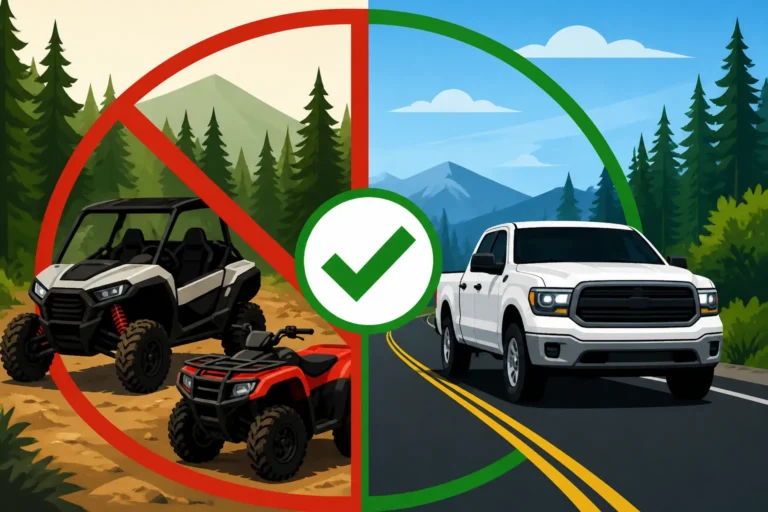
Another critical distinction is between NEVs and Off-Highway Vehicles (OHVs) like ATVs (All-Terrain Vehicles) or UTVs (Utility Task Vehicles), even those that people try to make "street legal." An NEV is designed from the ground up for low-speed, paved-road use. OHVs, by contrast, are built for off-road environments – dirt, sand, mud, and trails. While you can add aftermarket accessories to an OHV to enhance its performance, like robust suspension components from SuperATV, or outfit it with lights and turn signals, these modifications almost never convert an OHV into a true street-legal vehicle for general road use in California.
California has very strict rules about making OHVs street-legal, and generally, it's not possible to register a traditional ATV or UTV for unlimited public road use. Their emissions standards, safety features, and fundamental design are different. OHVs are registered for off-highway use (often with a Green, Red, or Tan Sticker) and have very limited exceptions for crossing roads or using specific [California's Combined-Use Highways]. For example, a UTV might be able to cross a road at a right angle or use a short [California Rules for Crossing a Public Road] segment connecting two trails, but it cannot generally be driven down Main Street like an NEV. If you're wondering about converting your off-roader, our articles [Are ATVs Street Legal in California?] and [Can You Make a UTV Street Legal in California?] provide a detailed explanation of why it's typically not feasible. An NEV has a passenger car license plate and title; an OHV does not.
Enforcement and Penalties for Misuse
Understanding the rules is crucial, but it's equally important to be aware of the consequences if those rules are ignored. California law enforcement takes NEV misuse seriously, primarily due to the inherent safety risks involved when these low-speed vehicles operate outside their designated parameters. The goal isn't just to issue tickets; it's to prevent accidents and ensure everyone's safety on our shared roadways.
Roadside Stops and Officer Discretion
If you're operating an NEV on a public road in California, you are subject to the same traffic laws and enforcement as any other motor vehicle. This means that law enforcement officers have the authority to pull you over if they observe any traffic violations or if your NEV appears to be operating outside the legal parameters. Common reasons for a stop might include driving on a road with a speed limit greater than 35 mph, failing to obey traffic signals or signs, or if your vehicle's safety equipment appears to be non-functional (e.g., a headlight out).
During a roadside stop, the officer will likely ask for your valid driver's license and the NEV's registration. They will also assess whether the vehicle is equipped with all the mandatory safety features and whether you are operating it in a legal manner for an NEV. It's easy to think a quick dash down a 45 mph road won't hurt, but law enforcement sees things differently, and for good reason – safety. Officers have discretion, but if the rules are clearly being broken, expect a citation. Being polite and cooperative, but also knowledgeable about the rules, can help in these situations.
Potential Fines and Vehicle Impoundment
The consequences of misusing an NEV can range from minor citations to more severe penalties. Operating an NEV on a road with a posted speed limit above 35 mph, for example, will likely result in a traffic ticket, similar to a speeding ticket or other moving violation. The fines for such infractions can vary significantly based on the specific violation and county, but they are generally not trivial. These fines can quickly add up, turning what seemed like a convenient shortcut into a costly mistake. For a general idea of how fines stack up for road-related violations, you can look at [California Fines for Riding on a Highway].
In more serious cases, especially for repeat offenders or if the operation poses a significant safety risk, law enforcement has the authority to impound the NEV. If your vehicle is impounded, you'll be responsible for towing fees, storage fees, and any associated release fees, in addition to the initial citation fines. This can be a substantial financial burden. Furthermore, operating an unregistered NEV or driving it without a valid license can lead to additional charges and penalties, sometimes even criminal charges depending on the circumstances. It's a stark reminder that even though NEVs are small and quiet, they are serious vehicles under the law, and adherence to the rules is paramount.
Comparing Low-Speed Vehicles in California
To help clarify the distinctions between various low-speed and off-highway vehicles, here's a table summarizing key characteristics and street legality in California.
| Feature | Neighborhood Electric Vehicle (NEV) | Golf Cart | Off-Highway Vehicle (OHV) (e.g., ATV, UTV) |
|---|---|---|---|
| Top Speed | Max 25 mph | Max 15-20 mph | Varies widely, often 40-70+ mph |
| Primary Use | Short-distance paved road travel | Golf courses, private property, limited street crossing | Off-road trails, dunes, dirt roads |
| California Registration | Yes, with DMV (license plates, title) | No (unless specially converted/registered as NEV) | Yes, off-highway registration (sticker/plate) |
| Driver's License Required | Yes, valid CA driver's license | No (unless on public street with local ordinance) | No (for off-road use), Yes (if combined-use highway) |
| Mandatory Equipment | Head/tail/stop lights, turn signals, mirrors, windshield, seat belts, VIN | Basic lights sometimes, no full safety suite | Varies, specific off-road requirements (e.g., spark arrester) |
| Public Road Use | Streets with posted speed limit ≤ 35 mph | Very limited, local ordinances for crossing/short segments | Very limited, specific combined-use highways, road crossings |
| Emissions | Zero tailpipe emissions | Zero tailpipe emissions | Varies, often internal combustion |
Disclaimer
This article is for general informational purposes only and does not constitute professional advice. Laws, prices and regulations vary by location and change over time. Consult a qualified professional for guidance on your specific situation.