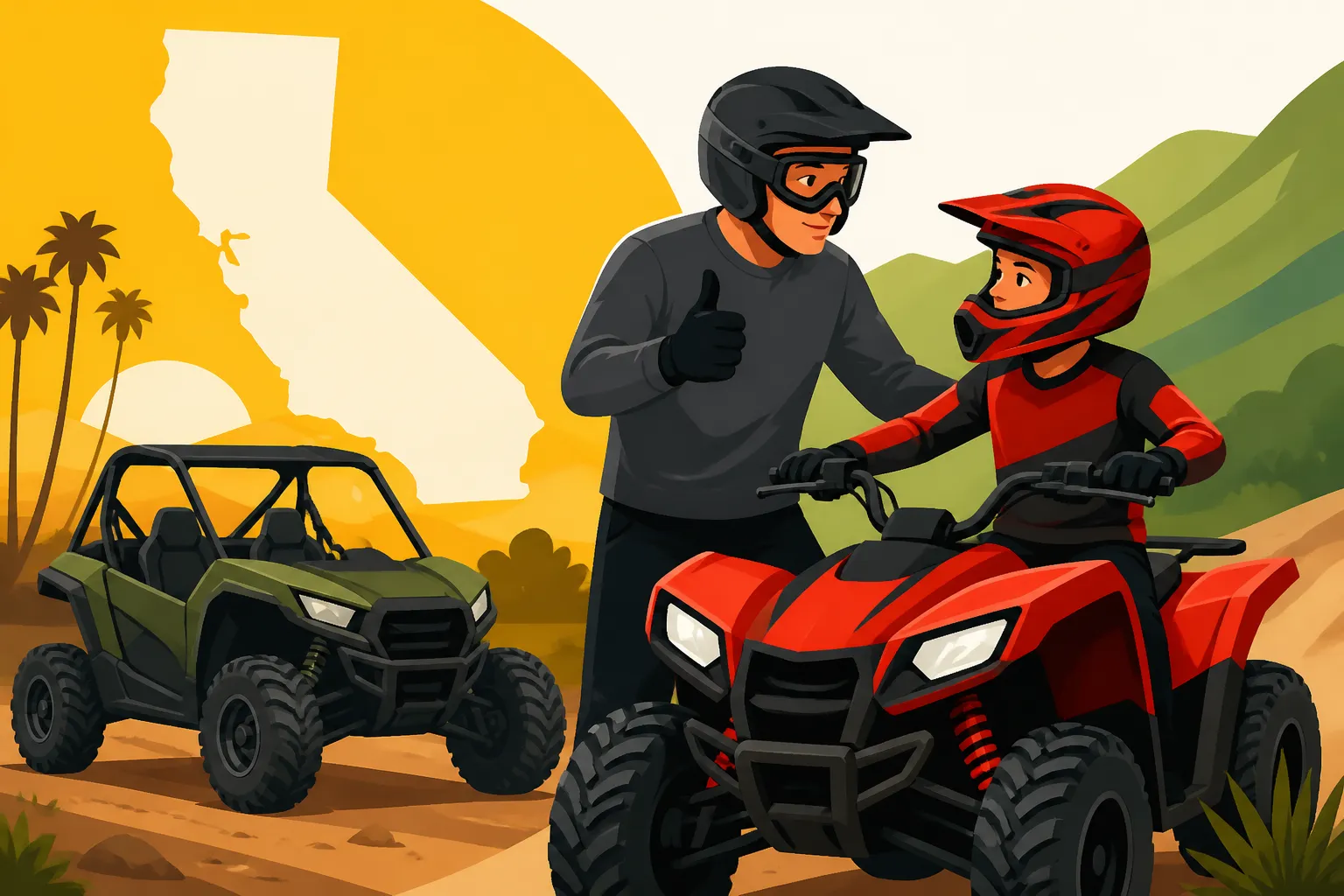
Direct Supervision by a Certified Adult in California
A child may be ready to ride, but California’s rules depend on the machine, the rider’s age, and whether the rider has completed safety training. For a minor who rides under adult supervision, “being nearby” is not a reliable standard. This article explains what certified adult supervision means in practice, where it matters, and what to check before heading out.
What direct supervision means
Direct supervision is active oversight while the young rider operates the machine. It is not the same as dropping a child at a trailhead with an adult who plans to ride elsewhere, or having a certified adult available by phone. The supervisor needs to be close enough to observe what is happening and respond promptly if the rider needs help or is about to make an unsafe choice.
That matters because supervision is meant to reduce risks a safety certificate alone cannot remove. A child may know basic controls but still misjudge speed, terrain, distance, or the behavior of other riders. On public land, a change in trail conditions or a busy riding area can turn a small mistake into a serious incident.
In the context of California’s youth ATV rules, a certified adult is an adult who holds the required ATV safety certificate. The certificate is not a general off-road driving credential, and an adult’s riding experience does not automatically substitute for it. Nor should you assume that a certificate for one kind of vehicle satisfies every requirement for another.
For the adult, direct supervision means paying attention throughout the ride. The exact legal requirements can depend on the vehicle and the rider’s age, but these are sensible safeguards:
- Stay close enough to keep the rider in view and offer immediate guidance.
- Choose terrain and speed appropriate to the young rider’s demonstrated skill.
- Do not let the rider travel beyond sight around a bend, over a dune, or onto a separate trail.
- Keep the riding group small enough that the supervisor can focus on the child.
- Stop the ride if the child is tired, upset, losing control, or no longer following instructions.
These points are practical ways to supervise; they are not a substitute for checking the current legal rule for the machine and riding location. A companion riding a different route nearby is not necessarily supervising directly. If the adult cannot see the young rider or intervene in time, treat that as a break in supervision.
How age and safety certificates affect the rule
California’s youth rules are not simply “a child may ride if an adult comes along.” The applicable requirement can depend on age, whether the young person has completed an approved safety course, and whether the vehicle is an ATV or another type of off-highway vehicle. The adult-supervision option is important, but it should not be treated as permission for a child to ride any machine.
For ATVs, minors may need to meet the state’s safety-training requirement or ride under the supervision of a qualified adult. The requirement for young riders under 14 is especially important: do not assume that a general adult presence is enough. Check that the supervisor has the required ATV safety certificate and can supervise directly. For riders aged 14 to 17, confirm whether the rider’s own certificate or adult supervision is needed for the specific circumstances.
| Rider situation | What to check before riding |
|---|---|
| Under 14 riding an ATV | Confirm the machine is suitable for the rider’s age and size, and that the adult meets the certificate and direct-supervision requirements. |
| Age 14 to 17 riding an ATV | Check whether the rider has the required safety certificate or will ride under a qualifying adult’s direct supervision. |
| Minor riding a side-by-side or another ROV | Check the separate operator-age, training, and vehicle rules. Do not assume the ATV rule applies unchanged. |
| Minor riding a rental | Ask the rental provider what rules apply to the machine, who may operate it, and what proof is required. |
| Rider with a certificate from another state | Confirm that California accepts it for the relevant vehicle and purpose before relying on it. |
A safety certificate and supervision solve different problems. The certificate shows that the rider has completed required training; supervision provides active oversight during the ride. Where the rules allow a young person to ride under a certified adult’s supervision, that does not mean training and safety preparation are unnecessary.
For a fuller overview of youth rules, see California Rules for Riders Under 18. The age thresholds and details for ATV operation are covered in [California Minimum Age to Ride an ATV], while [California ATV Safety Certificate Requirements] explains the certificate side of the rules. If you are relying on a certificate earned outside California, check Out-of-State Safety Certificates in California rather than assuming it transfers automatically.
Adult supervision does not override machine restrictions
A certified adult cannot make an unsuitable machine appropriate for a young rider simply by supervising. Manufacturers may identify minimum ages or rider sizes for particular machines, and those recommendations matter when choosing what a child can control safely. A youth ATV is not merely a smaller version of an adult machine: its controls, speed, and intended use are designed for a particular range of riders.
Before riding, consider whether the child can comfortably reach and operate the controls, steer, brake, and stop the machine. A child who can sit on an ATV in the driveway may still be unable to manage it on uneven ground or in sand. If the rider cannot control the machine without straining or losing balance, choose a more suitable option or do not ride.
Do not confuse permission to ride under supervision with permission to carry a passenger. ATV passenger rules and side-by-side passenger rules are different, and the vehicle’s seating design matters. See California Rules for Riding With Kids on Board for the passenger questions that can arise when children ride with an adult.
ATV supervision is not the same as UTV supervision
People often use “ATV,” “quad,” “UTV,” and “side-by-side” interchangeably, but California rules may treat these vehicles differently. An ATV is generally a straddle-seat vehicle operated with handlebars. A side-by-side, also called a recreational off-highway vehicle or ROV, has seating designed for occupants to sit inside the vehicle, often with a steering wheel and seat belts.
That distinction matters when checking age and training requirements. Do not assume an adult ATV safety certificate automatically qualifies a minor to operate a side-by-side, or that a rule for ATV operators applies to every UTV. Check the rules for the exact vehicle category, including any minimum operator age and any training or supervision requirement.
For a side-by-side, the adult should also consider whether the young operator can properly reach the controls, see over the dashboard, steer, and respond to the vehicle’s weight and handling. Seat belts and a protective structure do not make a machine suitable for an operator who cannot control it. Passengers must use the seating and restraint system as intended; they should not ride in cargo areas or improvised seats.
The adult should also distinguish between supervising an operator and carrying a child as a passenger. A child may be permitted to ride as a passenger in a properly equipped side-by-side under applicable rules, but that does not mean the child may drive it. Check California ROV Operators at Sixteen and Side-by-Side Passengers and California Rules for the separate operator and passenger issues.
If a group includes both ATVs and side-by-sides, plan supervision around the least experienced rider, not the fastest machine. A child on a small quad may not be able to keep up with adults on larger vehicles, and an adult driving a side-by-side may not be able to watch a child riding a separate ATV. When close supervision is required, keep the adult and young rider together on a route and at a pace that allow the adult to stay attentive.
Where the rule matters and what to bring
Youth safety requirements are particularly important when riding on public land, including public riding areas and designated off-highway routes. Do not assume that a rule disappears because the ride is organized, the family owns the land, or the machine is being used for a short distance. The requirements can depend on where the ride takes place and what vehicle is involved.
Before leaving, verify the current rules for the riding area and the machine. A park or land manager may have additional operating requirements, and access rules can differ by site. A trail that is open to one type of machine may not be open to another. Registration, permits, helmets, and other equipment requirements are separate from a child’s safety certificate or supervision arrangement.
Use this checklist before riding:
- Identify the vehicle. Confirm whether it is an ATV, a side-by-side/ROV, or another type of off-highway vehicle.
- Confirm the young rider’s age and role. A driver and a passenger are subject to different considerations.
- Check the applicable training rule. Determine whether the rider needs a safety certificate or may ride under a qualifying adult’s supervision.
- Verify the adult’s qualification. If the supervision option applies, make sure the adult holds the required certificate for the vehicle category.
- Plan continuous oversight. Agree on the route, pace, stopping points, and how the adult will stay close enough to supervise.
- Check the riding-area rules. Confirm that the vehicle and rider may use the intended routes and that required equipment and documents are available.
- Reassess on the day. Weather, visibility, crowding, fatigue, and the child’s confidence can all change whether a planned ride is appropriate.
Carry proof of any required safety certificate and the vehicle documents that apply to the trip. Do not rely on a memory of a course or a photo that may not show the required information clearly. If you are unsure what documents are accepted, check with the relevant agency or riding area before travel. What a Rider Under 18 Must Carry in California is useful when preparing paperwork.
Registration and permits are separate from youth supervision. Having the right sticker or permit does not prove that a minor has met the age or training rules. Likewise, a safety certificate does not replace the machine’s registration or the permit needed for a particular riding area. For visitors, check the rules for out-of-state machines and riders before assuming another state’s documents satisfy California requirements.
Rentals need extra attention because the rental provider may set its own age, training, and supervision conditions in addition to state requirements. Ask before booking whether a minor may operate the particular machine, what certificate the provider accepts, and whether a certified adult must ride alongside. A child’s age alone may not establish eligibility. See California Rules for a Rented Machine and [Renting an ATV in California] when planning a rental.
How to supervise well on the ride
A certificate is only one part of preparing a young rider. Before setting off, make sure the child understands how to stop, how to signal a problem, and what to do if separated from the group. Keep instructions simple and establish a clear rule that the child stops and waits if they cannot see the adult or are unsure where to go.
Choose a low-pressure route at first. Avoid starting a young rider in heavy traffic, steep terrain, deep sand, or a crowded riding area. The adult should watch how the child handles turns, braking, and changes in surface before increasing the difficulty. A child who is comfortable on flat ground may need time to adjust to ruts, loose gravel, or uneven trails.
Supervision is not effective if the adult is distracted by another rider, a phone, navigation, or a separate task. If more than one child needs close attention, bring enough qualified adults to supervise each rider appropriately or arrange a simpler ride. An adult who is also trying to lead a large group may not be able to keep a young operator in view.
Agree on boundaries before the ride. For example, tell the child not to pass the adult, leave the designated route, or continue after losing sight of the group. Explain where to stop if the adult is no longer visible. These expectations are especially useful in dunes and wooded areas, where a small change in direction can quickly separate riders.
Use protective gear that fits, and check the vehicle before riding. A helmet that shifts or a control the child cannot reach can undermine otherwise careful supervision. The adult should also make sure the machine is in sound working order and that the young rider knows how to use its controls. Gear and equipment requirements vary by vehicle and location, so confirm the applicable rules rather than treating one checklist as universal.
Stop when the child is tired or overwhelmed. Fatigue can affect judgment and coordination, and a young rider may not recognize when they need a break. A planned ride should be flexible enough to end early if conditions or the rider’s ability change. Safety supervision is an ongoing decision, not a one-time check at the trailhead.
Frequently Asked Questions
Does a certified adult have to ride on the same machine as the child?
Not necessarily. Supervision generally means actively watching and being close enough to respond, not automatically sharing the same vehicle. But an adult who rides out of sight or cannot intervene promptly may not be providing direct supervision. Check the rule for the rider’s age and vehicle, then plan to stay together.
Does an adult’s riding experience count instead of a safety certificate?
Do not assume it does. Experience is valuable, but it is not necessarily a substitute for a required certificate. If the youth rule relies on adult supervision, verify that the adult holds the certificate required for that vehicle and situation.
Can an ATV safety certificate be used for a UTV?
Do not assume so. ATVs and side-by-sides/ROVs are different vehicle categories, and their operator-age and training rules may differ. Confirm the requirement for the specific machine before a minor operates it.
Is adult supervision enough to let a child ride any ATV?
No. Supervision does not override age-related restrictions, machine suitability, manufacturer guidance, or riding-area rules. Select a vehicle the child can control and verify the requirements that apply to the rider and location.
Disclaimer
This article is for general informational purposes only and does not constitute professional advice. Laws, prices and regulations vary by location and change over time. Consult a qualified professional for guidance on your specific situation.