What California Charges Visitors to Ride
Visitors do not pay one universal fee to ride an ATV or UTV in California. What you owe depends on where you ride, how the machine is registered, and whether the area requires its own access permit. This guide separates the state’s nonresident OHV permit from dune permits and other possible costs, so you can check the right requirements before setting out.
What visitors may have to pay
The first question is not simply whether you are visiting from out of state. It is whether your machine has identification California recognizes for the place you plan to ride. Depending on the answer, your costs may include a California nonresident OHV use permit, a separate area permit, or neither of those—though you may still have other expenses such as camping or equipment.
Think of the possible charges in layers:
| Possible cost | What it covers | Is it always required? |
|---|---|---|
| California nonresident OHV use permit | California’s OHV identification requirement for certain nonresident machines | No. Qualifying registration or permits from limited states may satisfy the requirement |
| Special area permit | Access to a particular riding area, such as the Imperial Sand Dunes | Only where that area requires one |
| Camping or site fees | Overnight camping or use of a developed facility | No. Depends on the location and your plans |
| Safety equipment and preparation | Items such as a compliant dune flag, helmet, or spark arrester | Requirements depend on the machine, rider, and land |
| Administrative or transaction charges | Costs associated with purchasing or processing a permit | May apply; check the official seller before paying |
The California nonresident OHV use permit is a state-level requirement for qualifying off-highway vehicles operated on California public lands. It is not the same thing as a dune permit, camping reservation, event authorization, or the machine’s home-state registration.
That distinction matters because paying one fee does not automatically satisfy every other requirement. A visitor might already have recognized OHV identification and still need to buy an access permit for a particular dune area. Another visitor might not need that area-specific permit but still need California OHV identification.
The permit’s cost can change, so check the current amount, sales method, and validity period with the official California program before buying. The permit is generally tied to the individual machine, not to the rider’s whole group. If you bring more than one ATV or UTV, check the rules for each machine rather than assuming one permit covers the trailer or all the vehicles.
For a fuller explanation of the state permit itself, see California’s Nonresident OHV Use Permit. If you are looking for a specific fee breakdown, [California’s $30 Nonresident Permit] explains the charge associated with that permit, but confirm the current figure and any transaction charges through the official source before purchasing.
When a nonresident permit is required
California generally expects an OHV operated on public lands to display the required identification. A resident’s California registration is one route. For visitors, the key question is whether the machine’s out-of-state registration or permit is recognized under California’s reciprocity rules.
If the machine does not have qualifying identification, a nonresident OHV use permit may be required before you ride it on public land. This is not just a checkpoint issue. The permit requirement can apply at an OHV recreation area, on eligible public-land routes, and in other places where California’s OHV identification rules apply.
A permit can be necessary even if:
- You have registered the ATV or UTV in another state.
- The vehicle has a street-legal plate.
- You are only in California for a weekend.
- You have already paid for an area-specific permit.
- You have proof of ownership or a bill of sale.
Those documents may be useful, but they are not automatically substitutes for California-recognized OHV identification. A street-legal plate, in particular, answers a different question from an OHV permit. It may establish that the vehicle is registered for highway use in its home jurisdiction, but that does not necessarily satisfy California’s requirements for riding on public OHV land.
The permit is also not a general pass to ride wherever you like. It does not open closed trails, authorize riding on private property, replace a campground reservation, or grant permission to use a road that is not open to OHVs. Land managers set access rules for their own areas, and route designations still matter.
Before ordering, check the permit’s current validity period and display instructions. Do not assume that a permit bought for a previous trip remains valid, that it transfers to another machine, or that a digital receipt alone is sufficient proof in every situation. The product and its instructions should tell you what must be displayed and what paperwork to carry.
If you want to purchase ahead of time, Buying a California Nonresident Permit Online covers the buying process. Check that you are using the official seller and entering the correct machine information. A typo in a vehicle identifier can create a frustrating problem when a ranger or registration checker asks to see the permit.
Identify the vehicle and where you will ride
A quad, dirt bike, side-by-side, and other OHV may be covered by the same broad identification framework, but the details of a machine’s registration can differ. Identify the vehicle type, its home-state registration status, and the exact riding destination before deciding which permit to buy.
Then check the land manager’s rules for the destination. California State Vehicular Recreation Areas, national forests, BLM-managed riding areas, and other public lands may have different local requirements. Start with the state’s general permit rule, then confirm the rules for the actual location.
That is especially useful if your trip combines several places. A state permit may address the vehicle-identification requirement, while an individual riding area may have separate rules for access, camping, sound, spark arresters, or seasonal closures.
How reciprocity works
California does not treat every state’s OHV decal or registration as interchangeable with its own. Reciprocity is limited. In general, qualifying OHV identification from Oregon or Nevada may be recognized, while identification from many other states does not replace California’s nonresident permit.
The practical point is to verify the exact credential on your machine. “Registered out of state” is not enough information by itself. A state can issue a highway plate, an OHV decal, a recreational-use permit, or a combination of documents, and California’s treatment may depend on which one you have.
| Your machine’s identification | What to check before riding in California |
|---|---|
| Qualifying Oregon OHV permit or decal | Confirm it is current, attached or displayed as required, and valid for the machine |
| Qualifying Nevada OHV registration or decal | Confirm it is current and that the machine’s identification meets California’s reciprocity conditions |
| Registration or decal from another state | Do not assume California recognizes it; check whether a California nonresident permit is required |
| Street-legal plate from another state | Check separately; a highway plate does not automatically replace OHV identification |
| No current registration or permit | Determine whether California’s nonresident permit is required and whether the machine can legally be used at your destination |
For a more detailed explanation, see California OHV Reciprocity: Only Two States and Why Only Oregon and Nevada Count in California. If you are coming from a state other than those two, start by checking the California permit requirement rather than relying on a sticker that looks similar.
A street-legal plate is not a shortcut
Visitors often assume that a regular license plate settles the issue. It may not. An ATV or UTV can be street-legal in its home state without that status being accepted as permission to ride on California OHV land. The vehicle’s highway registration and its authorization for off-highway recreation are separate matters.
That does not mean an out-of-state plate is irrelevant in every situation. It means you should not use the plate alone as proof that you meet the California OHV identification rule. Check the relevant reciprocity rules and the destination’s instructions.
This distinction can prevent two common mistakes: skipping the California permit because the vehicle has a plate, and buying a permit unnecessarily because the visitor has not checked whether a qualifying Oregon or Nevada OHV credential already meets the requirement. If your documentation is unusual, ask the official program or land manager before you travel and keep the answer with your trip records.
Reciprocity is not a blanket exemption from local rules
Even when California recognizes your home-state OHV identification, you remain responsible for any area-specific permit or use rule. Recognition of an Oregon or Nevada credential does not automatically waive an Imperial Sand Dunes permit, a campground charge, an event permit, or other requirements.
It also does not make an otherwise closed or restricted route open. Reciprocity concerns identification; it does not change where a vehicle may be operated. Check both the general California requirements and the local rules for the trail system or recreation area.
Imperial Sand Dunes permits are a separate cost
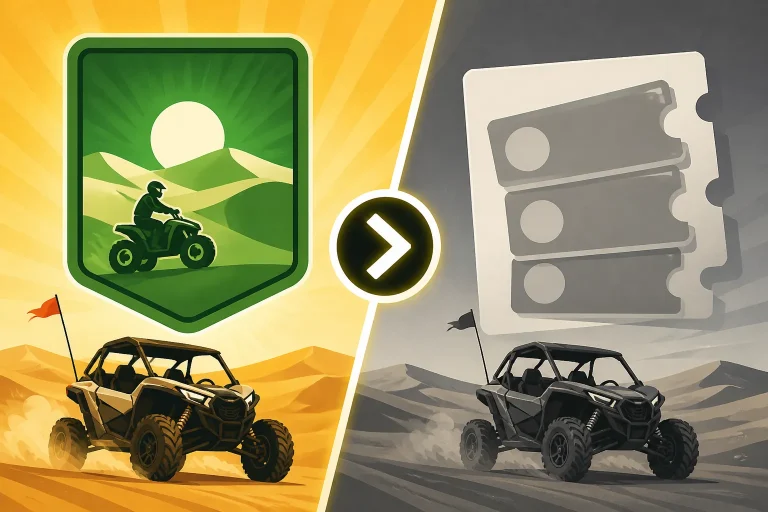
The Imperial Sand Dunes Recreation Area, often called the ISDRA or Glamis, has an area-specific permit system. This is separate from California’s nonresident OHV use permit. Visitors can need both: one to satisfy California’s OHV identification requirement and another for access to the dune area.
That is why the simple question “Do I need a California permit?” may not be enough if you are headed to the dunes. Ask two separate questions:
- Does my machine have California-recognized OHV identification?
- Does my trip require an ISDRA permit for the dates and use I have planned?
A qualifying Oregon or Nevada credential may address the first question, but it does not necessarily answer the second. Likewise, buying an ISDRA permit does not automatically replace the state-level identification required for a machine that lacks qualifying registration or a California nonresident permit.
ISDRA permits may be offered for different durations or purchase situations. The available options, prices, dates, and purchase procedures can change, so verify the current details with the official dune permit seller before traveling. Do not rely on a prior season’s price or assume that an old permit remains valid.
The permit requirement may also apply to vehicles entering the area even if they are not riding in the usual way. Check the official rules for tow vehicles, support vehicles, and vehicles used to access a campsite. A trailer itself is different from a motor vehicle, but the vehicle towing it may be covered by the area’s requirements. If your group is arriving in several vehicles, confirm which ones need permits.
For destination-specific guidance, see California Rules for Riding Imperial Sand Dunes. If you are deciding between a short visit and a longer stay, compare the current permit options with your full schedule rather than buying based on a remembered price or an assumption that one permit covers every vehicle.
Plan for the dates, not just the destination
Dune access and permit availability can be seasonal. Before leaving, verify that the recreation area is open, that your permit applies to the dates you will be there, and that you understand how it must be displayed. A permit that is valid for a particular period does not override a closure or other operating restriction.
Weekend and holiday trips deserve extra planning. Permit purchase options, on-site availability, campground conditions, and entry procedures may differ from what you encounter on a quieter weekday. If you plan to arrive late, check whether you can buy the required permit in advance and whether proof must be printed or displayed on the vehicle.
Do not treat the permit as a substitute for checking conditions. Weather, closures, route restrictions, and local safety rules can affect where you may ride after you arrive. The area’s official information is the best place to check these details before loading the trailer.
Other costs and requirements that can affect your trip
The permit is only one part of a visitor’s budget. The total cost depends on the area, the length of the trip, and what you bring. A rider heading to a free day-use area may have different expenses from a visitor staying overnight at a developed campground or buying a dune permit.
Possible additional costs include:
- Camping fees or reservations.
- Day-use or access charges at a particular facility.
- A transaction or service charge when purchasing a permit.
- Fuel, food, and vehicle recovery supplies.
- Safety equipment that you do not already own.
- Repairs or replacement parts needed to meet local requirements.
- Event fees if you are participating in an organized ride or competition.
Do not assume a camping reservation includes every vehicle permit, or that an area permit includes camping. Read the terms for each purchase. If one reservation is tied to a campsite and another permit is tied to a motor vehicle, they may be separate transactions with separate conditions.
Safety requirements may bring equipment costs
Some rules are not fees, but meeting them can still affect what you spend. California riding areas may require or enforce rules concerning helmets, spark arresters, noise limits, flags, youth riders, or vehicle use. Requirements differ by location and situation, so check the actual rules for your planned activity.
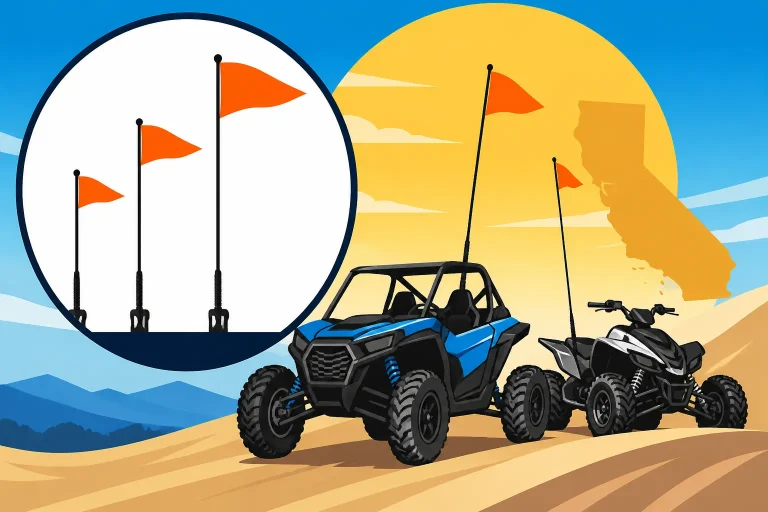
For example, dune riding has visibility and flag requirements. A helmet may be required for public-land riding, with limited exceptions that depend on the vehicle and rider. A spark arrester may be necessary in certain areas, especially where fire risk or brush-covered land is a concern. These are not interchangeable with a permit: having the required equipment does not excuse a missing permit, and having a permit does not excuse missing equipment.
If you buy gear online, Amazon may be convenient for basic items such as goggles, gloves, or document sleeves, but confirm that the product meets the riding area’s actual specifications. For regulated equipment, such as a spark arrester, check the applicable approval information and machine fit before ordering. Amazon listings can be useful for comparing models, but a product description alone is not proof that an item is accepted by a land manager.
A dune flag is another item where details matter. Check the required dimensions, mounting location, and height with the official area rules rather than choosing the first flag you find. Amazon may carry a range of flags and mounts, but fit and compliance are more important than choosing by appearance. Keep receipts and product details until you know the equipment works properly on your machine.
Event permits are different again
If you are organizing a group ride, race, commercial tour, or other organized activity, ordinary visitor permits may not cover the event. Organizers can have separate application, timing, insurance, and operating requirements. A participant’s vehicle permit does not authorize the organizer to conduct an event on public land.
Check California’s Sanctioned Event Permit Explained if you are planning an organized activity. Apply early enough to account for the agency’s review and any required documentation. Even a small gathering may need clarification if it involves organized use of a recreation area, signs, course marking, vendors, or commercial services.
Work out your likely cost before you leave
You can avoid most permit confusion by checking the requirements in a consistent order. This also makes it easier to budget, because you will know whether you are looking at one state permit, a separate area permit, or both.
- List every motorized vehicle you plan to bring. Include each ATV, UTV, dirt bike, and any support vehicle that may be subject to an area permit. Do not assume one document covers a whole group.
- Record each machine’s identification. Note the state that issued it, whether it is current, and whether it is an OHV decal or permit, a street-legal plate, or both.
- Check California’s reciprocity rule. Confirm whether the exact credential is recognized. If it is not, check the current requirements for the California nonresident OHV use permit.
- Identify every riding location. Make a list of state recreation areas, federal land, dunes, private facilities, or other destinations on your route.
- Check each location’s separate requirements. Look for access permits, camping reservations, vehicle permits, seasonal operating rules, and closure notices.
- Check equipment and rider rules. Confirm rules for helmets, age and supervision, sound, spark arresters, flags, passengers, and any other relevant requirement.
- Confirm current charges at the official source. Check the permit price, validity dates, transaction charges, and accepted purchase methods immediately before buying.
- Save proof in a form you can access. Follow instructions for displaying a sticker or permit and carrying supporting paperwork. Keep a backup copy of receipts and registration information.
This process is more reliable than searching only for “California ATV permit price.” A search result might describe the state permit but not the destination’s permit. It might also refer to a previous fee schedule or a different kind of vehicle. Use the search result to find the relevant agency, then verify the details directly.
Example: a visitor riding at a state recreation area
Suppose you bring a UTV from a state outside Oregon and Nevada to a California State Vehicular Recreation Area. First check whether the UTV’s existing OHV identification qualifies under California’s reciprocity rules. If it does not, determine whether a California nonresident permit is required. Then check the recreation area’s own access, camping, and equipment rules.
The total cost is not necessarily limited to the state permit. You may also pay for camping or other services, but those costs depend on the site and your plans. The important point is to avoid paying for an area pass that does not solve a state identification problem—or assuming state identification also pays for area access.
Example: a weekend at the Imperial Sand Dunes
A visitor riding at the ISDRA should check both the state identification requirement and the dune permit requirement. If the machine has qualifying identification, the visitor may not need the California nonresident permit, but the separate dune permit may still be required. If the machine lacks qualifying identification, the visitor may need to budget for both.
Check all motor vehicles covered by the dune rules, the permit’s valid dates, the display instructions, and current purchase options. If camping, review the campsite requirements separately. A single trip can involve multiple permits, but each has a different purpose.
Example: a machine with a street-legal plate
A visitor may arrive with an ATV or UTV carrying a street-legal plate from another state. Do not conclude from the plate alone that California’s OHV identification requirement is satisfied. Confirm whether that registration is recognized for the planned off-road use, and separately check the rules of the destination.
The plate also does not grant permission to ride on every road between a campsite and the trail. Road access depends on route designation and local rules. When in doubt, trailer the machine to a legal riding area instead of treating a highway plate as universal access.
Common mistakes visitors can avoid
Assuming every state’s sticker works in California
California’s reciprocity is limited. A sticker that is valid at home may not take the place of a California nonresident permit. Check the exact state and credential, rather than relying on a seller’s statement that a machine is “registered.”
Treating the state permit and dune permit as one charge
They are separate requirements with separate purposes. The state permit addresses California OHV identification for certain nonresident machines. An area-specific permit addresses entry or use of a particular recreation area. If your destination is the ISDRA, verify both.
Believing a street plate covers off-road identification
A street plate can be valid for highway use without satisfying a separate OHV identification requirement. Verify what California recognizes for the type of riding you plan to do.
Buying one permit for several machines
Permits are often associated with a specific vehicle. Read the terms carefully before assuming that one purchase covers multiple ATVs, a UTV and a support vehicle, or every member of a riding group.
Forgetting that the tow vehicle may be covered by local rules
A dune permit system may address more than the OHV that is driven on the sand. Check whether the tow vehicle or other motor vehicles entering the area need their own permit. Do not assume the trailer’s status determines the tow vehicle’s requirements.
Relying on an old receipt or prior season’s information
Permit charges, duration, sales methods, and operating rules can change. A receipt from a previous trip may not establish current eligibility. Verify the current terms before you travel, especially when the trip is months away or falls near a seasonal opening.
Assuming a permit makes a route legal
A permit is not permission to cross private property, ride a closed route, use a highway, or ignore local restrictions. Route maps, posted signs, gates, and closure notices still matter. If your intended route is unclear, ask the land manager before riding it.
Arriving without proof you can show
A permit that is valid but inaccessible can still turn a straightforward check into a delay. Follow the instructions for attaching or displaying it, and carry the required registration or supporting paperwork. A photo of a document may be useful as a backup, but do not assume it replaces an original or displayed permit when the rules require one.
For related help with visiting riders, see California OHV Permit for Out-of-State Riders. If you are unsure whether your home-state credential counts, Does California Honor an Oregon OHV Permit? and Does a Nevada Decal Work in California? address those specific cases.
A practical bottom line for visitors
Start with the machine, not the fee. Confirm what identification it carries and whether California recognizes that credential. If it does not, check the California nonresident OHV permit and its current cost. Then check the separate rules for every place on your itinerary, especially if you are going to a dune area or staying overnight.
Your total may be one permit, multiple permits, or no California nonresident permit at all. Reciprocity can remove the state-permit purchase for some visitors, but it does not automatically cover area access. And neither kind of permit replaces safe equipment, legal routes, or any camping reservation you need.
Before departing, verify current charges and instructions through the official program or land manager. Keep the permit associated with the correct machine, display it as directed, and carry the documents that show the machine’s identification. That small check is far less frustrating than discovering at a gate that the permit you bought was for a different purpose.
Disclaimer
This article is for general informational purposes only and does not constitute professional advice. Laws, prices and regulations vary by location and change over time. Consult a qualified professional for guidance on your specific situation.