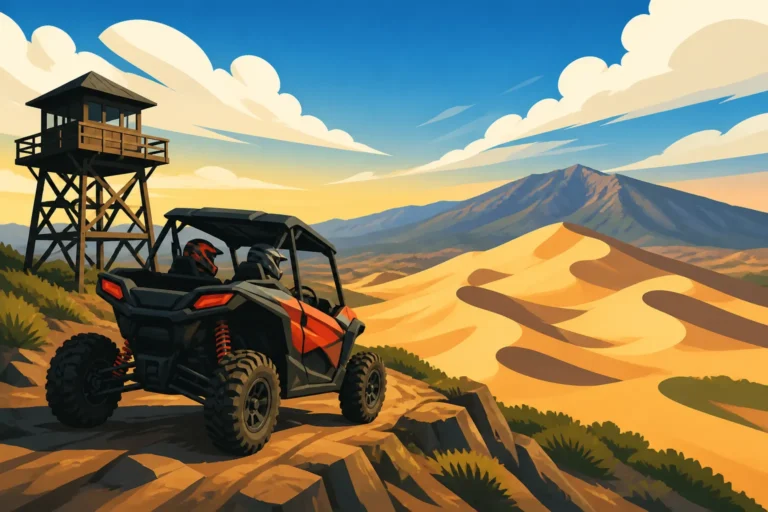
California OHV Areas With Rentals On Site
Finding an ATV or UTV rental near a California riding area can be confusing: a shop may be close to the entrance without being inside the park, and renting a machine does not automatically include permission to ride every route. This guide explains where rentals are commonly available nearby, what “on site” really means, and what to confirm before you book.
What to Know About California OHV Areas With Rentals
On-site does not always mean inside the riding area
When people search for California OHV areas with rentals on site, they often mean one of three things: a rental counter inside a recreation area, a business just outside the entrance, or a company that delivers a machine to a campground or staging area. Those options can feel very different on ride day. A shop a short drive away may be convenient, but it may not be able to hand you a vehicle at the trailhead or let you ride directly from its lot.
Oceano Dunes near Pismo Beach is the clearest example of a riding destination with rental businesses close by. Shops around Pier Avenue are near the access to the sand, but proximity does not mean that every rental includes the same access, route, or delivery arrangement. Check the current park rules and ask the rental company where you collect the machine and where the rental agreement allows you to ride. The local details are covered in [Oceano Dunes Entry From Pier Avenue] and [Renting on Pier Avenue in Oceano].
Other popular areas, including Hungry Valley SVRA, Hollister Hills SVRA, and Ocotillo Wells SVRA, are better approached as ride areas where you should verify rental availability separately. Do not assume that a park has an on-site rental counter just because it has day-use access, campsites, or a visitor facility. Many riders bring their own machines, while rental options may be based in a nearby town or require advance arrangements.
Rental access and riding access are separate questions
Before booking, confirm two things independently: whether the provider can supply a vehicle for your chosen area, and whether the vehicle can legally be ridden where you plan to go. A rental company may offer a guided tour, limit riders to a designated area, or require you to transport the machine to a specific entrance. A reservation alone does not establish that the vehicle can be used on every road, trail, or dune.
This distinction matters especially for public riding areas. Rules can vary by location and by route, and a rental company’s permission is not a substitute for land-manager rules. Ask which entrance to use, where riding is allowed, whether a guide is required, and what happens if a route or area is closed. For a broader overview, see [California OHV Areas With Rentals On Site] and [California OHV Areas With Rentals On Site]—but confirm details directly with the park and provider before you travel.
California Riding Areas to Check for Rentals
Oceano Dunes near Pismo Beach
Oceano Dunes is the most straightforward place to investigate if you want to rent close to a California riding area. Rental businesses operate around Pismo Beach and Pier Avenue, near the beach access area. Some offer ATVs, side-by-sides, or guided experiences, but vehicle types, rider requirements, pickup arrangements, and permitted riding areas can differ from one provider to another.
The practical advantage is that a nearby rental can spare you from trailering your own machine across the state. The trade-off is that you still need to plan the handoff, orientation, safety gear, and time to reach the permitted riding area. A short rental window can feel rushed if you arrive late, need help with controls, or encounter crowded access points. Ask whether your reservation includes a briefing and what time you must return; do not assume the clock starts only once you reach the sand. Related planning topics include [California's Pismo Beach Rental Row] and [Walking to the Sand From a Rental Shop].
Also ask the shop whether its rental is suitable for your group. A family with younger riders may need a different machine and supervision plan than two experienced adults looking for a faster dune ride. Find out what gear is supplied, whether helmets are included, and whether the vehicle is sized for each intended driver. For details on how rental rules and location restrictions can affect a trip, see [California Rentals and Where You May Ride] and [California Rentals for a Family Group].
Glamis and the Imperial Sand Dunes
Glamis is a major destination for dune riding, but it is not safe to assume that a rental will be waiting at your campsite or at the edge of the sand. Rental arrangements may involve a provider, delivery, a designated pickup location, or a guided outing. Confirm the exact logistics before committing to lodging or driving out with a group that is counting on renting.
The Imperial Sand Dunes are expansive, and orientation matters even for confident riders. A first-time visitor may underestimate distances, changing sand conditions, and how easy it is for a group to become separated. Ask the provider what riding area is included, whether the rental is guided or independent, what communication equipment is supplied, and what recovery support is available if the machine becomes stuck or stops working. For trip planning around the area, [Imperial Sand Dunes, California's Biggest Dune Field] and [Glamis From October to April] offer useful background.
A map app can help you plan, but it cannot replace posted closures, signs, or directions from land managers. onX Offroad can be useful for reviewing routes and getting familiar with the area before you arrive; check that your planned route is open and permitted rather than treating a line on a map as proof of access. If you are renting, ask whether the provider recommends a particular route or restricts where its vehicle may go.
Ocotillo Wells and other desert areas
Ocotillo Wells SVRA is a large desert riding destination, but its size does not guarantee that rental machines are available at the park. Check with providers in the wider area and ask whether they deliver, where pickup happens, and whether the vehicle is approved for the specific riding plan you have in mind. Delivery may be convenient, but confirm the delivery point and return process rather than assuming a machine can be dropped anywhere in the recreation area.
The same cautious approach applies to Hungry Valley and Hollister Hills. They are established riding areas, but a visitor should verify rental options with both the relevant park and a rental provider. A business described as “near” a park may still require you to transport the machine, and a rental company may not permit its vehicles on every trail or route. Start with [California's State Vehicular Recreation Areas], then contact the specific location about access and current facilities.
For unfamiliar trail networks, use a map to prepare without relying on it as the final word on legality. onX Offroad can help you inspect the general layout and plan questions to ask, such as whether a road connects to an open trail or crosses a restricted area. Confirm route status on arrival, especially after weather, fire activity, or seasonal closures. More planning guidance is available in [California Trail Maps and Where to Get Them].
| Riding area | Rental situation to investigate | What to confirm before booking |
|---|---|---|
| Oceano Dunes near Pismo Beach | Rental shops are close to the Pier Avenue access area | Pickup location, ride area, rental duration, gear, and current access rules |
| Glamis and the Imperial Sand Dunes | Rental arrangements may require advance coordination or delivery | Exact meeting point, permitted riding area, recovery support, and any guide requirement |
| Ocotillo Wells SVRA | Verify providers in the wider area; do not assume an on-site counter | Delivery or transport, park access, route restrictions, and return arrangements |
| Hungry Valley SVRA | Check directly with the park and nearby providers | Whether a machine is available for the date and how it reaches the riding area |
| Hollister Hills SVRA | Confirm availability rather than assuming rentals are inside the park | Pickup, allowed trails, operating requirements, and equipment provided |
How to Choose a Rental That Fits Your Trip
Match the machine to the riders and terrain
An ATV and a UTV are not interchangeable choices. An ATV is ridden astride and requires balance, body positioning, and control from the individual rider. A UTV has seats and a steering wheel, but it is wider and may be restricted on narrow trails. Think about the least experienced person in the group, not just the person who makes the booking.
For a family outing, ask about minimum ages, passenger rules, child restraints, and which machines are available for younger riders. For a group with mixed experience, a UTV may feel more approachable to some people, while an ATV may suit a rider who already knows how to handle one. Neither option makes challenging terrain automatically safe. If you are unsure, ask whether the provider offers a beginner-friendly ride or a guided option, and be honest about your group’s experience.
Terrain should shape the choice too. Soft dune sand, narrow trails, and rocky routes put different demands on both rider and vehicle. A wider side-by-side may be comfortable for some desert outings but unsuitable for a narrow trail. Ask the provider what machine is appropriate for your intended location, and confirm that the rental agreement allows you to take it there. The overview at [Quad or Side-by-Side for California Sand] can help you frame that decision.
Compare the full booking, not just the rental window
Before paying a deposit or confirming a reservation, ask for the complete terms in writing. Find out what the booking includes, what equipment is supplied, whether fuel is included, and how damage, cleaning, late returns, or recovery are handled. Ask whether the company places a hold on a payment card and what could lead to additional charges. The amounts and terms vary, so check the provider’s own booking materials rather than relying on an old review or a friend’s past experience.
Also check the cancellation policy and what happens if weather, a park closure, or another access issue disrupts the plan. A rental business may have one policy for customer cancellations and another for conditions that prevent riding. If you are traveling a long distance, this is not a minor detail: a changed plan can mean losing a full day, rearranging lodging, or finding another activity at short notice.
Arrive with enough time to complete any paperwork and safety briefing. Photograph the rental vehicle before you leave, including existing damage, and report concerns to staff before starting the ride. Confirm the return location and expected fuel level. These simple steps help avoid the uncomfortable end-of-day scramble when a group is tired, dusty, and trying to remember what the vehicle looked like at pickup.
A Practical Checklist Before You Go
Confirm the location and rules
Call or message the rental provider close to your travel date and confirm the precise pickup address, where the vehicle may be ridden, and whether you need to transport it. Then check the riding area’s own information for access, closures, and any requirements that apply to your group. Park access and rental availability are separate; both need to line up.
Ask whether the machine needs its own registration or identification for the location and what documents the operator must carry. Rental companies often handle vehicle paperwork, but you should still know what proof will be provided and what you should keep with you. If your plan involves a public riding area, look into applicable permit and safety requirements in advance. [California OHV Permits Explained] is a useful starting point for understanding that side of the preparation.
Prepare for a safer, less stressful ride
Bring clothing suited to dust, sun, and changing temperatures, along with eye protection and closed-toe footwear. Ask the provider what protective equipment is included and whether you can bring your own helmet. Follow the machine’s passenger limits and safety instructions, and keep the group within the skill level of its least experienced rider. On a desert trip, carry water and agree on a regrouping plan before anyone sets off.
Download or review maps before losing reliable cell service. onX Offroad may help you familiarize yourself with the surrounding network, but check official information and posted signs for access restrictions and closures. Share your intended route with someone who is not riding, and do not split from your group without agreeing on a meeting point. If visibility, weather, fatigue, or machine behavior makes the ride feel wrong, stopping early is a sensible decision—not a failed outing.
Use these questions when calling a provider
A quick call can uncover details that a booking page leaves unclear. Ask:
- Is the rental counter inside the riding area, nearby, or at a separate pickup location?
- Can the vehicle be ridden from pickup, or must it be transported to the entrance?
- Which specific riding areas and routes are permitted under the rental agreement?
- What are the minimum age, license, passenger, and supervision requirements?
- What equipment is included, and what should each rider bring?
- Is the ride guided, independent, or limited to a designated area?
- What are the fuel, return, damage, breakdown, and cancellation policies?
- What happens if access closes or conditions prevent riding?
The best choice is the one that fits your location, experience, schedule, and comfort level—not simply the rental listing that sounds closest to the dunes or trailhead. Confirm the details, plan for the actual pickup and return, and treat park rules as separate from the rental company’s instructions.
Disclaimer
This article is for general informational purposes only and does not constitute professional advice. Laws, prices and regulations vary by location and change over time. Consult a qualified professional for guidance on your specific situation.