Riding a Forest Road Legally in California
Trying to figure out where you can legally ride your ATV or UTV on California's vast network of forest roads can feel like navigating a dense, unmapped wilderness itself. There's nothing more frustrating than packing up your rig, driving for hours, only to find a locked gate or a sign telling you that your machine isn't welcome. This guide is here to clear up the confusion, helping you understand the rules and regulations so you can enjoy California's beautiful forest lands responsibly and without worry.
Understanding California's Forest Road Network
California boasts an incredible array of national forests, state forests, and other public lands managed by various agencies like the U.S. Forest Service (USFS) and the Bureau of Land Management (BLM). These lands are crisscrossed with thousands of miles of roads, ranging from well-maintained paved surfaces to rugged, single-track dirt paths. Not all of these roads, however, are open to off-highway vehicles (OHVs) like ATVs and UTVs, and knowing the difference is absolutely crucial to avoiding a citation or, worse, damaging sensitive habitats.
Who Manages These Roads and Why It Matters
The primary managers of forest roads where you'll likely want to ride your OHV are the U.S. Forest Service and the Bureau of Land Management. Each agency has its own set of regulations, though they often align with state laws regarding OHV use. What's important to grasp is that these agencies develop specific travel management plans for their areas. These plans designate which roads, trails, and areas are open to different types of vehicles, and they often change. Just because a road looks like a great place to ride doesn't mean it's legal. It's a common mistake to assume that all dirt roads are fair game for off-road machines, and that's just not the case on public lands.
Forest roads serve many purposes beyond recreation – they're used for logging, fire suppression, administrative access, and even private land access within the forest boundaries. This multi-use aspect is why designations are so vital. You might encounter roads primarily meant for full-sized highway-legal vehicles, while others are specifically carved out for OHV recreation. Understanding the managing agency for the specific forest you plan to visit is your first step in responsible riding.
Motor Vehicle Use Maps (MVUMs): Your Essential Guide
If you're planning to ride on national forest lands, the single most important tool in your arsenal is the Motor Vehicle Use Map (MVUM). These maps are the official designation of where you can and cannot ride motorized vehicles, including your ATV or UTV. They are legally binding, and ignorance of the map is not a valid excuse if you're caught on a closed route. The frustration of trying to find clear information can be real, but these maps cut through the ambiguity.
MVUMs are black and white, often showing roads and trails with different lines indicating whether they are open to vehicles 50 inches or less, wider vehicles, or full-sized vehicles, and what time of year they are open. You'll find designations for specific roads like [Green Dot Roads and What They Allow], which are often part of broader travel management plans. It's not enough to just know about the map; you absolutely have to get the specific MVUM for the forest or ranger district you intend to explore. These maps are usually free and can often be downloaded from the USFS website or picked up at a ranger station. Without one, you're essentially riding blind. A good aftermarket accessory like a sturdy map case, perhaps from SuperATV, can help keep your MVUM protected from the elements out on the trail.
The Legalities of Riding OHVs on California Forest Roads
Once you understand where you can ride, the next crucial step is understanding how you can ride legally. This involves more than just having a machine; it includes proper registration, essential equipment, and adhering to rider safety requirements. Skip any of these, and you could face fines, even if you're on an open road.
California OHV Registration and Identification
First and foremost, your ATV or UTV must be properly registered for off-highway use in California, or hold an equivalent permit from a reciprocal state. This is non-negotiable for riding on public lands, including forest roads. The sticker you receive, whether it's a Green Sticker, Red Sticker, or the newer Tan Sticker, tells rangers and law enforcement that your machine is compliant with California's OHV laws. You can learn more about the specifics of the fees involved by looking into the [California OHV Registration Cost].
If you're riding a machine that's primarily designed for off-road use, it will need either a California Off-Highway Vehicle (OHV) identification plate or a valid out-of-state OHV permit from a state with reciprocity. Currently, California only has reciprocity agreements with Oregon and Nevada, meaning if you're visiting from, say, Arizona or Utah, you'll still need to purchase a California Nonresident OHV Use Permit. This can sometimes catch out-of-state visitors by surprise, so it's best to be prepared. This plate or sticker must be clearly displayed on your machine. Without it, you're not legal.
Essential Equipment for Safe and Legal Riding
Beyond registration, your OHV needs to meet certain equipment standards to be legal on California's forest roads. These aren't just suggestions; they are mandates designed for safety and environmental protection.
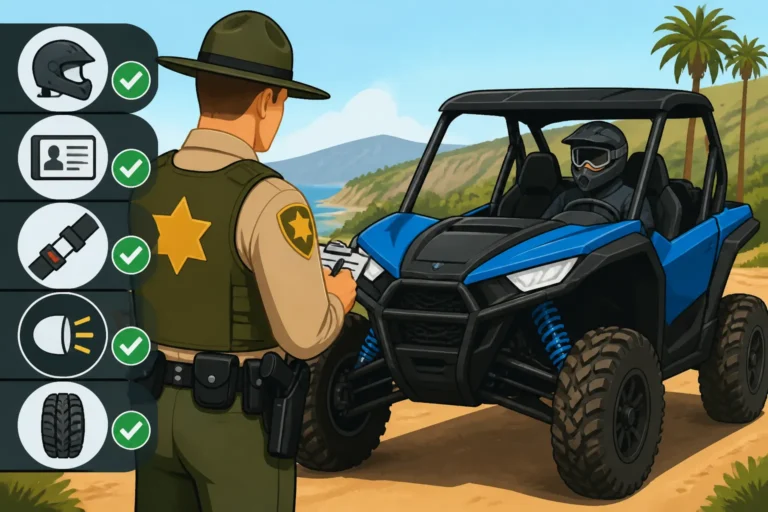
Here's a quick rundown of critical equipment:
| Requirement | Description | Why It's Important |
|---|---|---|
| Spark Arrester | All OHVs operating on public lands must be equipped with an approved spark arrester. This is especially vital in California, given the constant threat of wildfires. | Prevents sparks from the exhaust system from igniting dry vegetation and starting a wildfire. |
| Muffler/Exhaust | Your machine must have a functional muffler to keep noise within legal limits. Aftermarket exhausts are common, but they must still comply with sound regulations. | Reduces noise pollution and minimizes disturbance to wildlife and other recreationists. |
| Brakes | Fully functional service brakes capable of stopping and holding the vehicle. | Essential for safety, especially on varied forest terrain. |
| Lights | If riding at night, your OHV must be equipped with at least one headlight that can illuminate objects 200 feet ahead, and a red taillight visible from 500 feet to the rear. | Crucial for visibility and safety during low-light conditions. |
| Safety Flag (Dunes) | While not typically required on most forest roads, if your route takes you into open desert areas or dunes, a safety flag on a whip may be mandatory. Always check specific area rules. | Enhances visibility in open, undulating terrain. |
The spark arrester is particularly crucial on [California Brush-Covered Land], as a single spark can devastate vast areas. Don't risk it; ensure your machine is compliant with [California Spark Arrester Rules]. Many riders choose to upgrade parts of their OHV, and companies like SuperATV offer a range of aftermarket components that can enhance your machine's performance and durability, but always ensure they meet California's legal requirements for public land use.
Rider Requirements and Safety Gear
California law also dictates who can ride and what safety gear they must wear. These rules apply universally on public lands.
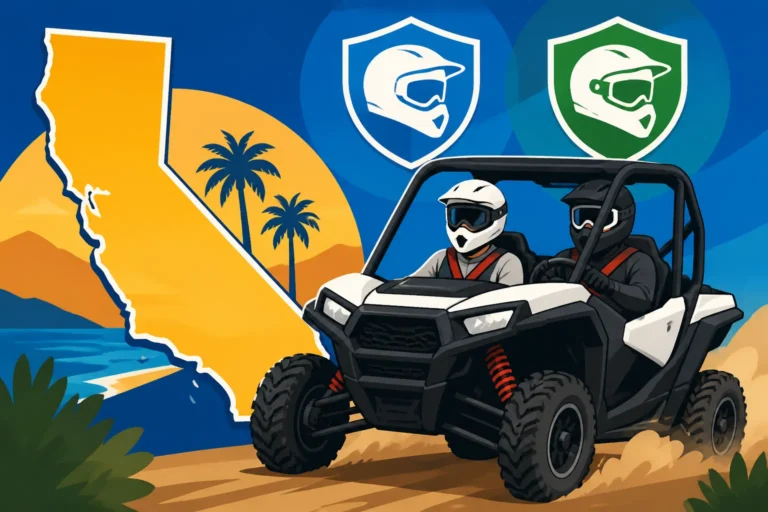
- Helmets: Anyone riding an ATV on public land in California must wear a U.S. DOT compliant helmet. This is an absolute must, regardless of age. For UTVs (often called ROVs), the rules are slightly different: if the vehicle is equipped with a roll cage and seatbelts, adults over 18 may not be required to wear a helmet if the vehicle's manufacturer did not recommend one and the rider is properly secured by a seatbelt. However, for youth under 18, helmets are mandatory in all OHVs, including UTVs. It's always safest to wear one, regardless. You can delve deeper into this specific requirement by reading about [California Helmet Law for ATV Riders].
- Minimum Age: There are specific age requirements for operating OHVs on public lands. For ATVs, children under 14 must be supervised by a certified adult and possess a California ATV Safety Certificate. For ROVs (UTVs), the minimum operator age is 16. Understanding [California Minimum Age to Ride on Public Land] is vital for family outings.
- Passengers: On ATVs, generally, no passengers are allowed unless the ATV is specifically designed by the manufacturer to carry more than one person and is equipped with a seat and footrests for the passenger. For UTVs, passengers are allowed as long as there are designated seating positions with seatbelts. Always ensure every passenger is properly secured.
- Carrying Registration: You should always carry your current OHV registration or permit when riding. A physical copy is best, as cell service can be spotty in many forest areas, making digital proof unreliable if asked by a ranger.
Key Considerations and Best Practices for Forest Road Riding
Even when you have all your ducks in a row with registration and equipment, there are still crucial aspects to consider before and during your ride on California's forest roads. These ensure not only your legality but also your safety and the preservation of the beautiful environment.
Checking for Closures and Restrictions
California's forests are dynamic environments, constantly subject to conditions that can lead to closures or restrictions. This is perhaps the most frequent frustration for riders – arriving at a favorite spot only to find it unexpectedly closed.
- Fire Closures: California's fire seasons often lead to extensive forest closures for public safety. Always check the managing agency's website (USFS, BLM) for the specific forest district you plan to visit before you leave. [California Fire Closures That Shut Trails] can come into effect rapidly and without much notice.
- Seasonal Closures: Some roads or trails may have seasonal closures to protect wildlife, prevent resource damage during wet conditions, or manage snow. MVUMs often indicate these, but always double-check current conditions.
- Weather-Related Closures: Heavy rain or snow can make roads impassable or extremely fragile, leading to temporary closures. Respect these closures; riding on wet, muddy trails can cause irreparable damage.
- Maintenance Closures: Occasionally, roads are closed for maintenance or improvement projects. These are usually posted in advance, but last-minute changes can occur.
The lesson here is simple: never assume a route is open. Always check the official sources right before your trip. Getting reliable updates can be tough, but a quick call to the local ranger station is often the best approach.
Designated Routes vs. Off-Trail Riding
On virtually all public lands managed by the USFS and BLM in California, motorized vehicle travel is restricted to designated routes only. This means you cannot just go "off-roading" wherever you please. Stick to the roads and trails marked on the MVUMs and other official maps. Riding off-trail, known as "cross-country travel," is a major source of resource damage, erosion, and conflict with other land users, and it carries stiff penalties. You can face significant [California Fines for Riding on a Highway] if you mistakenly think a road is open for free-range riding when it isn't.
Many riders, especially those new to forest riding, confuse open terrain with open access. Always remember: "Stay on the trail." This includes washes and dry lake beds unless they are specifically marked as open routes on an official map. Even if it looks like others have done it, don't follow unauthorized tracks. Protecting these natural areas is part of being a responsible rider.
Emergency Preparedness and Etiquette
Riding in remote forest areas means you're often far from assistance. Being prepared is not just smart; it's essential for your safety and that of your riding companions.
- Navigation: While MVUMs are great, also carry a physical map and compass, or a GPS device. Cell signal is often nonexistent. Knowing how to read a [Motor Vehicle Use Map for a Forest] is a fundamental skill.
- Basic Supplies: Always carry water, snacks, a first-aid kit, tools for minor repairs (tire plug kit, air pump, basic wrench set), and extra fuel. A tow strap is also a good idea.
- Know Your Limits: Ride within your skill level and the capabilities of your machine. Forest roads can be deceptive, with unexpected obstacles, steep climbs, or slippery surfaces. Don't be pressured to tackle terrain you're not comfortable with.
- Ride with a Buddy: It's always safer to ride with at least one other person. If something goes wrong, you have someone to assist or go for help.
- Share the Road: Forest roads are often used by hikers, mountain bikers, equestrians, and other vehicles. Be courteous, yield to others (especially non-motorized users), and reduce your speed when approaching blind corners or other users. Your SuperATV gear might make your machine look tough, but always ride with respect for others.
- Leave No Trace: Pack out everything you pack in. Do not litter. Stay on designated routes. Protect water sources.
- Trail Closures: Be aware that [California Trail Closures to Check First] are common due to various reasons, from weather to wildlife protection.
By following these guidelines and respecting the rules, you can ensure that your forest road adventures in California are enjoyable, safe, and legal for years to come.
Disclaimer
This article is for general informational purposes only and does not constitute professional advice. Laws, prices and regulations vary by location and change over time. Consult a qualified professional for guidance on your specific situation.