California Fines for Riding a Public Road
It's incredibly frustrating, isn't it? You've got a powerful off-highway vehicle (OHV) – perhaps an ATV or a UTV – that you love to ride, but the rules about taking it on public roads in California feel like a confusing labyrinth. Many riders just want to get from one section of a trail to another, or even just to a gas station, and find themselves facing hefty fines and other severe penalties for seemingly minor infractions. This guide is here to shed some light on California's strict regulations regarding OHVs on public roads, explain what those fines look like, and, more importantly, how to avoid them so you can enjoy your ride without the unwelcome surprise of a citation.
The Harsh Reality: Why Most OHVs Aren't Street Legal in California
Let's just get it out there: in California, with very few exceptions, your ATV or UTV is generally not considered street legal. This isn't just about whether it has headlights or turn signals; it's a fundamental difference in how these vehicles are manufactured and classified. Many riders come from other states where making a UTV street legal is a common practice, and they arrive in California only to find a completely different set of rules. This often leads to a lot of confusion and, unfortunately, tickets.
What Makes an OHV Different Legally?
The primary issue boils down to federal safety standards. When an ATV or UTV rolls off the assembly line, it's typically manufactured to meet Off-Highway Vehicle (OHV) safety standards, not Motor Vehicle Safety Standards (MVSS) set by the National Highway Traffic Safety Administration (NHTSA) for vehicles designed for public roads. This distinction is crucial. An OHV isn't built with the same crashworthiness, emissions controls, or other specific features required for a vehicle to be registered and driven legally on highways alongside cars and trucks. For instance, things like seat belt design, windshield strength, and even tire ratings are often different. Trying to "convert" an OHV by adding mirrors or turn signals, while well-intentioned, rarely makes it genuinely street legal in the eyes of California law. It's why phrases like [Street Legal ATVs in California: The Short Answer] are so prevalent.
The Core Problem: Federal Safety Standards
Manufacturers certify vehicles for a specific purpose. Your side-by-side or quad is built for rugged off-road use, not for highway speeds or urban traffic. This is a federal hurdle, not just a state one. California's Vehicle Code reflects this by largely prohibiting the registration of OHVs for on-highway use. You can add all the blinkers and horns you want, but if the original manufacturer did not certify it to MVSS standards for highway use, it simply won't pass muster with the California Department of Motor Vehicles (DMV) or law enforcement. This can be a bitter pill to swallow, especially if you've invested heavily in aftermarket parts from companies like SuperATV that enhance your machine's off-road capability, but don't address its fundamental street-legal status. It’s a classic case of what your machine is designed for versus what you want it to do on the pavement.
Common Violations and Their Consequences
Ignorance of the law is never a valid excuse, and in California, it can hit your wallet hard. Understanding where you absolutely cannot ride and what the repercussions are is the first step to staying out of trouble. This isn't just about avoiding a fine; it's about protecting your driving record and keeping your machine from being impounded.
Riding on Paved Highways and City Streets
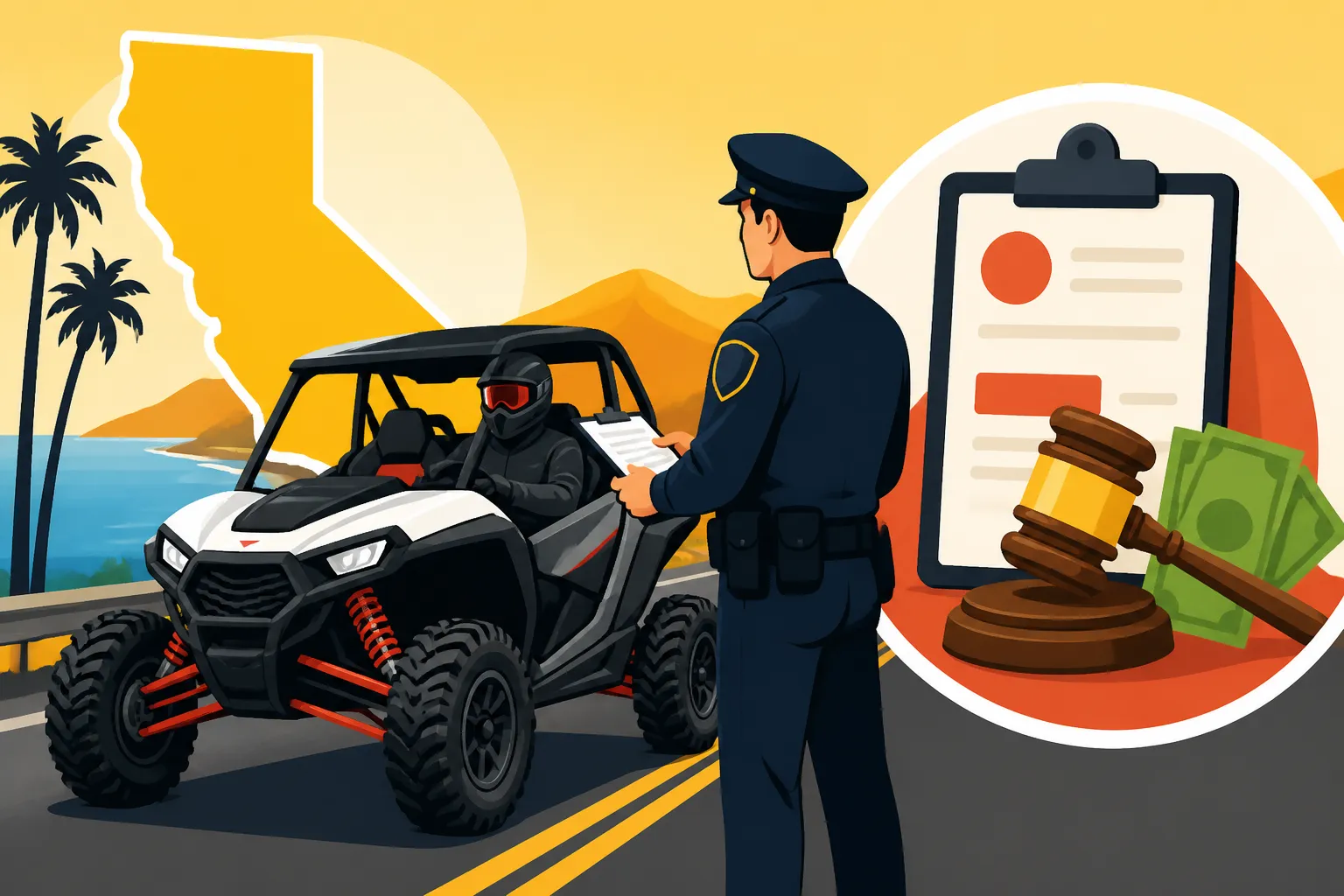
This is perhaps the most common and easily spotted violation. Cruising down a paved state highway, a city street, or even a local residential road on your ATV or UTV, unless it's a specifically designated combined-use segment, is almost always illegal. Law enforcement officers, whether it's local police, county sheriffs, or the California Highway Patrol (CHP), are very aware of these regulations. They see OHVs on paved roads as a safety hazard and a clear violation of vehicle code. The fines for this can be substantial, often starting in the hundreds of dollars, and they can quickly escalate if other violations are tacked on, such as operating an unregistered vehicle or lacking proper safety equipment. It’s a very quick way to incur [California Fines for Riding on a Highway].
Riding on a public street also raises significant insurance questions. Most OHV insurance policies are designed for off-road use and may not cover incidents that occur on public roads. This means that if you're involved in an accident, even a minor one, you could be personally liable for damages and injuries, which could be financially devastating. This lack of appropriate coverage is a huge risk that many riders overlook when they decide to "just quickly" run to the store on their quad.
Navigating Unincorporated County Roads
Ah, the county dirt road – it looks so inviting, so much like a trail! Many riders mistakenly assume that because a county road is unpaved, it's fair game for OHV use. This is a dangerous misconception in California. Unless a specific county board of supervisors has formally designated a particular segment of road for combined use with OHVs, it's still considered a public roadway and off-limits to unregistered off-highway vehicles. [Riding a County Dirt Road in California] requires very specific conditions. These roads are often used by regular passenger vehicles, and the dust, noise, and differing speeds of OHVs can pose serious hazards. Law enforcement in rural areas, particularly county sheriffs, are typically well-versed in these local ordinances and won't hesitate to issue citations.
The fines here are similar to those on paved roads, but what often catches riders off guard is the sheer volume of these roads. You might think you're "out in the middle of nowhere," but if that dirt path is a county-maintained right-of-way, you're on a public road. It's critical to verify the legal status of any unpaved road before you ride on it. Just because it looks like a trail doesn't mean it is legally considered one for OHV purposes.
Forest Service Roads and Designated Routes
National Forests and Bureau of Land Management (BLM) lands offer vast opportunities for OHV riding in California, but even here, the rules for roads can be tricky. Many forest service roads are open to licensed, street-legal vehicles, but not necessarily to OHVs. The key here is to consult Motor Vehicle Use Maps (MVUMs), which clearly designate which roads and trails are open to which types of vehicles. You might find that a scenic dirt road winding through a national forest is designated for full-sized vehicles only, and riding your UTV on it would be a violation. [Riding a Forest Road Legally in California] hinges on understanding these maps.
The good news is that these maps also designate specific "mixed-use" roads or trails where OHVs are permitted, often to connect different sections of a trail system or to allow access to campgrounds. However, these are clearly marked and are the exception, not the rule. Riding an OHV on a non-designated forest service road can still lead to a citation from a Forest Service law enforcement officer, a BLM ranger, or even local sheriffs or CHP. The consequences often include fines and possibly even being escorted out of the area or having your vehicle impounded if you're a repeat offender or operating recklessly.
| Type of Public Road | General OHV Legality | Potential Fines (Approx.) | Additional Penalties | Enforcement Agencies |
|---|---|---|---|---|
| Paved Highways/City Streets | Generally ILLEGAL | $200 – $1,000+ | Vehicle Impound, License Points | CHP, Local Police, Sheriff |
| Unincorporated County Roads | Generally ILLEGAL (unless designated) | $200 – $750+ | Vehicle Impound, License Points | Sheriff, Local Police |
| Forest Service/BLM Roads | ILLEGAL (unless designated on MVUM) | $150 – $500+ | Vehicle Impound, Exclusion | Forest Service, BLM, Sheriff |
| Designated Combined-Use Routes | LEGAL (with specific conditions) | None (if compliant) | N/A | CHP, Local Police, Sheriff |
| Road Crossings | LEGAL (with specific conditions) | None (if compliant) | N/A | CHP, Local Police, Sheriff |
Note: Fines vary widely by jurisdiction and specific circumstances. These figures are illustrative and not exact amounts. Always check current regulations.
Beyond the Fine: Additional Penalties
A monetary fine is just one piece of the puzzle. Getting caught riding your OHV on a public road in California can lead to a cascade of other headaches that can be even more costly and inconvenient than the initial ticket. It's crucial to understand these broader implications.
Vehicle Impoundment and Recovery Costs
One of the most immediate and painful consequences of being cited for riding an OHV illegally on a public road is the potential for your vehicle to be impounded. Law enforcement officers have the discretion to tow and store your ATV or UTV, especially if they deem it unsafe to continue operating, or if you're operating it without proper registration or other required elements. The moment your machine is on the back of a tow truck, the meter starts running. Towing fees alone can be several hundred dollars, often increasing significantly if it's after hours or from a remote location. Then, you'll face daily storage fees at the impound lot, which can quickly add up to hundreds more.
To retrieve your machine, you'll typically need to pay all impound and storage fees in full, present proof of ownership, and potentially even register your vehicle if that was part of the issue. If you're from out of state and just visiting, this can turn your fun trip into a logistical nightmare, requiring you to navigate local impound procedures from afar. It's a huge financial hit and a massive inconvenience that far outweighs the perceived time-saving benefit of riding on a forbidden road.
Points on Your Driver's License and Insurance Impacts
Here's a consequence many OHV riders don't anticipate: illegal road use can lead to points being added to your state driver's license. While OHVs don't require a driver's license for off-road operation (though a safety certificate is often required for younger riders), violations on public roads are often treated as moving violations, just like if you were driving a car. Accumulating points on your license can lead to increased insurance premiums for your car, and too many points can even result in a suspended driver's license. This means your ability to drive your everyday vehicle could be jeopardized by a momentary lapse of judgment on your ATV. [What a California Sheriff Checks Roadside] can have wide-ranging impacts.
Beyond your driver's license, your insurance could also take a hit. Your OHV insurance provider might view these violations negatively, potentially raising your rates or even declining to renew your policy if you become too high-risk. This is why understanding [California OHV Insurance Requirements] is so important, especially when considering even brief periods of on-road operation. The repercussions extend far beyond the trail and into the daily necessities of your life.
Limited Exceptions: Where You CAN Ride Legally (and Safely)
It's not all doom and gloom! While California is strict, there are specific, limited circumstances where OHVs can legally operate on public roads. Understanding these exceptions is key to avoiding fines and ensuring you're riding safely and lawfully. These aren't blanket permissions, but rather highly specific designations you must adhere to precisely.
Combined-Use Highway Segments
California Vehicle Code 38026 allows local jurisdictions – like a city council or county board of supervisors – to designate short segments of public highways for "combined use." This means that under very specific conditions, OHVs can share the road with traditional vehicles. These segments are usually established to connect two otherwise separate off-road trail systems, allow access to a trailhead from a nearby town, or provide a route to gas stations or services. It’s important to note that these are usually quite short, often with a [California's 3-Mile Combined-Use Cap], and are clearly marked with signs indicating OHV access. You won't find yourself cruising for miles down a freeway on a combined-use route.
When riding on these designated routes, OHV operators must still obey all rules of the road that apply to motor vehicles, including speed limits, stop signs, and traffic signals. Your OHV must also be registered with a current green or red sticker and adhere to all other operational requirements, like spark arresters and sound limits. Even with aftermarket accessories that make your UTV look more street-ready, like those from SuperATV, it still must meet these specific operational requirements for combined-use routes. The responsibility is entirely on the rider to know exactly where these segments begin and end and to ensure their machine and their operation are compliant. Always carry your [California OHV Registration Paperwork Checklist] to avoid issues.
Crossing Public Roads
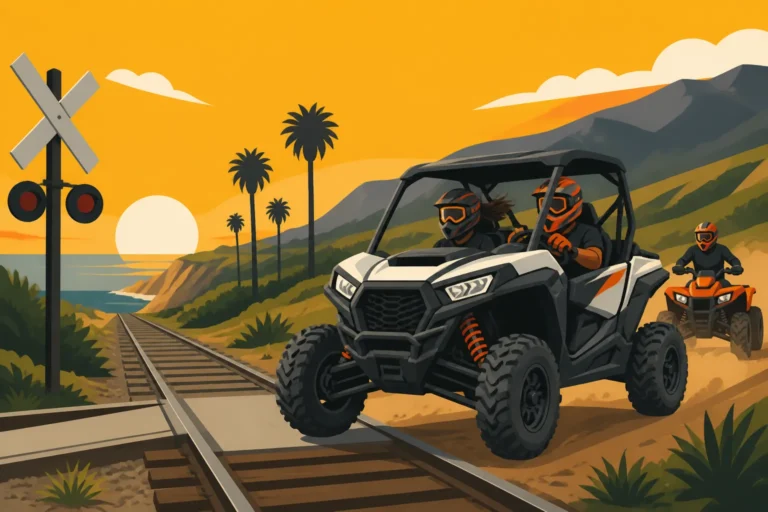
Another critical exception allows OHVs to cross a public road. This is often necessary when an off-road trail system is bisected by a paved highway or county road. The rules for crossing are very specific to minimize danger:
- Right Angles: You must cross the road at approximately a 90-degree angle to the road surface. No diagonal turns or cruising along the shoulder.
- Come to a Complete Stop: Before entering the roadway, you must come to a complete stop.
- Yield to Traffic: You must yield the right-of-way to all traffic on the public road that is close enough to constitute an immediate hazard.
- Quickest Route: You must cross by the most direct route, not lingering on the roadway.
These rules are designed for safety, allowing OHV riders to transit across a road quickly and predictably. Attempting to ride along the shoulder, even for a short distance, or to turn and travel down the road will likely result in a citation. [California Rules for Crossing a Public Road] are very clear, and rangers and officers will be watching. These crossings are often at designated points, but even at undesignated points, the rules for safe crossing still apply.
Avoiding the Trouble: Best Practices for California Riders
The best way to avoid fines and penalties for riding your OHV on public roads in California is to simply not do it, unless you're absolutely certain you're on a legally designated combined-use route or performing a legal crossing. But how do you stay certain? It comes down to preparation, knowledge, and responsible riding habits.
Know Your Maps and Designations
Before you even load up your rig, do your homework. Get the latest maps for the areas you plan to ride. For National Forests and BLM lands, this means looking up and downloading the current Motor Vehicle Use Maps (MVUMs). These maps are your bible for understanding what trails and roads are open to OHVs and what the specific restrictions are. For State Vehicular Recreation Areas (SVRAs), check their websites for official maps and any specific regulations regarding internal paved roads.
Many GPS units and smartphone apps now integrate these maps, making it easier than ever to track your location against legal routes. However, always double-check against official, current sources. A printed map can also be a lifesaver if you lose signal. Don't rely on "I thought this was okay" or "someone told me." When in doubt, assume it's not permitted. It’s far better to spend an extra few minutes reviewing maps than to spend hours dealing with a citation and tow truck. Knowing where to find [California Trail Maps and Where to Get Them] is a critical skill for any rider.
Trailering to the Trailhead
The most foolproof way to avoid illegal road use fines in California is to trailer your ATV or UTV directly to an authorized staging area or trailhead. This completely bypasses any ambiguity about road legality. Load your machine onto a trailer, hook it up to your tow vehicle, and transport it to the designated off-road riding area. Many SVRAs and BLM/Forest Service areas have large parking lots specifically designed for this purpose.
While it might feel like an extra step compared to just riding from your campsite or local lodging, it's the safest and most compliant approach. Not only does it protect you from fines, but it also protects your machine from the wear and tear of pavement riding, for which it wasn't designed. [Trailering Instead of Riding in California] is often the only realistic and legal option for extensive off-road adventures. Invest in a good trailer and secure tie-downs from a reputable brand (perhaps SuperATV offers some robust options!), and make it part of your routine. It's peace of mind that's worth every penny.
Always Carry Required Documents
Even on legal combined-use routes or during a crossing, you should always have your California OHV registration (your Green or Red Sticker paperwork) and any applicable safety certificates readily available. While you don't need a driver's license for off-highway operation, you will if you're cited on a public road, as the violation will likely be tied to it. Many riders carry digital copies on their phone, but a physical copy in a waterproof bag on your machine is highly recommended in case of device failure or lack of signal. Having your paperwork in order can sometimes prevent further complications during an interaction with law enforcement, even if you are being cited for an infraction. It's all about demonstrating responsibility.
Disclaimer
This article is for general informational purposes only and does not constitute professional advice. Laws, prices and regulations vary by location and change over time. Consult a qualified professional for guidance on your specific situation.