California Helmets for Every Age on Public Land
Navigating the dusty trails and wide-open spaces of California on your ATV or UTV is an incredible experience, but it comes with a serious responsibility: keeping yourself and your passengers safe. It's frustrating to keep up with all the rules, especially when you just want to get out and ride, but understanding California's helmet laws isn't just about avoiding a ticket; it's about protecting lives. This guide is here to break down everything you need to know about wearing helmets on public land in California, making sense of the regulations, and helping you ensure everyone in your group is as safe as possible.
The Absolute Imperative of Helmets on California Public Land
When you're out there, whether tearing through the dunes of Glamis or exploring the forest roads of the Sierras, the risks are real. Uneven terrain, sudden obstacles, unexpected rollovers – they're all part of the adventure, but they can also turn dangerous in an instant. This is precisely why California takes helmet safety so seriously for off-highway vehicle (OHV) riders and passengers. It's not just a suggestion; it's a critical piece of your riding gear that can literally be a lifesaver.
The Inherent Dangers of Off-Road Riding
Think about the forces at play when you're riding an ATV or UTV. You're often moving at significant speeds over unpredictable surfaces. A sudden drop-off, a hidden rock, or even another rider's mistake can send you sprawling or cause your machine to flip. These machines are designed for rugged environments, but that ruggedness also means they don't always offer the same passive protection as a street vehicle. There's no airbag to deploy, no crumple zone to absorb impact. Your body, especially your head, is incredibly vulnerable. We've all seen or heard stories of spills that could have been far worse without proper gear, and unfortunately, some that were tragic precisely because a helmet wasn't worn. It’s easy to feel invincible when the sun is out and the engine is humming, but even a low-speed tip-over can result in serious head trauma.
How Helmets Prevent Catastrophic Injuries
A quality helmet is engineered to dissipate impact energy away from your skull. It has multiple layers: a hard outer shell that spreads the force over a wider area, a soft inner liner that crushes to absorb energy, and comfort padding that helps it fit snugly. Without this crucial protection, your head takes the full brunt of any impact. We’re talking about the difference between a concussion and a catastrophic brain injury, or even life and death. Helmets are designed to handle glancing blows, direct impacts, and even abrasive slides across the ground. They protect against lacerations, skull fractures, and the kinds of traumatic brain injuries that can alter a life forever. It's a sobering thought, but it's the reality of off-road riding, and it underscores why that helmet on your head is the single most important piece of safety equipment you own.
Beyond the Law: Prioritizing Your Personal Safety
While the law is certainly a motivator – and nobody wants a ticket – the biggest reason to wear a helmet is for your own well-being and that of your loved ones. Imagine trying to explain to your family why you chose to skip a helmet and ended up with a severe injury. It’s not just about compliance; it's about making a conscious decision to value your health and future. Many veteran riders will tell you that they've had close calls where their helmet took the hit, not their head. They're grateful for that protection, even if they initially begrudged wearing it. It’s about building a safety culture within your riding group, where everyone understands that a helmet is non-negotiable, just like having enough fuel or water. It's an investment in your ability to keep riding for years to come.
California's Universal Helmet Mandate on Public Lands
California has made its stance very clear: if you're riding an ATV or UTV on public land, a helmet is almost always required for everyone, regardless of age. This isn't a complex rule with lots of gray areas; it's a straightforward directive designed to protect all participants in the sport. It can feel like a nuisance to gear up, especially on a hot day, but the intent is pure safety.
The All-Encompassing Requirement for Riders and Passengers
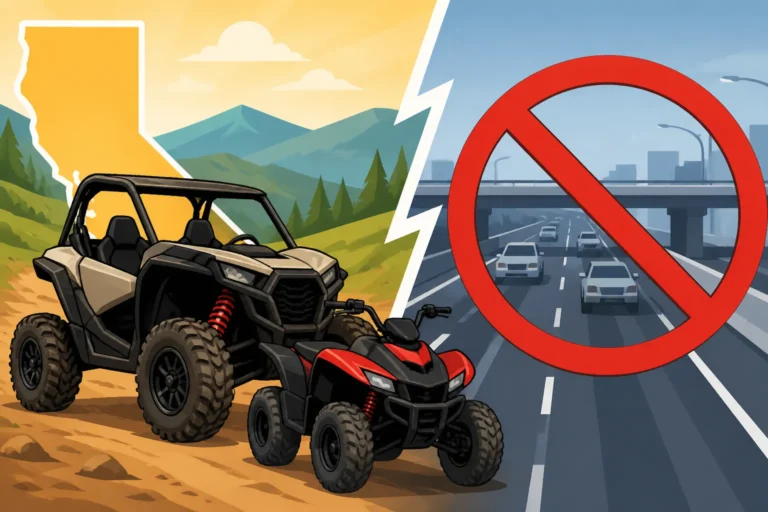
The Golden State’s vehicle code specifies that any person, driver or passenger, riding an OHV on public lands must wear a safety helmet. This includes everyone on ATVs, dirt bikes, side-by-sides, sand rails, and any other type of OHV. There's no "if," "and," or "but" for most machines. You can't say, "Oh, I'm just going slowly," or "We're just going a short distance." If you're on public land, which includes State Vehicular Recreation Areas (SVRAs) like Hungry Valley or Oceano Dunes, National Forests, BLM land, and designated county routes, that helmet needs to be securely fastened on your head. This also means if you're taking your UTV to an area with [California's Combined-Use Highways], you'll still need that helmet whenever you transition from a road designated for highway vehicles only to a public OHV trail.
Age Considerations and Supervision Requirements
California’s helmet law doesn't differentiate by age; it applies to all. However, age does play a crucial role in who can operate an OHV and the level of supervision required. For instance, children under 14 operating an ATV are generally required to be under the direct supervision of a parent or guardian who has an ATV Safety Certificate. Even when there are specific age limits for operating certain machines – like the [California ROV Operator Age Limit] – the helmet rule remains constant for every single person on board. So, if your 12-year-old is riding an age-appropriate quad under your watchful eye, both you and they must be wearing helmets. There are specific requirements for [California Rules for Riders Under 18], and getting an [California ATV Safety Certificate Requirements] is often part of the equation for younger riders.
Where the Helmet Law Applies: Public Land Defined
It's important to understand what "public land" means in the context of this law. It's any land that isn't privately owned and explicitly designated for private use. This includes California's SVRAs, which are purpose-built for OHV recreation. It also covers vast tracts of Bureau of Land Management (BLM) land in the deserts, National Forests, and designated county or forest roads. The moment your tires touch ground that is publicly owned and open for OHV use, the helmet law kicks in. This doesn't apply to your own private property, of course, but for most people, the fun happens on public trails. Even if you're just cruising through a campground in an SVRA, the helmet rule still applies. You can't just throw it on when you hit the "real" trails; it's required the moment you start moving.
The Specific ROHV Helmet Waiver for Adults in California
Now, this is where things get a little nuanced, but it's a key point for many UTV owners. California offers a specific waiver for adults in recreational off-highway vehicles (ROHVs) under certain conditions. It's not a blanket exemption for all UTVs, but rather a carefully defined exception that recognizes the different safety features built into these machines compared to traditional ATVs. This is the [California's ROHV Helmet Waiver for Adults].
Understanding the "Rollover Protection Structure" (ROPS)
The waiver primarily applies to adult occupants (18 years and older) of a Recreational Off-Highway Vehicle (ROHV) that is equipped with a functional rollover protection structure (ROPS) and occupant restraints (seatbelts or harnesses). Think of your modern side-by-side: it has a factory-installed cage designed to protect occupants in a rollover, along with seatbelts. The logic here is that the combination of a robust cage and seatbelts provides a significant level of protection, similar to what you'd find in a street vehicle. If your UTV has these features and you're wearing your seatbelt, adult riders can potentially forgo a helmet. However, it's critical to ensure your ROPS is intact and hasn't been modified in a way that compromises its integrity. Many riders even upgrade their cages for increased safety and rigidity, with aftermarket solutions available from brands like SuperATV that specialize in UTV parts and accessories, ensuring their machine meets or exceeds these protection standards.
The Crucial Role of Seatbelts and Restraints
The ROPS is only effective if you stay within its protective envelope. This is why the occupant restraints – seatbelts or harnesses – are absolutely non-negotiable when utilizing the ROHV helmet waiver. If you're an adult in a UTV with a ROPS, but you choose not to wear your seatbelt, then the waiver doesn't apply, and you must wear a helmet. The seatbelt keeps you securely inside the cage during a tip-over or accident, preventing you from being ejected or from hitting your head on the cage itself or the ground. It’s a complete system: the cage protects the space, and the seatbelt keeps you in that space. Ignoring one element compromises the entire safety principle behind the waiver. You can learn more about [California Seat Belt Rules in a UTV] to fully understand these requirements.
Side-by-Sides vs. ATVs: Why the Distinction?
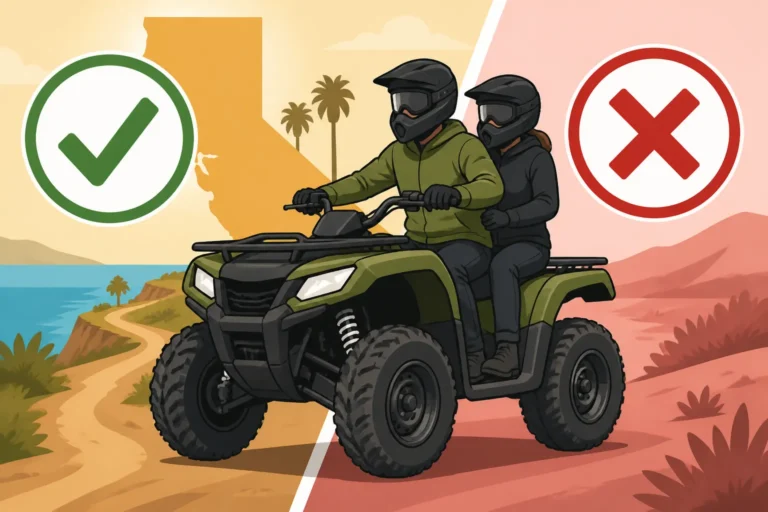
This waiver is specifically for ROHVs (which primarily means side-by-sides/UTVs) and not for traditional ATVs. Why the distinction? ATVs, by design, are rider-active machines. You shift your weight, lean into turns, and use your body to control the machine. They don't have a ROPS or seatbelts, and therefore offer no inherent rollover protection beyond the rider's own skill and protective gear. Side-by-sides, on the other hand, are designed with occupants sitting side-by-side, typically with steering wheels and foot pedals, and crucially, they have that factory-installed or aftermarket ROPS and seatbelts. This fundamental difference in design and built-in safety features is what allows for the adult helmet waiver on ROHVs, while ATVs always require a helmet for every rider and passenger, regardless of age. So, for those riding a traditional ATV, the [California Helmet Law for ATV Riders] is always in full effect.
Choosing the Right Helmet for California Riding
Just having any helmet isn't enough; you need the right helmet. It’s an investment, but one that pays dividends in safety and peace of mind. There's a lot of marketing out there, but focusing on certified safety standards and proper fit is paramount.
Understanding DOT, Snell, and ECE Certifications
When you're shopping for a helmet, you'll see various certifications. The most common in the US is DOT (Department of Transportation). This is the minimum legal standard for helmets in California and across the country. A DOT-certified helmet means it meets certain federal safety requirements. Beyond DOT, you'll often see Snell certification. Snell is a private, non-profit organization that sets much higher and more stringent testing standards than DOT. A Snell-certified helmet offers an even greater level of protection. Finally, ECE (Economic Commission for Europe) is a widely recognized international standard, often considered comparable to, or even exceeding, Snell in some aspects. For maximum protection, look for helmets with Snell or ECE certification in addition to DOT. While these standards don't specify a helmet for every application, they indicate a high level of impact protection.
Full-Face vs. Open-Face Considerations for OHVs
For off-road riding, a full-face helmet is almost always the superior choice. It offers comprehensive protection for your entire head, including your chin and jaw, which are incredibly vulnerable in a crash or rollover. Flying debris, roost from other riders, and impacts from branches are also thwarted by a full-face design. While some street riders might opt for open-face helmets, they are generally not recommended for OHV use due to the unique risks of off-road terrain. The dust, the dirt, the unexpected branch – all of these can cause significant facial injury if unprotected. A full-face helmet, combined with goggles, provides the best defense against both impact and environmental hazards.
The Critical Importance of Proper Fit and Maintenance
A helmet can only protect you if it fits correctly. A helmet that's too loose will shift on impact, potentially exposing your head or even coming off. One that's too tight will be uncomfortable and distracting. When trying on a helmet, it should feel snug all around your head, with no pressure points. Your cheeks should feel a slight squeeze, and when you try to move it side-to-side or up-and-down, your scalp should move with it. If it slides independently, it's too big. Also, check the chin strap – it should be secure, allowing only enough room for one finger to fit snugly underneath.
Just like any other piece of gear, helmets require maintenance. Inspect your helmet regularly for cracks in the shell, fraying straps, or compressed liner material. If a helmet has sustained a significant impact (even if it looks fine on the outside), it should be replaced immediately, as the internal protective layers may be compromised. Most helmet manufacturers also recommend replacing helmets every five to seven years, regardless of crashes, as materials can degrade over time.
| Certification | Description | Safety Level | Typical Use |
|---|---|---|---|
| DOT | US Department of Transportation minimum standard, required for legal road use in the US (and for OHV in CA). Focuses on impact absorption. | Basic | Street, Off-Road (minimum legal in CA) |
| Snell | Private foundation with more rigorous testing protocols, including multiple impacts and wider impact zones. Higher safety margin. | Advanced | Motorsports, Racing, Higher-End Street & Off-Road |
| ECE | European Economic Community standard, internationally recognized. Tests for impact absorption, penetration, and peripheral vision. | Advanced | Global Standard, Racing, Higher-End Street & Off-Road |
Helmets for Kids: Sizing and Specific Needs
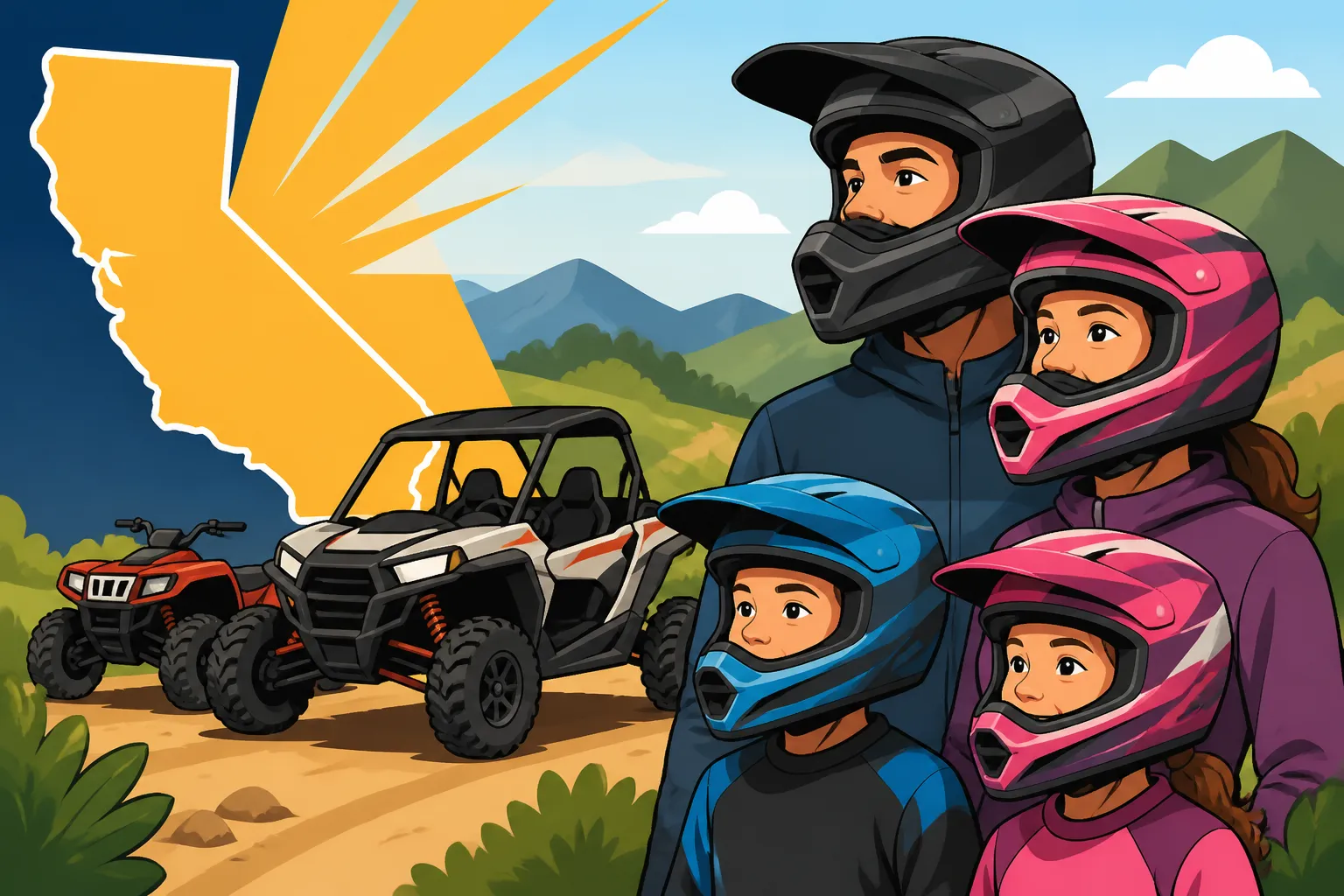
Protecting our youngest riders is paramount, and this means getting them properly fitted with their own helmets. Never put a child in an adult helmet that's too big, or one that's hand-me-down and potentially compromised. Kids' helmets are designed for smaller heads and often lighter necks, ensuring a proper fit and distribution of weight. Follow the same fit guidelines as for adults: snug, no independent movement, and a secure chin strap. It's also a good idea to involve your child in the selection process (within reason!) to encourage ownership and willingness to wear it. Many rental shops in places like Oceano Dunes, such as Steve's ATV Rentals or Arnie's ATV Rentals, will include helmets in their rental packages and ensure proper sizing for all riders, including children. For more specific details on [California Helmet Law for UTV Passengers] or [California Minimum Age to Ride on Public Land], these are excellent resources to consult.
The Consequences of Ignoring California's Helmet Law
It's easy to dismiss a law as just another bureaucratic hurdle, but ignoring California's helmet mandate can have serious repercussions, far beyond just a simple fine. From roadside citations to devastating personal injury, the risks are simply not worth it. The authorities, from California Highway Patrol (CHP) to rangers in SVRAs and National Forests, are vigilant about enforcing these rules, especially in popular riding areas.
Fines and Citations from Law Enforcement
If you're caught riding on California public land without a helmet, and you don't qualify for the ROHV waiver, you're looking at a citation. A ranger or an officer can pull you over, issue a ticket, and potentially even prevent you from continuing your ride until you comply. These fines aren't insignificant, and they can quickly add up, especially if you have multiple unprotected riders in your group. It’s a sure way to spoil a fun day out. Imagine driving all the way to Ocotillo Wells or the Imperial Sand Dunes, only to be turned back or fined at the gate because someone in your party isn't wearing the required safety gear. It's frustrating, costly, and entirely avoidable.
Accident Liability and Insurance Implications
Beyond the immediate fine, riding without a helmet can have far-reaching consequences in the event of an accident. If you're involved in a crash and weren't wearing a helmet, even if another party was at fault, your injuries could be more severe. This could significantly impact any personal injury claims you might make, as insurance companies or courts might argue that your injuries were exacerbated by your failure to wear protective gear. This is often referred to as comparative negligence, where your own actions contribute to your damages. It could mean a reduced settlement or even a complete denial of medical claims related to head injuries. Even for those with excellent [California OHV Insurance Requirements], failing to comply with basic safety laws can complicate payouts significantly. It’s a gamble that puts your financial future, and your health, at stake.
The Long-Term Impact on Yourself and Your Family
This is the most critical consequence of all. While fines and legal battles are serious, nothing compares to the potential for life-altering injury. A severe traumatic brain injury can lead to permanent cognitive impairment, physical disability, and a drastically reduced quality of life. The impact extends far beyond the individual, affecting family members who may become caregivers, facing immense emotional and financial strain. It means missing out on future rides, family events, and the simple joys of life. While we all crave the freedom that off-roading offers, that freedom should never come at the cost of your health or the peace of mind of your loved ones. Wearing a helmet is a small act that offers monumental protection, ensuring you can return home safely to ride another day.
Ensuring Children are Safely Protected on California Trails
California has a profound commitment to protecting young riders, and this is reflected strongly in its helmet laws and other safety regulations. If you're bringing children along for the ride, whether they're driving or just passengers, their safety must be your absolute top priority. It's not just about what the law says; it's about safeguarding the future of our sport and, more importantly, the children themselves.
California's Minimum Age to Ride and Helmet Rules
While the helmet law is universal, California also has specific age restrictions and supervision rules for operating OHVs. For example, children under 14 years old are generally prohibited from operating an ATV on public lands unless they are under the direct supervision of an adult who possesses an approved ATV Safety Certificate. Even for side-by-sides, there are rules regarding [California Rules for Riders Aged 14 to 18] and minimum operator ages. Regardless of age or the specific machine, every child, without exception, must wear an approved safety helmet when riding an OHV on public land. There is no ROHV waiver for minors, even in a UTV with a full cage and seatbelts. This means if you have a child riding shotgun in your side-by-side, they absolutely need a helmet securely fastened. You can find more details in the guidelines for [California ATV Passenger Ban Explained] for certain machines, which highlights the state's emphasis on youth safety.
Supervision Requirements and Certified Adults
For younger riders, particularly those under 14 on ATVs, the law mandates direct supervision by a certified adult. This means the supervising adult must be within eyesight and capable of immediately intervening if necessary. This isn't just a recommendation; it's a legal requirement designed to prevent accidents involving inexperienced youth riders. This supervising adult is also responsible for ensuring the child is properly geared up, which always includes a helmet. Many parents take a [California ATV Safety Course] themselves not just for the certificate, but to be better informed and model safe riding practices for their children. It’s about creating a safe learning environment where kids can develop skills responsibly.
Appropriate Gear and Helmet Sizing for Young Riders
As mentioned earlier, getting the right size helmet for a child is crucial. A helmet that's too large can provide little to no protection in an impact. When purchasing gear, ensure that helmets, goggles, and any other protective wear are specifically designed for children and fit them properly. Just like adults, kids need DOT-compliant (or better, Snell/ECE) helmets. Don't fall into the trap of buying a helmet they'll "grow into." Their safety today is what matters most. Alongside a properly fitted helmet, children should wear eye protection, gloves, long pants, a long-sleeved shirt, and sturdy over-the-ankle boots. This complete ensemble of protective gear, with the helmet as its centerpiece, significantly reduces the risk of injury, allowing children to enjoy the thrill of off-roading in the safest possible manner.
Disclaimer
This article is for general informational purposes only and does not constitute professional advice. Laws, prices and regulations vary by location and change over time. Consult a qualified professional for guidance on your specific situation.