Why a Stock UTV Cannot Be Plated in California
It’s a scene played out countless times across California: you're planning an epic weekend trip to Glamis or Ocotillo Wells, loading up your shiny UTV, and a thought pops into your head. "Why can't I just slap a license plate on this thing and drive it on the street?" You see street-legal UTVs in other states, or perhaps you've even spotted a golf cart zipping down a local street, and the frustration bubbles over. This guide is here to unravel that mystery and explain precisely why, despite their growing popularity and versatility, a stock UTV simply cannot be plated for street use in California.
The Foundational Divide: Why UTVs Aren't Built for California Roads
Let's get right to the heart of the matter: a UTV, or Utility Terrain Vehicle, is fundamentally designed and classified as an Off-Highway Vehicle (OHV) in California. This isn't just a label; it's a deep-seated distinction rooted in how these machines are manufactured, regulated, and ultimately intended for use. They are incredible machines, capable of tackling challenging terrain and carrying gear, but that very capability for the trail makes them unsuitable for the public highway system.
Purpose-Built for Off-Highway Adventures
Think about where you ride your UTV: the vast dunes of the Imperial Sand Dunes Recreation Area, the rocky trails of Johnson Valley, or the winding paths of Hungry Valley. These environments demand specific engineering: robust suspension to absorb brutal impacts, high ground clearance to clear obstacles, knobby tires for traction on loose surfaces, and often a narrow profile to navigate tight trails. A UTV's design prioritizes these off-road performance characteristics over the safety and compliance features required for on-road operation. Its very DNA is built for dirt, not asphalt.
This purpose-built design impacts everything from the chassis to the engine. Manufacturers like Polaris, Can-Am, and Kawasaki engineer their UTVs to excel in demanding off-road conditions, which often means they omit components that would add unnecessary weight or complexity for trail use, but are absolutely critical for street legality. Things like turn signals, rearview mirrors, proper headlights and taillights, and even windshield wipers might be present in a basic form, but they aren't necessarily designed to meet the rigorous standards for highway operation.
The Lack of Federal Motor Vehicle Safety Standard Certification
This is perhaps the biggest and most foundational reason a UTV cannot be plated for California roads: it simply does not meet the Federal Motor Vehicle Safety Standards (FMVSS). These are a comprehensive set of regulations established by the National Highway Traffic Safety Administration (NHTSA) that all vehicles sold and operated on public roads in the United States must comply with. Cars, trucks, motorcycles – they all have to pass these stringent tests to be deemed safe for highway use.
UTVs, by their very definition as off-highway vehicles, are exempt from these FMVSS requirements. This exemption allows manufacturers to build specialized machines without the immense cost and design constraints associated with street-legal vehicle certification. If a manufacturer were to attempt to build a UTV that met all FMVSS, it would likely bear little resemblance to the nimble, powerful machines we know and love for the trails, and its cost would skyrocket. This difference is key to understanding [Why a Stock UTV Cannot Be Plated in California].
Unpacking the Federal Motor Vehicle Safety Standards FMVSS Gap
The FMVSS are not just a few simple checkboxes; they are an exhaustive list covering everything from occupant protection to lighting and braking systems. The fact that UTVs are exempt from these means they inherently lack many features deemed critical for safe operation alongside cars and trucks.
Key Components Not Meeting Road Standards
Let's consider some specific examples of components where UTVs typically fall short of FMVSS requirements for street vehicles:
- Lighting and Signaling: While UTVs have headlights and taillights, they often don't meet the brightness, aim, or visibility standards for highway use. Turn signals might be too small, too dim, or simply non-existent on basic models. Side marker lights, reflectors, and proper license plate illumination are also often missing or inadequate.
- Braking Systems: UTV brakes are designed for off-road speeds and conditions, not the demanding stopping power required for highway emergencies or sustained high-speed travel. They may not have ABS (Anti-lock Braking System) or other advanced braking technologies common in street vehicles.
- Windshields and Wipers: A UTV's windshield, if it has one, might be made of polycarbonate, which is durable for off-road impacts but not typically certified as safety glass required for street vehicles. Wipers and defrosters, if present, are often rudimentary and not designed for clear visibility in all weather conditions on a highway.
- Mirrors: Side mirrors and rearview mirrors on UTVs are often smaller, less robust, or positioned differently than those required for clear, expansive visibility on public roads.
These are just a few examples. Each of these components, individually and collectively, plays a vital role in ensuring a vehicle can safely navigate the complex environment of public roads, something a UTV simply isn't engineered to do.
Crashworthiness, Airbags, and Structural Integrity
Beyond individual components, the core structural design of a UTV is not built for crashworthiness in the same way a passenger car is. Street-legal vehicles undergo extensive crash testing to ensure occupant safety in various collision scenarios, including frontal, side, and rear impacts, as well as rollovers. This includes crumple zones designed to absorb impact energy, sophisticated airbag systems, and reinforced passenger compartments.
UTVs, on the other hand, are primarily designed with rollover protection structures (ROPS) or similar roll cages to protect occupants during off-road rollovers, which are very different from high-speed highway collisions. They generally lack airbags, sophisticated seatbelt pretensioners, or the extensive structural engineering required to withstand impacts with heavier, faster-moving street vehicles. Trying to modify a UTV to meet these standards would be akin to rebuilding the entire vehicle from the ground up, effectively turning it into a different type of machine altogether. Companies like SuperATV create fantastic aftermarket cages and protection, but these are for enhanced off-road safety and durability, not for converting the UTV to FMVSS compliance.
California's Unique Emissions and Regulatory Landscape
Even if a UTV somehow met all the FMVSS requirements (which it doesn't), California has an additional layer of regulation that makes street legality virtually impossible for these machines: its stringent emissions standards. The California Air Resources Board (CARB) has some of the toughest air quality regulations in the nation, and their requirements for off-highway vehicles are distinctly different from those for on-road vehicles.
Distinct CARB Requirements for Off-Highway Vehicles
CARB classifies OHVs separately from street-legal vehicles, with their own set of emissions certification processes. This is why you see the Green, Red, or Tan sticker system in California. [What CARB Compliance Means in California] for OHVs ensures that machines sold for off-road use meet certain pollutant limits, but these limits are generally less restrictive than those for vehicles intended for everyday highway travel. The testing cycles, pollutant thresholds, and evaporative emissions requirements differ significantly.
An engine certified for off-highway use might produce more pollutants than an equivalent engine certified for on-road use. This is not to say UTVs are "dirty" machines, but rather that the regulatory framework acknowledges their specialized use case and the less frequent, often seasonal, nature of their operation. Trying to force an OHV-certified engine to meet on-road vehicle emissions standards would require substantial and costly modifications, if it's even technically feasible, and would necessitate a completely new certification process.
The Unbridgeable Chasm of Street Legal Emissions
To be truly street-legal and plated in California, a vehicle's engine and entire emissions system must be certified as meeting the state's on-road vehicle standards. This means passing tests for tailpipe emissions, evaporative emissions, and demonstrating long-term durability of emissions control components. For a UTV, this would involve a complete re-engineering of its powertrain and exhaust system, something manufacturers simply don't do for an off-highway product.
The cost and complexity of bringing an existing UTV platform into compliance with California's on-road emissions standards would be astronomical, far outweighing any potential market benefit. Therefore, manufacturers focus on meeting the OHV emissions requirements, which are challenging enough, and do not pursue on-road certification for these vehicles. This fundamental difference in emissions classification creates an almost insurmountable barrier for UTVs seeking street plates in California.
Navigating the California Vehicle Code: OHVs on Public Roads
Beyond federal safety and state emissions, the California Vehicle Code (CVC) explicitly defines and regulates how Off-Highway Vehicles interact with public roads. Understanding these definitions is crucial to grasping why a UTV cannot be plated for regular street use.
The Strict Definition of a "Highway"
In California, the term "highway" in the CVC is much broader than you might think. It doesn't just mean a freeway or a major interstate; it refers to any publicly maintained way open to the use of the public for purposes of vehicular travel, including streets, roads, and even paved or unpaved county roads. This means that if it's a public thoroughfare, it falls under the "highway" definition, and OHVs are generally prohibited from operating on them. [Why California Will Not Convert a UTV] into a street-legal vehicle stems directly from these foundational definitions.
The CVC clearly delineates OHVs from street-legal vehicles, requiring that OHVs display an identification plate (the green, red, or tan sticker, often accompanied by a small metal plate) rather than a traditional license plate. This OHV identification system is for off-road tracking and revenue for OHV parks, not for street-legal permission. It's why [Why a California OHV Plate Is Not a License Plate] is a common point of confusion for new owners.
Understanding Limited Combined-Use Exceptions
Now, you might have heard about "combined-use highways" or "crossing the road" and wondered if these are loopholes. Unfortunately, they are extremely limited exceptions that do not make a UTV street legal.
- Crossing the Road: The CVC allows for specific, limited circumstances where an OHV can cross a public roadway at an angle, safely and quickly, to continue on another trail. This is not "driving on the road" but a brief, direct traversal.
- Combined-Use Highways: These are very specific, designated segments of public roads, usually in rural areas near OHV riding parks like the Inyo National Forest, where an OHV may legally operate for a short distance to connect two trails or access a staging area. These segments are few and far between, precisely designated by local authorities, and often come with strict rules regarding speed, time of day, and display of [California OHV Registration for a UTV]. Crucially, they are never more than [California's 3-Mile Combined-Use Cap]. This is a far cry from being able to drive your UTV to the grocery store or commute to work. You'll often see signs indicating where these segments begin and end, acting as clear boundaries for OHV use.
These exceptions are designed to provide practical access to OHV areas, not to confer general street legality. Attempting to use these exceptions as justification for driving a UTV on undesignated public roads will almost certainly result in a citation from law enforcement, who are well-versed in the distinctions. [California Fines for Riding on a Highway] can be substantial, making it a costly mistake to assume your UTV is street legal beyond designated areas.
The Limits of Modification and Out-of-State Registrations
The desire to make a UTV street legal in California is strong, leading many owners to consider aftermarket modifications or look at how other states handle registrations. However, it's important to understand why these avenues almost always lead to disappointment in the Golden State.
| Feature | Standard Street-Legal Vehicle (California) | Off-Highway Vehicle (UTV) |
|---|---|---|
| Federal Standards | Must meet FMVSS | Exempt from FMVSS |
| Emissions (CARB) | On-road certified (e.g., car, truck) | Off-highway certified (Green, Red, Tan sticker) |
| Registration | Vehicle license plate | OHV ID plate/sticker |
| Insurance | Mandatory liability insurance | Often not mandatory for OHV use alone |
| Safety Glass | Required for windshields | Polycarbonate/no windshield common |
| Brakes | FMVSS-compliant, ABS common | Off-road specific |
| Lighting | FMVSS-compliant headlights, signals, etc. | Basic off-road lighting |
| Airbags | Common, FMVSS-mandated | Not present |
| Design Intent | Public road travel | Off-road recreation |
Aftermarket Parts Don't Change Fundamental Classification
You might see a thriving aftermarket industry for UTVs, offering everything from turn signal kits and DOT-approved tires to windshields and rearview mirrors. It's true that companies like SuperATV produce high-quality accessories that improve a UTV's functionality and safety for off-road use. However, bolting on these parts, no matter how many you add, does not change the UTV's fundamental classification as an OHV in California.
The core issue isn't just having the right components; it's about the vehicle being certified by the manufacturer as meeting all federal and state standards for on-road use from the factory. An aftermarket turn signal kit doesn't magically confer FMVSS crashworthiness or CARB on-road emissions certification upon a UTV that was never designed for it. Law enforcement in California will still view a modified UTV as an OHV, and operating it on public roads (outside of the extremely limited combined-use exceptions) will still result in a citation. While your UTV might look more "street-ready" with a full windshield and turn signals, its underlying legal status remains unchanged.
Why Other States' Rules Don't Apply in California
Another common source of confusion is the existence of "street-legal UTVs" in other states. It's true that some states, often with less dense populations or different regulatory philosophies, allow UTVs to be registered and operated on public roads, sometimes with minimal modifications. However, California does not recognize these out-of-state registrations as granting street legality within its borders.
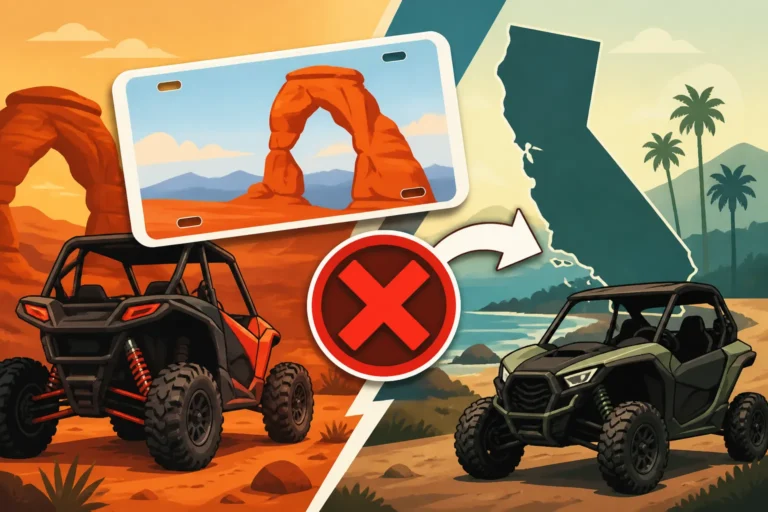
If you bring a UTV from Arizona or Utah, for example, that has a street-legal license plate in its home state, California law enforcement will still apply California Vehicle Code. Your out-of-state plate might allow you to legally transport the UTV on a trailer into California, but it will not permit you to drive it on a public road here. The reason is simple: California has determined that the inherent design of these vehicles, their lack of FMVSS compliance, and their emissions profile make them unsuitable for its highway system. Stories of riders receiving tickets for operating [An Arizona Street-Legal UTV in California] or [Why a Utah-Plated RZR Gets a Ticket in California] are unfortunately common, serving as a stark reminder that California's rules stand firm, regardless of where your machine was registered previously.
The bottom line is that while the idea of a street-legal UTV is appealing for its convenience and versatility, California's comprehensive regulatory framework—spanning federal safety standards, state emissions laws, and the California Vehicle Code—creates an insurmountable barrier for stock UTVs. For an OHV to truly be street legal in California, it would need to be designed and certified by the manufacturer from the ground up to meet all these requirements, which would fundamentally change what a UTV is and how much it costs. For now, enjoy your UTV where it's meant to be: off-highway, on the incredible trails and dunes California has to offer.
Disclaimer
This article is for general informational purposes only and does not constitute professional advice. Laws, prices and regulations vary by location and change over time. Consult a qualified professional for guidance on your specific situation.