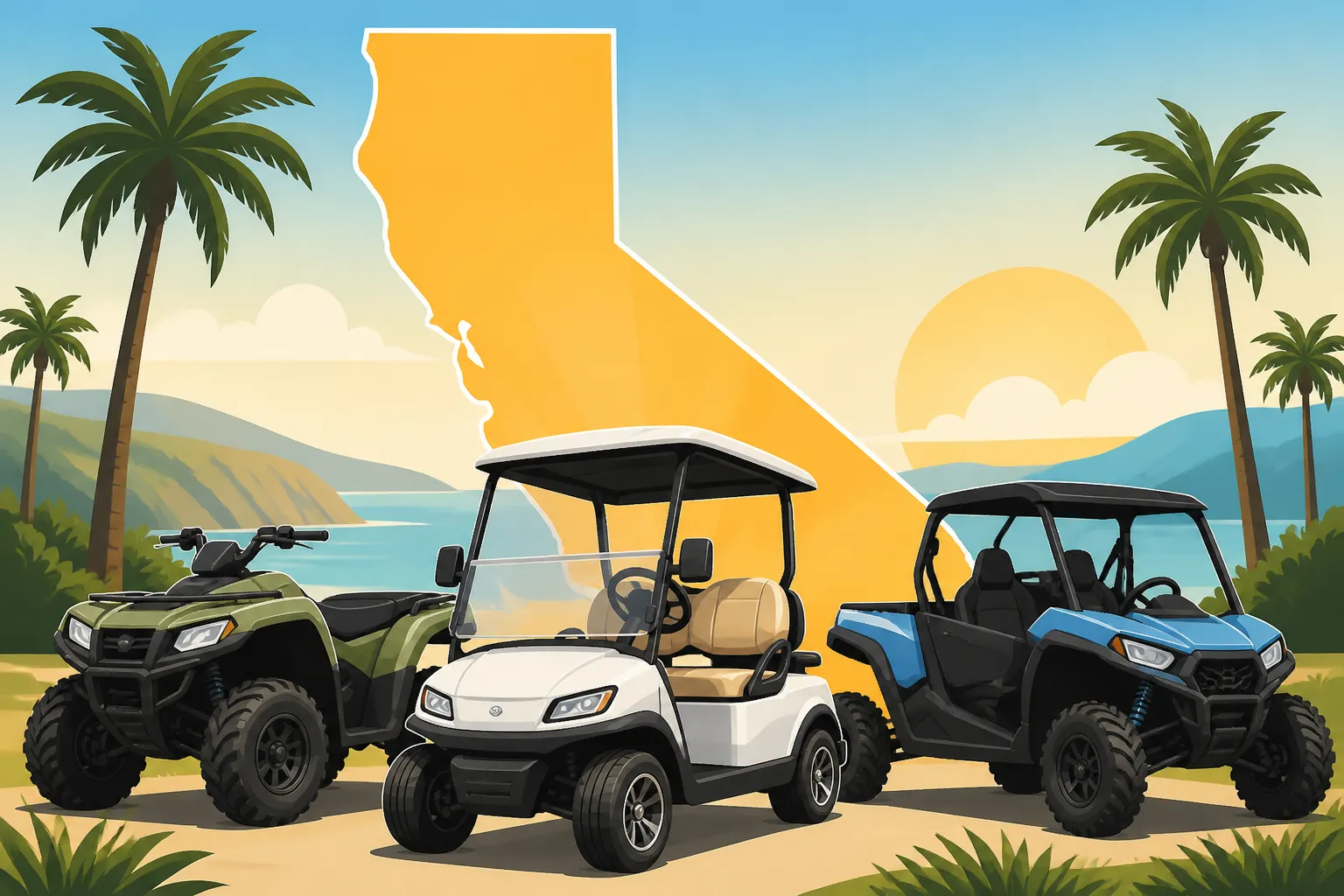
Golf Carts and NEVs in California
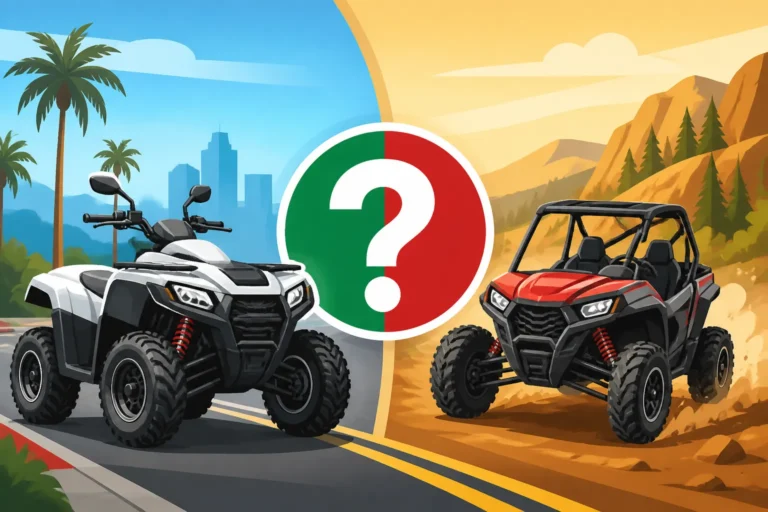
It's incredibly frustrating, isn't it? You're out enjoying California's incredible off-road trails in your ATV or UTV, and then you see someone casually cruising down a paved road in what looks like a tricked-out golf cart or a compact electric vehicle. Immediately, the question pops into your head: "Why can't my machine do that?" You've invested in your rig, maybe added some upgrades, and it feels perfectly capable. This guide will cut through the confusion and explain the distinct legal categories in California that determine which low-speed vehicles can use public roads and why your powerful off-highway vehicle typically can't.
Understanding the Landscape of "Street Legal" in California
California's vehicle laws can feel like a labyrinth, especially when you start looking at the nuances of what's allowed on public roads versus what's strictly for off-highway use. It's a common point of contention and confusion for many ATV and UTV owners who simply want to understand the logic behind the rules.
The Fundamental Difference: OHV vs. Street-Legal Vehicle
Let's start with the core distinction that causes so much head-scratching. Your ATV or UTV, by its very design and original manufacturer's intent, is categorized as an Off-Highway Vehicle (OHV). This means it's built for rough terrain, mud, sand, and trails – environments where a typical street vehicle wouldn't last five minutes. They have robust suspensions, powerful engines, and tires designed for traction in loose conditions, not smooth asphalt.
The moment you roll out of your driveway onto a public road, you enter a completely different legal realm. Street-legal vehicles, whether they're cars, trucks, motorcycles, or even those seemingly simple golf carts and NEVs, are built to meet specific federal and state safety and emissions standards. These standards dictate everything from headlights and turn signals to crashworthiness, braking systems, and even the type of glass in the windshield. The frustration many OHV owners feel stems from seeing what appears to be a less robust, slower vehicle on the road while their capable machine is restricted. It seems unfair, but the law isn't based on perceived capability, but rather on explicit design and certification.
The Legal Framework: California Vehicle Code (CVC) Sections
The California Vehicle Code (CVC) is the rulebook that governs all vehicles operating within the state. It meticulously defines various vehicle types and their permissible uses. OHVs, for example, are primarily governed by sections related to off-highway operations, registration with the OHMVR Division, and specific equipment requirements for trail riding, such as spark arresters and sound limits.
Street-legal vehicles, on the other hand, fall under sections that cover everything from registration with the DMV, insurance requirements, emissions testing (for most), and a long list of safety features. The problem isn't that your UTV isn't "safe enough" in your eyes; it's that it simply doesn't meet the specific, often federally mandated, design and certification criteria to be classified as a motor vehicle for highway use. There isn't a simple form you can fill out or a modification kit you can buy to bridge this gap for a purpose-built OHV. The difference isn't just about a decal; it's about fundamental vehicle classification and regulatory pathways established in the CVC.
What Exactly is a Golf Cart in California's Eyes?
When you spot a golf cart cruising down a local street, it might seem to defy the logic that keeps your UTV off the pavement. But California's Vehicle Code has very specific definitions and allowances for these specialized vehicles.
Defining a Golf Cart by the CVC
According to the California Vehicle Code, a "golf cart" is a motor vehicle having not less than three wheels, designed to transport persons and equipment for playing golf in an area designated as a golf course. More importantly, it must have a maximum speed of 15 miles per hour. These aren't machines built for speed or conquering rugged terrain; they're designed for a very specific, low-impact purpose.
Think about a typical golf cart: it’s almost always electric, small, relatively lightweight, and has minimal safety features compared to a traditional car. It has a light frame, basic lighting, and usually no doors or sophisticated suspension. These inherent limitations are precisely what allows them to operate under a different set of rules. They're not seen as a threat to the general flow of traffic or as requiring the same level of crash protection as a full-size vehicle. Their design clearly signals their limited function, making them distinct from the powerful off-road machines we ride.
Where Golf Carts Can Legally Go (and Not Go)
The primary allowance for golf carts on public roads centers around very specific conditions. Generally, a golf cart can be operated on a street, highway, or public parking facility that has been "designated" for golf cart use by a local authority (like a city council or county board of supervisors). These designations are usually found around golf courses, planned communities, or resort areas where low-speed, short-distance transportation is common.
A key provision allows golf carts to be operated on a street or highway that has a posted speed limit of 25 miles per hour or less, if the operation is within one mile of a golf course. This "one-mile radius" rule is what often allows golfers to drive their carts from their homes to the course. However, they cannot simply drive on any public road they choose. They are typically prohibited from crossing or riding on state highways, freeways, or roads with higher speed limits. The intent is clear: golf carts are for local, low-speed transit in very specific, designated areas, not for general road use.
Local Ordinances and Golf Cart Routes
This is where things get really localized and interesting. While the state CVC provides the overarching framework, individual cities and counties have the power to create local ordinances that designate specific streets or portions of streets for golf cart operation. This means that what's legal in one town might not be in the next, even if they're geographically close.
A prime example is Palm Desert, California, which has extensively integrated golf cart lanes into its urban planning. [Palm Desert's Golf Cart Lanes] Here, you'll find entire networks of designated routes, clearly marked, that allow residents to move freely between neighborhoods, shopping centers, and golf courses using their carts. These are not informal understandings; they are official city designations, often accompanied by specific signage and road markings. For a local government to designate these routes, they must typically conduct traffic studies, evaluate safety, and get approval from relevant state agencies if the road impacts state-controlled routes. The goal is to provide a safe, alternative transportation option that reduces reliance on traditional vehicles for short trips, benefiting both residents and the environment. This is a far cry from an OHV simply wanting to drive down a highway.
Decoding Neighborhood Electric Vehicles (NEVs) and Low-Speed Vehicles (LSVs)
Beyond golf carts, there's another category of low-speed vehicles that often gets mistaken for street-legal UTVs or causes confusion when seen on public roads: Neighborhood Electric Vehicles, or NEVs, also sometimes referred to as Low-Speed Vehicles (LSVs). While they might look more substantial than a golf cart, they still operate under very specific, strict limitations.
What Sets an NEV/LSV Apart from a Golf Cart?
NEVs and LSVs are distinct from golf carts primarily in their design and performance capabilities. While both are low-speed, NEVs are typically more robust, often resembling miniature cars, trucks, or utility vehicles. They are almost always electric and are designed to meet federal safety standards for low-speed vehicles, which are more stringent than those for golf carts.
Key requirements for an NEV/LSV to be street-legal include: a 17-digit VIN (Vehicle Identification Number), headlamps, stop lamps, turn signals, taillamps, reflex reflectors, a rearview mirror (or mirrors), a parking brake, a windshield, seat belts, and a vehicle identification number. They must also meet specific standards for braking systems and impact protection. Crucially, they have a maximum speed of 25 miles per hour. This speed limit is a defining characteristic; if it can go faster, it's generally not an NEV. While a UTV, especially one from a brand like SuperATV that offers numerous accessories, can be equipped with turn signals and mirrors, it doesn't fundamentally change its classification or grant it a VIN that designates it as an NEV. [California Low-Speed Vehicle Registration]
Where NEVs Are Permitted to Drive
The rules for NEVs are also quite specific. In California, an NEV can be operated on a public street or highway where the posted speed limit is 35 miles per hour or less. This is a crucial distinction from golf carts, which are generally restricted to 25 mph or less and specific designated routes. An NEV can use roads where the speed limit is 30 or 35 mph, but it absolutely cannot be driven on roads with higher speed limits, such as freeways, expressways, or major arteries where traffic typically moves faster than 35 mph.
The idea behind NEVs is to provide a practical, environmentally friendly option for short-distance travel within communities, allowing them to access local shops, schools, or parks without needing a full-size car. However, they are not intended for long-distance travel or high-speed environments. Owners must also register their NEVs with the California DMV, just like any other street-legal vehicle, and they often require insurance. Without this proper registration and adherence to the speed limit rules, an NEV is just as illegal on a main road as an unregistered OHV.
Examples of NEV-Friendly Communities and Regulations
Just like with golf carts, many California communities have embraced NEVs as part of their local transportation strategy. These are often planned communities or cities that have proactively created ordinances to integrate NEVs into their street networks. For instance, the City of Lincoln in Placer County has developed a comprehensive Neighborhood Electric Vehicle Master Plan. [Inside the City of Lincoln's NEV Master Plan] This plan outlines specific streets and routes where NEVs are permitted, often connecting residential areas to commercial districts, parks, and other amenities.
These local plans are vital because they provide clarity and structure for NEV use, ensuring safety for both NEV operators and other motorists. They typically involve detailed studies of traffic patterns, road design, and safety considerations before designating routes. This careful planning allows residents in these areas to use their NEVs for daily errands, reducing traffic congestion and promoting a greener lifestyle. However, it's essential for NEV owners, or anyone considering buying one, to thoroughly check the specific regulations in their local area, as what's allowed in Lincoln might not be in a neighboring county. The state sets the general framework, but local authorities tailor the specifics to their unique urban landscape.
Why Your ATV or UTV Isn't a Golf Cart or NEV
This is often the hardest pill for ATV and UTV enthusiasts to swallow, and it's where much of the frustration really boils over. You look at your rugged, powerful off-highway vehicle and compare it to a diminutive golf cart or a slower NEV, and you can't help but wonder why your machine can't share the road. The answer lies in fundamental design, purpose, and legal classification.
Design and Safety Feature Discrepancies
At its core, an ATV or UTV is designed for off-road performance. This means a suspension built to absorb massive impacts, tires with aggressive treads for traction in dirt and sand, and engines optimized for power delivery in challenging conditions, not necessarily for quiet, efficient cruising on pavement. While modern UTVs, especially those from reputable manufacturers, come with advanced safety features like seatbelts and roll cages, these are engineered for protecting occupants in an off-road rollover, not necessarily for meeting the rigorous crash standards required for on-highway vehicles.
Consider the differences: A street-legal vehicle requires DOT-approved tires, which are designed for pavement grip and longevity, not tearing through mud. It needs a proper windshield (often tempered glass) with wipers, a horn, and a full array of DOT-compliant lighting (headlights, tail lights, brake lights, turn signals) that meet specific brightness and visibility standards. Most OHVs lack these specific components, or if they have them, they're not certified for street use. For instance, an aftermarket LED light bar from SuperATV might make your night riding incredibly bright off-road, but it's not a legal street headlight. The exhaust system on many performance OHVs, while thrilling for enthusiasts, often exceeds the noise limits for street vehicles, and their emissions systems are typically not designed to meet California's stringent on-road exhaust requirements.
The Impossibility of "Converting" an OHV to Street Legal in California
This is perhaps the most critical point for ATV and UTV owners: California does not have a straightforward or generally applicable pathway to convert a purpose-built Off-Highway Vehicle into a street-legal vehicle. It's a common misconception that simply adding a turn signal kit, a horn, and some mirrors will get you a license plate. Unfortunately, that's not how it works in the Golden State.
Unlike some other states that might allow for "builder" or "assembled" vehicle registrations with a thorough inspection process, California has largely closed this avenue for OHVs. The state's Department of Motor Vehicles (DMV) and the California Air Resources Board (CARB) have very strict rules about vehicle certification. For a vehicle to be registered for street use, it generally needs to have been manufactured and certified by the original equipment manufacturer (OEM) to meet all federal motor vehicle safety standards (FMVSS) and California's specific emissions standards (often labeled "50-state legal"). A UTV that comes from the factory with an "Off-Road Use Only" designation cannot simply bypass these requirements by adding aftermarket parts, no matter how comprehensive. [Why California Will Not Convert a UTV] [Are ATVs Street Legal in California?] This is why you'll often hear about people registering their UTVs in states like Arizona or Montana through LLCs to get street plates, only to find those plates are still not recognized as valid for general street use in California. [Why a Stock UTV Cannot Be Plated in California]
Consequences of Illegal Road Use
Operating an unregistered or non-street-legal ATV or UTV on a public road in California carries significant risks and penalties. This isn't just about a slap on the wrist; it can lead to serious legal and financial consequences. You could face hefty fines for operating an unregistered vehicle, for not having proper safety equipment, or for violating vehicle code sections related to OHV use on highways.
Beyond the immediate fines, law enforcement has the authority to impound your machine. This means extra fees for towing and storage, which can quickly add up and become far more expensive than any fine. More importantly, operating an OHV on a public road typically voids your insurance coverage. If you're involved in an accident, even a minor one, you could be held personally liable for damages, medical expenses, and property repair, potentially leading to devastating financial ruin. It’s not worth the risk, no matter how short the distance or how tempting it might be. [California Fines for Riding on a Highway] The state is very serious about maintaining the distinction between off-highway and on-highway vehicles for public safety and environmental reasons.
Limited Road Use for OHVs: Understanding Combined-Use Routes
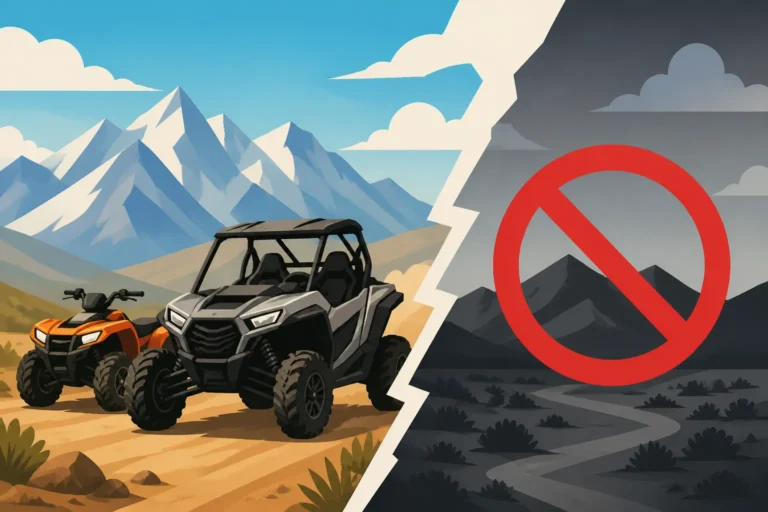
While generally your ATV or UTV cannot be driven on public roads in California, there is one very specific, and highly limited, exception that sometimes confuses riders. These are known as "combined-use highways," and they are far from a free pass to drive your OHV anywhere on the pavement.
The Exception to the Rule: Combined-Use Highways
Combined-use highways are segments of public roads that have been specially designated by a local authority (like a county or city) to allow for both conventional vehicle traffic and off-highway vehicle access. The key word here is "designated." These aren't just any dirt roads or paved stretches; they must be officially approved and signed. The primary purpose of these routes is not for general OHV transportation, but rather to connect two otherwise separated off-highway trails or to provide access from a trail system to a staging area, fuel stop, or other necessary service.
These designations are incredibly rare and are typically found in very rural, low-traffic areas, often adjacent to State Vehicular Recreation Areas (SVRAs) or within National Forests. The CVC is very clear on the strict conditions: the segment must be less than three miles long [California's 3-Mile Combined-Use Cap], the road's speed limit is usually quite low, and the designation often requires consultation with the California Highway Patrol (CHP) to ensure safety. [California's Combined-Use Highways] It's a tightly controlled exception, not a loophole.
Navigating a Combined-Use Route Legally
If you're lucky enough to encounter and use a designated combined-use route, you must adhere to all the rules of the road that apply to conventional vehicles. This means obeying speed limits, stop signs, traffic signals, and yielding the right-of-way. In addition, you still need to ensure your OHV is properly registered with a current California Green or Red Sticker (or a valid nonresident permit).
Riders and passengers must also wear an approved helmet, regardless of age, as this is still considered public land use. For minors under 18 operating an ATV, a valid ATV Safety Certificate is also required. The intent of these routes is purely functional: to bridge a gap between off-highway sections. They are not for leisurely cruises, joyrides, or commuting. You're expected to use them directly and efficiently to reach the next segment of your off-road adventure or necessary services. Rangers and local law enforcement will be looking for riders who are clearly using these routes for purposes beyond their designated intent. [Riding a Designated Route From the Dunes to a Store]
The Rarity and Specificity of These Routes
It cannot be overstated how few combined-use routes exist across California. Despite the vastness of the state's public lands and off-road opportunities, the process for designating these routes is extremely complex and requires significant planning, public input, and coordination between local, state, and sometimes federal agencies. Concerns about safety, environmental impact, and potential conflicts with other road users make these designations very challenging to obtain.
You won't find a comprehensive, statewide list of combined-use routes because they are managed at the local level. Some examples might exist near SVRAs like Hollister Hills, Ocotillo Wells, or within certain National Forest areas, but they are almost always short, clearly marked, and integrate seamlessly into an existing trail network. [California Combined-Use Highway List] It's crucial not to confuse these highly specific designated routes with general county dirt roads or unpaved segments that might appear to be "open" to OHVs. Unless there's official signage explicitly stating it's a combined-use route, assume your OHV is prohibited from general road use. Always check local maps, like Motor Vehicle Use Maps (MVUMs) for National Forests, and local county regulations before venturing out.
Practical Considerations and Local Nuances
Understanding the legal categories and restrictions is one thing, but navigating the real-world application, especially with local variations, is another. Being a responsible rider or owner of a low-speed vehicle means always doing your homework.
Always Check Local Ordinances
The state of California sets the broad legal framework for golf carts, NEVs, and OHVs, but local jurisdictions (cities and counties) have significant power to implement their own, often more restrictive, ordinances. This is especially true for golf carts and NEVs. A particular city might have a robust NEV master plan, designating numerous streets where these vehicles can operate. However, a neighboring city might have no such plan, or even actively restrict such vehicles on its streets.
Therefore, before assuming you can drive a golf cart down a certain street or a NEV through a particular neighborhood, it is absolutely essential to consult the specific city or county's vehicle ordinances. These are typically available on the local government's website or by contacting their planning or public works department. What's legal in Palm Desert for a golf cart might be illegal in Santa Monica. This patchwork of rules means "know before you go" is not just a suggestion, it's a necessity to avoid citations and frustration.
Enforcement and Safety
Law enforcement officers, whether from the California Highway Patrol (CHP), county sheriffs, or city police departments, are trained to identify different vehicle classifications and enforce the relevant sections of the Vehicle Code. When they see a vehicle on a public road, they're looking for proper registration, safety equipment, and whether the vehicle type is even permitted on that specific road. [What a California Sheriff Checks Roadside] If your OHV is on a public street where it's not explicitly designated as a combined-use route, you can expect to be pulled over.
Beyond the legal aspect, there's the critical issue of safety. Golf carts and NEVs are designed for low-speed environments. They are not built to withstand impacts with full-size vehicles traveling at higher speeds. Likewise, OHVs, while robust off-road, lack many of the on-road safety features that prevent accidents or protect occupants in a collision with a street-legal vehicle. Mixing these different vehicle types on roads they aren't designed for creates inherent dangers for everyone involved. Adhering to the rules isn't just about avoiding a ticket; it's about protecting yourself and others from potentially serious harm.
Future Trends and Advocacy
The landscape of personal transportation is always evolving, and there are ongoing discussions in many states, including California, about expanding access for various types of vehicles, including OHVs, to public roads. Some states have enacted "street legal" conversion laws or broader combined-use route programs. However, California, with its unique environmental and traffic challenges, tends to be more conservative in this regard.
For enthusiasts who wish to see more opportunities for responsible OHV road access, advocacy plays a crucial role. This involves engaging with local and state elected officials, participating in public comment periods for proposed legislation, and supporting organizations that champion responsible off-highway recreation. It's about presenting well-reasoned arguments for safe, limited, and designated access, rather than simply wishing for blanket street legality. While the immediate future for converting your UTV into a full-fledged street-legal vehicle in California remains highly improbable, staying informed and participating in respectful advocacy efforts can help shape future policies regarding off-highway vehicle use.
| Vehicle Type | Typical Max Speed | Street Legal in California? | Key Identifying Features | Permitted Road Use |
|---|---|---|---|---|
| Golf Cart | 15 mph | Limited | 3+ wheels, electric, basic lights, golf-course focused | Designated golf cart lanes/routes; within 1 mile of golf course on <25 mph roads |
| NEV/LSV | 25 mph | Yes | 4 wheels, electric, full lights, VIN, seatbelts, windshield | Streets with posted speed limit of 35 mph or less |
| ATV/UTV (OHV) | Varies | No | Designed for off-road, aggressive tires, no FMVSS cert. | Primarily off-highway trails; very limited, designated combined-use segments |
Disclaimer
This article is for general informational purposes only and does not constitute professional advice. Laws, prices and regulations vary by location and change over time. Consult a qualified professional for guidance on your specific situation.