Inheriting a Quad in California
The emotional weight of losing a loved one is immense, and dealing with their estate can feel like navigating a complex maze, especially when it involves vehicles like an ATV or UTV. Inheriting an off-highway vehicle (OHV) in California comes with its own unique set of rules and paperwork, and it's easy to feel overwhelmed by the process. This guide is here to help you understand the steps involved in legally transferring ownership and registering an inherited quad or side-by-side in the Golden State, so you can focus on the memories, not the bureaucracy.
Understanding California's OHV Paperwork After a Loss
When you're grieving, the last thing you want to think about is paperwork, but getting a handle on the deceased's documents is the crucial first step in transferring an inherited OHV in California. The specific path you take will depend heavily on whether a will or trust exists, and what other records your loved one kept.
The Importance of a Will or Trust
A well-drafted will or trust can significantly simplify the process of transferring an inherited ATV or UTV. If your loved one explicitly stated in their will that you are to receive the quad, this document serves as clear evidence of their wishes. The executor of the estate, appointed in the will, will typically be responsible for initiating the transfer. This usually involves presenting the will and the death certificate to the California Department of Motor Vehicles (DMV) or a licensed OHV service provider, alongside the necessary transfer forms. Having these clear instructions can help prevent disputes among heirs and streamline the administrative tasks during an already difficult time.
However, many people pass away without a will, a situation known as dying "intestate." If there's no will, state law dictates how assets are distributed, and this can make the transfer process more complicated, potentially requiring court intervention through probate. In such cases, the court will appoint an administrator to manage the estate, and they will follow California's laws of succession to determine who inherits the OHV. While it's always recommended to consult legal advice for complex estates, for many OHVs, there are streamlined processes available through the DMV that avoid full probate, which we'll explore shortly. Even if there's no will, if the OHV was jointly owned with rights of survivorship, the surviving owner may only need to present the death certificate to transfer full ownership.
Locating Essential Documents
Before you can even think about visiting the DMV, you need to gather specific documents related to the inherited OHV. The most critical item is the original California Certificate of Title. This pink slip proves legal ownership, and its presence will make the transfer process much smoother. Without it, you'll need to jump through additional hoops to prove ownership, which can add significant delays. It's often tucked away in a safe deposit box, a home safe, or a file cabinet with other important papers.
Beyond the title, look for the current registration card and any corresponding sticker information. Knowing the OHV's last registered status can be helpful. If you can't find the title, don't despair; the DMV has processes for [Replacing a Lost California OHV Title], though it will add an extra step to your journey. You'll also need a certified copy of the deceased's death certificate. This document is crucial for proving the death and initiating any transfer of assets. Finally, if a will or trust exists, have those documents readily available, as they will be required to establish your legal right to inherit the vehicle. Sometimes, people also keep the original Bill of Sale from when they first purchased the OHV, which can be useful if there's any question about the machine's history or if it was never formally titled.
Navigating the California DMV Transfer Process
Once you've gathered the necessary documents, it's time to tackle the actual transfer process. California's DMV has specific forms and procedures for transferring ownership, especially when it involves an inherited vehicle. Understanding these steps can help you avoid common pitfalls and ensure a smooth transition.
Required Forms and Documentation
The primary form you'll need to complete is the Application for Title or Registration, commonly known as Form REG 343. This form collects all the pertinent information about the OHV and the new owner. As the heir, you'll fill out your details as the new owner and provide information about the deceased owner. It's essential to complete this form accurately and thoroughly, as any errors can lead to delays. The good news is that for inherited vehicles, the section where the previous owner typically signs to release interest will usually be handled by attaching the death certificate and any probate documents or an affidavit. [What California's Form REG 343 Asks For] is a great resource to understand each line item.
In addition to REG 343, if the estate is relatively small and avoids formal probate, you'll likely need to complete Form REG 5, the Affidavit for Transfer Without Probate. This affidavit allows for the transfer of vehicles (including OHVs) without a court order, provided certain conditions are met, such as the total value of the deceased's estate being below a specific threshold and a certain amount of time having passed since the death. Always have the certified death certificate on hand, as it is a non-negotiable requirement. Depending on the OHV's history or if it's being registered for the first time in California, you might also need a Vehicle Verification form, REG 31, completed by an authorized verifier. This is often required for vehicles without a prior California record or if there are discrepancies. You can learn more about this process in [California Vehicle Verification on Form REG 31].
Dealing with Probate vs. Non-Probate Transfers
The biggest hurdle for many heirs is understanding whether the inherited OHV needs to go through probate court. Probate is the legal process of proving a will (if one exists), identifying and inventorying the deceased person's property, paying their debts, and distributing the remaining property to the rightful heirs. This can be a lengthy and costly process, often taking months or even years. Generally, probate is required when the deceased's estate, including the value of the OHV and other assets, exceeds a certain value and there's no will or other legal mechanism to bypass it. If the court is involved, you'll need certified copies of the court orders authorizing the transfer to present to the DMV.
However, for many OHVs, especially those that are part of smaller estates, California offers streamlined "non-probate" transfer options. The most common for vehicles is the Affidavit for Transfer Without Probate (REG 5) mentioned earlier. This allows you to bypass the court system entirely, as long as the estate meets the specified financial and time requirements. For instance, if at least 40 days have passed since the death and the total value of the deceased's personal property in California (excluding certain items like real estate) is below a specific statutory limit, you may be able to use this affidavit. This is usually the quickest and most cost-effective method for transferring an OHV. Regardless of the method, the goal is to correctly complete the transfer of registration, as detailed in [Transferring a California OHV Registration]. You might find resources like LawDepot helpful for understanding how to prepare certain affidavits or declarations, should they be needed to support your claim.
Fees and Potential Penalties
Transferring an inherited OHV in California isn't entirely free, and it's crucial to be aware of the associated costs. You'll typically be responsible for a transfer fee, which is a nominal charge for processing the change of ownership. Additionally, there might be a fee for a new identification plate or sticker if the old one is expired or missing. While inherited property transferred directly from a deceased person to an heir is generally exempt from sales or use tax, it's always wise to clarify this with the DMV, especially if the transfer involves an estate sale or other complex arrangements. [California OHV Registration and Sales Tax] provides more details on tax implications.
One of the most important things to watch out for is late penalties. California imposes penalties if you don't complete the transfer within a specific timeframe after the owner's death. This late penalty can add an unexpected cost to an already difficult situation. For example, [The $28 Transfer Penalty in California] can be assessed if the transfer isn't processed promptly. The exact number of days you have to complete the transfer can vary depending on the circumstances, so it's always best to initiate the process as soon as you have all the necessary documents to avoid these additional charges.
What to Do If the Quad Has No Record or Special Circumstances
Sometimes, inheriting an OHV isn't as straightforward as finding a pristine title and a clear will. You might encounter situations where the quad has no official record, was purchased out-of-state, or the title is simply missing. Each of these scenarios requires a slightly different approach to get the machine legally in your name and ready for the trails.
Inheriting a Quad Without a Title
It's not uncommon to inherit an OHV only to discover that the original Certificate of Title is nowhere to be found. This can be a frustrating hurdle, but it's not insurmountable. If the OHV was previously registered in California, you'll generally need to apply for a duplicate title in the deceased owner's name first. This requires presenting the death certificate and proof of your legal right to handle the estate (e.g., executor's letter, affidavit) to the DMV. Once the duplicate title is issued in the deceased's name, you can then proceed with the standard transfer of ownership process to put it into your name.
If the OHV has never been titled or registered, the process becomes a bit more involved, requiring you to establish the chain of ownership from its original purchase. This might involve finding the original Manufacturer's Certificate of Origin (MCO) or any old bills of sale. For specific guidance on how to navigate this, check out [California OHV Registration Without a Title]. LawDepot can be a useful resource if you need to create a sworn statement or affidavit to attest to the ownership history in the absence of a formal title.
Machines That Were Never Registered
Perhaps your loved one owned an ATV or UTV that they only ever rode on private land, and as a result, it was never formally registered with the California DMV or issued a Green, Red, or Tan sticker. Inheriting such a machine means you'll be initiating its first-ever official registration. This process typically requires you to prove ownership from the ground up. You'll need the original Manufacturer's Certificate of Origin (MCO) or, failing that, a detailed bill of sale from the original purchase. If these are unavailable, you might need to provide an affidavit explaining how the machine came into the deceased's possession.
In these cases, a physical inspection of the vehicle, known as a vehicle verification, is almost certainly required. A DMV employee, California Highway Patrol officer, or authorized private verifier will confirm the vehicle identification number (VIN) and other details match the paperwork. This step is crucial to ensure the vehicle isn't stolen and to establish its identity within the DMV system. After successful verification and proof of ownership, you can then apply for a title and registration, receiving the appropriate California OHV sticker. Understanding the steps for [Registering a California Quad That Never Had a Sticker] will be invaluable here.
Out-of-State Inheritances
If the OHV you've inherited was primarily used and registered in another state, bringing it into California requires special attention to California's unique OHV regulations. California has strict emissions standards, and this significantly impacts which sticker your machine will receive. When you bring an out-of-state OHV into California, you'll generally need to go through a verification process to confirm its VIN and ensure it meets California's standards, especially for emissions.
Machines that are not 50-state emissions compliant may be eligible for a Red Sticker, or in some cases, a Green Sticker if they are old enough (pre-2003 model year). Newer machines that don't meet California's emissions may be restricted to a Red Sticker's seasonal riding schedule. It's critical to understand [What CARB Compliance Means in California] and how it will affect your ability to ride year-round. You'll follow the general steps for [Registering an Out-of-State Machine in California], providing proof of ownership (the out-of-state title), the death certificate, and probate or affidavit documentation, along with the required verification.
Ensuring Your Inherited Quad is Ready for the Trails
Once the administrative hurdles are cleared and the inherited OHV is legally in your name, the next exciting step is getting it ready for adventure! But before you hit the dirt, a few final checks and considerations will ensure you're riding safely and legally in California.
Green, Red, or Tan Sticker?
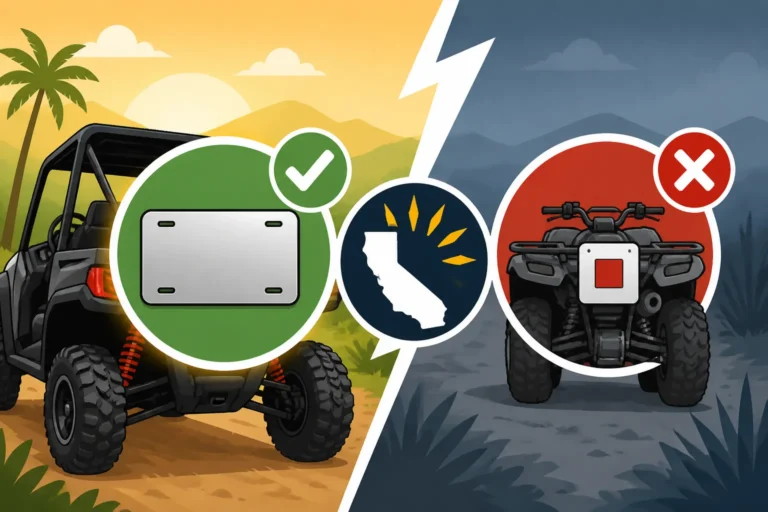
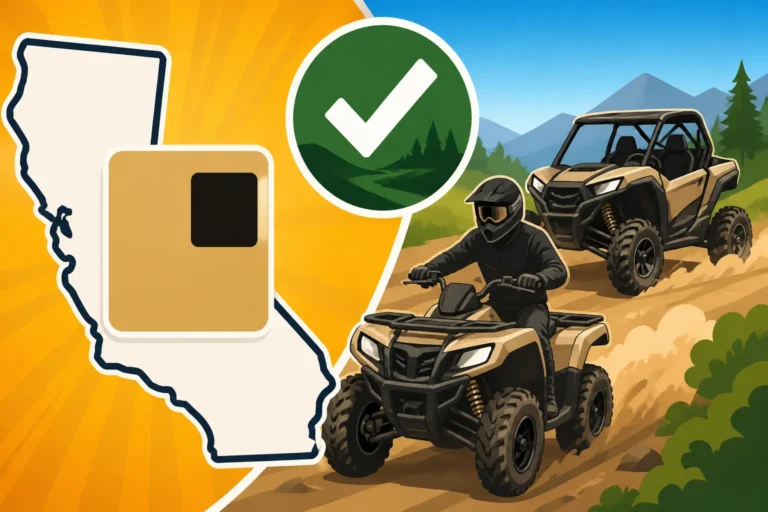
California uses a distinct sticker system for off-highway vehicles, and understanding which one applies to your inherited quad is crucial for legal riding. Your OHV will receive one of three colored identification stickers: Green, Red, or Tan. The color depends primarily on the vehicle's model year and its compliance with California Air Resources Board (CARB) emission standards. A Green Sticker allows year-round riding in all approved OHV areas. Generally, this applies to California emission-compliant machines and older vehicles (model year 2002 and older) that predate stricter regulations. [California's Green Sticker Explained] goes into detail about its eligibility.
A Red Sticker, on the other hand, designates vehicles that do not meet California's stringent emission standards, typically newer machines manufactured for sale in other states. These machines are subject to seasonal riding restrictions in many areas, usually limiting use to certain times of the year, particularly outside peak smog seasons. [Red Stickers and What Changed in California] highlights recent changes to these rules. Finally, the Tan Sticker is a special permit for competition vehicles that are not otherwise eligible for Green or Red stickers, allowing them to participate in sanctioned events. You can learn more about these in [California's Tan Sticker Machines]. Knowing which sticker your inherited machine qualifies for is paramount to planning your rides and avoiding citations. For a comprehensive overview, read [Green, Red and Tan: California's Three Stickers].
Safety and Maintenance Checks
Even if your inherited quad looks like it's in perfect condition, a machine that has been sitting for a while, or one whose maintenance history is unknown, warrants a thorough inspection before its first ride. Start with the basics: check all fluid levels (oil, coolant, brake fluid), inspect tire pressure and condition, and test the brakes. Look for any signs of wear and tear, loose bolts, or damaged components. A quick check of the battery and electrical system is also a good idea. Consider changing the oil and inspecting the air filter, as old fuel can also cause problems if the machine hasn't run recently.
Beyond mechanical readiness, ensure you have all the necessary safety gear. This includes a DOT-approved helmet, goggles, gloves, long pants, and sturdy footwear. California has strict helmet laws for OHV riders, particularly for minors, but it's always wise for riders of all ages to wear appropriate head protection. Make sure any spark arrestor is present and in good working order, as this is a legal requirement on public lands to prevent wildfires. A well-maintained machine and proper safety gear are your best friends on the trails.
Finding Places to Ride
With your inherited OHV legally registered and safety-checked, the only thing left is to find some amazing places to ride! California boasts a diverse array of off-highway vehicle areas, from vast desert dunes to mountainous trails and dense forest tracks. The state's State Vehicular Recreation Areas (SVRAs) are purpose-built for OHV recreation and offer a variety of terrains and amenities. Popular SVRAs include Glamis (Imperial Sand Dunes), Oceano Dunes (Pismo Beach), Hungry Valley, and Hollister Hills.
Beyond SVRAs, many national forests and Bureau of Land Management (BLM) lands also offer designated OHV routes and open riding areas. It's crucial to always check local regulations, obtain necessary permits (like the Imperial Sand Dunes Recreation Area permit), and consult Motor Vehicle Use Maps (MVUMs) before heading out, as access can vary and change due to weather, fire closures, or environmental concerns. For a comprehensive guide to exploring California's riding opportunities, explore [Where to Ride an OHV in California]. Remember to ride responsibly, respect the environment, and always ride within your skill level.
| Document Type | Purpose for Inherited OHV Transfer | Where to Obtain/Check | Notes |
|---|---|---|---|
| Original Certificate of Title | Proof of legal ownership by the deceased. Necessary for transfer. | Deceased's personal records (safe, file cabinet, safe deposit box) | If lost, must apply for [Replacing a Lost California OHV Title] in deceased's name first. |
| Certified Death Certificate | Official proof of the owner's passing. Required for all transfers. | County Public Health Department where death occurred | Get multiple copies; often needed for other estate matters. |
| Form REG 343 | Application for Title or Registration by the new owner (heir). | California DMV website or field office | Complete accurately; indicates you are the new owner. See [What California's Form REG 343 Asks For]. |
| Form REG 5 | Affidavit for Transfer Without Probate (if applicable). | California DMV website or field office | Used for small estates to bypass probate court; eligibility rules apply. |
| Will / Trust Documents | Legal instruction for asset distribution; appoints executor. | Deceased's legal counsel, personal records, probate court | Simplifies transfer by clearly stating heir; executor handles paperwork. |
| Court Order (if probate) | Official document authorizing transfer from probate court. | Probate court overseeing the estate | Required if the estate goes through formal probate; executor presents this to DMV. |
| Bill of Sale (if new reg) | Proof of original purchase for machines never registered/titled. | Deceased's personal records, original dealer | Essential if [Registering a California Quad That Never Had a Sticker] for the first time after inheriting. |
| Form REG 31 | Vehicle Verification (if required). | Authorized verifier (DMV, CHP, licensed verifier) | Common for out-of-state machines or if VIN discrepancies. See [California Vehicle Verification on Form REG 31]. |
Disclaimer
This article is for general informational purposes only and does not constitute professional advice. Laws, prices and regulations vary by location and change over time. Consult a qualified professional for guidance on your specific situation.