Failing a Sound Check at a Gate
A sound check at a California OHV entrance can turn a planned ride into a frustrating turnaround, especially if you do not know what the test measures or what to do after a failure. The right response is to understand the result, avoid unsafe roadside fixes, and confirm the site’s requirements before trying again.
What a failed sound check means
A failed check means the machine measured louder than the applicable limit under the test procedure being used. It does not necessarily mean every riding area applies the same limit or that every failure leads to the same consequence. Requirements can depend on the machine, its model year, the land manager, and the test standard in effect at that location.
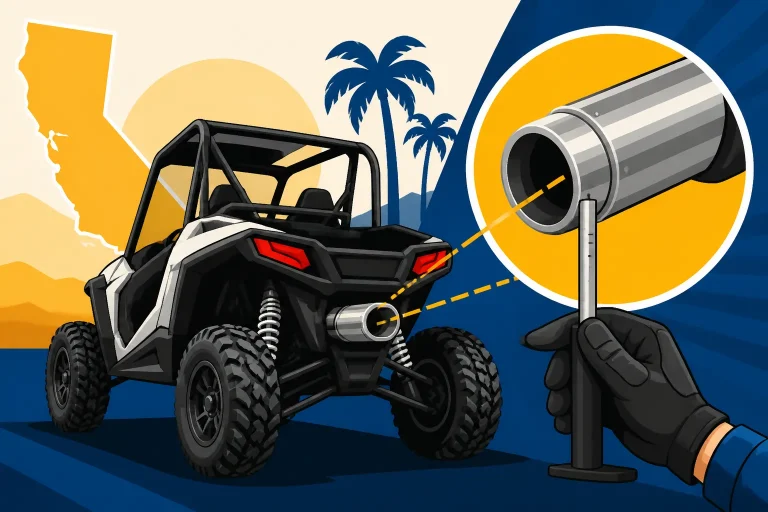
A gate check is a practical screening, not a sound test you can reliably reproduce by revving the engine in a driveway. Staff may use a sound meter and a prescribed setup, including a specific meter position and engine operating condition. Small differences in distance, angle, background noise, or engine speed can affect a reading. For a closer look at the standardized approach, see California Sound Test Procedure and How a Ranger Measures Your Exhaust Noise.
California OHV references commonly distinguish between a 96-decibel limit for newer machines and a higher limit for some older machines. Which standard applies to your ATV or UTV depends on the relevant rules and the machine’s details; do not assume that age alone settles the question. Review The 96-Decibel Limit on a California Trail, One Hundred One Decibels for Older Machines, and California Sound Limits for OHVs Explained before relying on a number.
A failed check can mean staff will not allow the machine to proceed into the riding area. The next step may be to have it checked again after a correction, take it away on a trailer, or follow the site’s instructions. The land manager determines what options are available at that location. A test result at one gate also does not automatically establish what will happen at another site.
Keep sound compliance separate from other equipment requirements. A quiet exhaust does not prove that a spark arrester is approved or in place, and a compliant spark arrester does not prove that the machine meets the sound limit. Check each requirement on its own.
| What happened | What it tells you | Practical next step |
|---|---|---|
| The meter reading is over the site’s limit | The machine did not pass under that test setup | Ask staff to explain the result and the site’s retest or exit options |
| The reading is close to the limit | Small differences in setup or engine condition may matter | Ask whether the test can be repeated using the required procedure |
| The exhaust has visible damage or a loose part | A leak or failed component may be contributing to noise | Do not ride until the problem is safely repaired |
| The machine passes sound but fails another equipment check | Sound compliance does not satisfy unrelated requirements | Identify and address the separate issue |
What to do at the gate after a failure
Stay calm and ask staff what the result means for that specific riding area. A useful first question is whether the machine may be tested again after a repair and, if so, where that can happen. If you are unsure how the test was performed, ask which procedure and limit were applied. A respectful conversation is more useful than arguing over a phone reading or revving the engine to demonstrate that it “sounds fine.”
Then follow the instructions you receive. If the machine is not allowed to enter, do not ride it past the checkpoint, around a closed gate, or onto an unapproved route to reach another entrance. Arrange to transport it out if required. The consequences of riding a machine after being told it cannot enter can be more serious than the inconvenience of ending the trip.
Use this sequence to keep the situation straightforward:
- Ask for the result and applicable standard. Make sure you understand whether the failure concerns sound, another equipment requirement, or both.
- Ask whether a retest is permitted. Some locations may allow a second check after a reasonable correction; others may direct you to leave.
- Look for an obvious, safe-to-address cause. A loose exhaust connection or damaged component may be apparent, but do not attempt an improvised repair beside traffic or in a crowded staging area.
- Follow the site’s directions. If the machine cannot enter, load it or move it as staff instruct. Do not assume a different trail or entrance is an acceptable workaround.
- Document what you were told. Note the site, machine, result, and any recommended repair. This helps you ask a mechanic to diagnose the issue and prepare for another visit.
A failed reading does not by itself identify the faulty part. The exhaust might have a leak, damaged packing, a missing or altered baffle, or a component that is not suited to the machine. Engine condition and the way the system is installed can also matter. Avoid making repeated high-speed runs in an attempt to “clear” the exhaust; that can increase noise and risk damage without fixing the cause.
If a citation or other formal enforcement action is involved, read the paperwork carefully and follow its instructions. The process and consequences can depend on the site and circumstances. For general information about possible enforcement, see California Fines for a Loud Machine.
How to diagnose and fix the cause
Begin with a visual inspection when the machine is off and cool. Check the exhaust system for loose fasteners, gaps at joints, damaged mounts, cracks, missing parts, or signs of escaping exhaust. Do not put your hands near hot components, and do not run the engine in an enclosed space. If you see damage or are not confident about the inspection, have a qualified mechanic check it.
A well-maintained exhaust can still be too loud. Some aftermarket systems are designed for performance or competition use rather than meeting the sound requirements for a public riding area. A product listing, a seller’s claim that a pipe is “quiet,” or a label on one component does not guarantee that the complete machine will pass a gate test. Compatibility, installation, condition, and the testing procedure all matter. More detail is available in Aftermarket Exhaust and California Sound Checks.
Common issues to ask a mechanic to check include:
- Exhaust leaks: A poor seal at a joint or a cracked pipe can make the system louder and may create a safety concern.
- Worn or missing packing: Some mufflers use packing material that can degrade with use. Repacking must follow the manufacturer’s instructions and use suitable materials.
- Missing or altered components: A removed baffle, damaged core, or modified outlet can affect sound output.
- Incorrect fitment: An exhaust intended for a different machine may not function as expected, even if it can be physically installed.
- Loose mounting hardware: Vibration can loosen connections or allow exhaust parts to rattle.
- Other mechanical problems: An engine or intake issue may affect how the machine runs and sounds; do not assume the muffler is the only possible cause.
Do not plug the exhaust outlet, pack it with improvised material, or fit an unapproved insert just to get past a check. These shortcuts can create excessive heat, restrict exhaust flow, damage the engine, or pose a fire and burn risk. Any repair should be appropriate for the machine and its intended use.
The sound requirement is also separate from emissions compliance. A quiet exhaust does not establish that the machine meets other applicable rules, and a compliant emissions label does not establish that its current exhaust passes a sound test. If you are changing parts, check the machine manufacturer’s guidance and the relevant rules for the place you plan to ride.
How to reduce the chance of failing again
The best preparation is to inspect and maintain the machine before the trip, rather than trying to diagnose it at the entrance. Check the exhaust for leaks, loose hardware, damaged components, and signs that packing or other service parts need attention. Keep records of repairs and parts installed; they can help a mechanic identify what has changed if the machine fails again.
A consumer sound meter can be useful for spotting a machine that has become noticeably louder, but a home reading is not a guarantee of passing. A phone app is even less dependable as a compliance test. Device accuracy, calibration, background noise, distance, angle, and engine speed can all differ from the gate procedure. Treat a home check as an early warning, not official approval.
Before leaving, confirm the riding area’s current requirements and any relevant check-in instructions. If you have recently installed an exhaust or made engine changes, ask a qualified shop to inspect the complete setup. A machine that passes one test may still fail another if the procedure or applicable standard differs, so plan for the specific site rather than relying on a past result.
If your machine fails again after a repair, stop treating it as a simple gate inconvenience. Ask a shop to diagnose it under controlled conditions and verify the exhaust configuration for your model. Repeatedly arriving at a gate and hoping for a different reading can waste a trip and may leave you with no permitted place to ride.
Disclaimer
This article is for general informational purposes only and does not constitute professional advice. Laws, prices and regulations vary by location and change over time. Consult a qualified professional for guidance on your specific situation.