Taking the Course at a Rental Counter
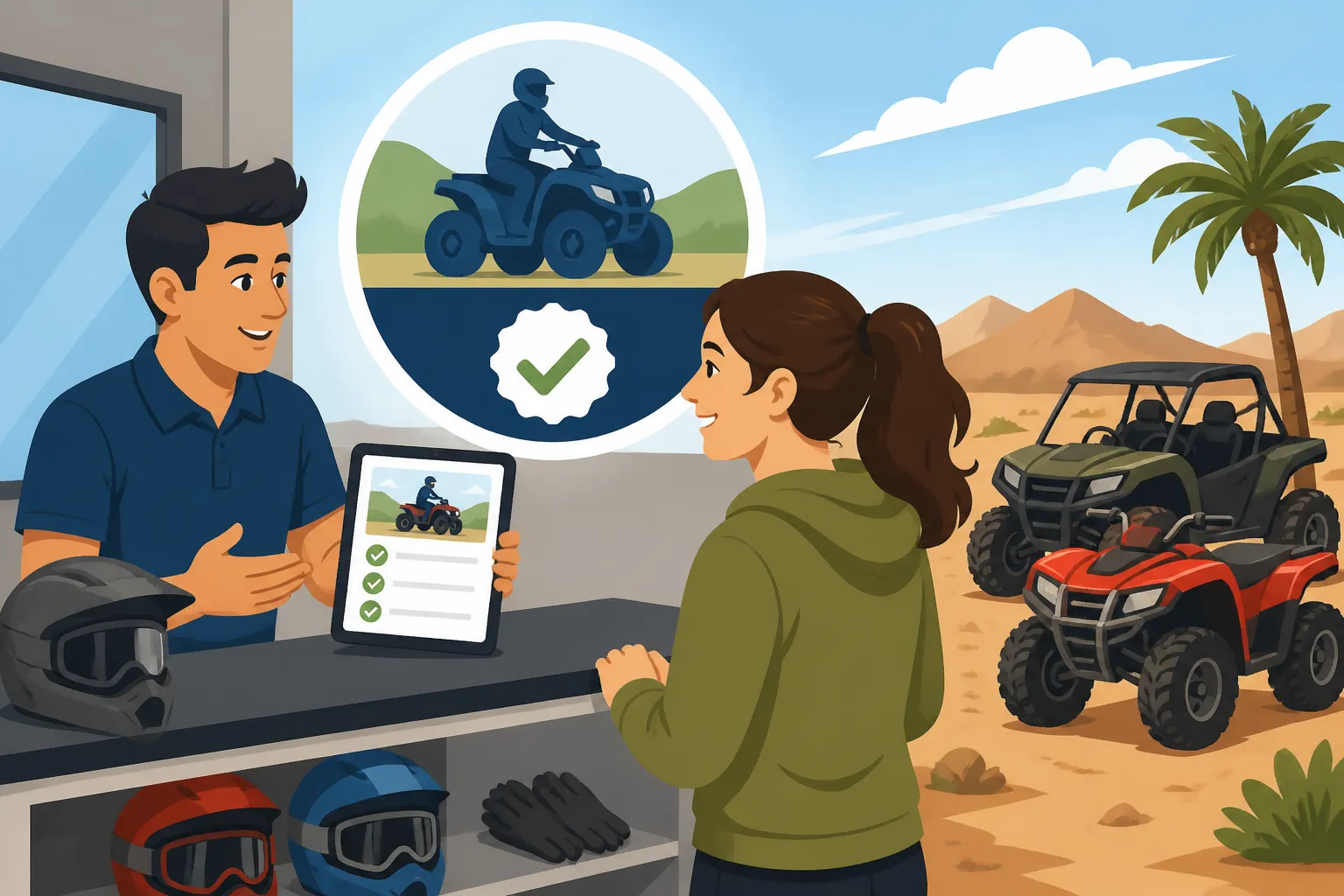
A rental counter may offer a quick ATV safety course, but not every shop’s orientation is the same as a California-recognized safety certificate. If you are renting for a child or teen, or the rental company says a certificate is required, confirm what the course provides before you arrive. Knowing the difference can prevent delays and help you choose a machine the rider can handle safely.
What a safety course at a rental counter usually means
A rental shop may use “course” to describe a short safety briefing, a formal safety education program, or both. Those are not interchangeable. A briefing can teach the controls and the shop’s rules without providing proof of completion of a safety course that California requires for some young riders.
For riding on California public land, riders under 18 generally need to meet the state’s safety-certificate requirement or ride under the required supervision of an adult who holds a certificate. The details depend on the rider and machine, so check California ATV Safety Certificate Requirements and the rules for California Rules for Riders Under 18 before booking. A rental shop’s own age and training policies may be stricter than the state requirement.
The phrase “at the counter” does not necessarily mean the entire course happens in person, on site, or just before the ride. A shop might ask you to complete a course online beforehand, review proof at check-in, and then give a short hands-on orientation. Another shop may offer a training option on site. Some may provide only an orientation and require you to arrive with any certificate you need.
Ask the shop what the course actually is. In particular, find out whether completion produces a certificate, who issues it, and whether the certificate satisfies the requirement for the rider’s situation. A shop employee’s confirmation is useful, but keep the course provider’s completion record too.
| What the shop calls it | What it may include | What to confirm |
|---|---|---|
| Safety briefing or orientation | Controls, starting and stopping, route limits, and rental rules | Whether it is only a shop briefing |
| Safety course | Instruction and an assessment, sometimes completed online | Who provides it and what proof you receive |
| Certificate check | Staff review an existing certificate or record | Which certificate formats the shop accepts |
| Hands-on familiarization | Practice with controls before departure | Whether it is included and which machine it covers |
This distinction matters even if an adult is renting. The shop may require every operator to complete an orientation, while state certificate rules apply to certain younger riders. Neither requirement automatically replaces the other. For a broader overview of renting and preparing for pickup, see [Renting an ATV in California].
How to check whether the course will meet your needs
Before paying a deposit or planning the trip around a course at the shop, call or message the rental company. A few precise questions are more helpful than asking only, “Do you have a safety course?”
Ask whether the course is a formal safety education course or the rental company’s own briefing. If it is formal, ask for the provider’s name and how you will receive proof of completion. If the shop says the course is accepted for a California safety-certificate requirement, ask how that applies to the rider and machine you plan to rent. You can also check the applicable state requirements independently rather than relying on a generic “certificate” description.
The rider’s age and machine type matter. California has rules that vary by age and by vehicle category, and a course offered for an ATV may not answer every question about operating a side-by-side. If your group includes both ATV and UTV riders, tell the shop the exact machines and operators you are booking. For visitors, check California Safety Certificate for Visiting Riders rather than assuming a certificate from another state will be accepted in every situation.
Ask about timing, too. A course may require advance registration, a separate device or account, or time to finish before check-in. If there is an assessment, the rider may need to pass it before the shop will release the machine. Do not assume that arriving early will leave enough time to complete every requirement, especially with a group.
Before the call ends, confirm these details:
- Whether you need a certificate, a shop orientation, or both.
- Whether the course can be completed at the rental location or must be done beforehand.
- What proof to bring, such as a certificate, completion email, or account record.
- Which riders must complete the course and whether each operator needs separate proof.
- Whether the course applies to the ATV or UTV you will operate.
- What happens if a rider cannot complete or pass the course before pickup.
If you already hold a certificate, ask whether the shop accepts it and whether it needs to be printed. The requirements for a visiting rider may differ from a shop’s preferred paperwork, and a screenshot alone may not satisfy the rental company’s check-in process. For details on documents a rental company may review, see What a Rental Counter Checks.
What to expect during check-in
A counter course or briefing is usually only one part of picking up a rental. Staff may check the booking, confirm the operators, review age and license requirements, explain where you are allowed to ride, and inspect or record the condition of the machine. The exact process differs by company, so leave time for it rather than arriving just before your reserved ride.
If the course is completed at the counter, the rider may be asked to watch instructional material, answer questions, or demonstrate basic controls. A shop briefing may cover throttle and brake operation, engine shutoff, safe starting, stopping distance, passenger rules, speed expectations, and what to do if the machine becomes stuck or has a problem. Listen to the guidance for the specific vehicle being rented. Knowing how a different ATV works does not guarantee you are familiar with this one.
A parent or supervising adult should stay involved when a young rider is taking the course. Confirm which person is responsible for supervision on the ride and whether that person must hold a safety certificate. A parent’s signature on rental paperwork, by itself, should not be treated as proof that the rider meets a separate state safety requirement.
The shop may also explain its own restrictions. It could limit where the rental can go, prohibit certain maneuvers, or require the group to stay together. These rental conditions are separate from state rules and from any public-land access requirements. Follow the most restrictive rule that applies. If a machine is being rented for dunes, trails, or a designated riding area, ask staff to explain any route boundaries before you leave.
A safety course does not replace protective equipment, a machine inspection, or a clear understanding of the rental agreement. Check that the helmet fits and ask which additional gear is provided. Shops differ in what they include, so review California Rentals That Include a Helmet and bring suitable gear if needed. Inspect the machine with staff and report existing damage before departure. Read the rental agreement carefully; a course does not cancel the terms of the contract or guarantee that every type of damage is covered. For that distinction, see What a Waiver Does Not Cover.
How to make the course work for a family or group
If several people will take turns operating, plan for each operator to meet the applicable requirements. One person’s course completion does not automatically cover every rider, and a certificate held by one adult does not necessarily settle the supervision question for the whole group. Give the rental company the number and ages of all intended operators when you book.
For a child or teen, do not wait until check-in to find out whether the rider can use the machine you reserved. The rental company may have minimum-age rules, machine-size limits, or training conditions that are stricter than state rules. A course cannot make an oversized or unfamiliar machine a good fit. If your group includes younger children, review Renting to a Rider Aged 9 to 12 in California and ask the shop what size and type of machine it will allow that rider to operate.
For a group booking, set one person to gather the paperwork and confirm each operator’s course status. Keep completion records accessible, but do not rely on a phone photo unless the shop says it accepts one. If the course is online, complete it well before the trip and save the confirmation somewhere the rider or supervising adult can retrieve it without a weak signal.
A good check-in should leave the rider able to explain the basic controls, the boundaries of the permitted riding area, and what to do if something goes wrong. If the rider is still confused after the briefing, ask for clarification or more practice before leaving. The purpose is not simply to get through a counter requirement; it is to make sure the person operating the rental understands the machine and the rules that apply.
Finally, keep the shop’s course confirmation separate from any other paperwork you may need for the ride. A rental course may satisfy a rental company’s training policy without serving as proof of a state-required certificate, and a certificate may not replace registration or permit documents. Ask what you need to carry for your planned riding area, and confirm the answer with the relevant official source if the shop’s explanation is unclear.
Disclaimer
This article is for general informational purposes only and does not constitute professional advice. Laws, prices and regulations vary by location and change over time. Consult a qualified professional for guidance on your specific situation.