Competition Machines and California Decibels
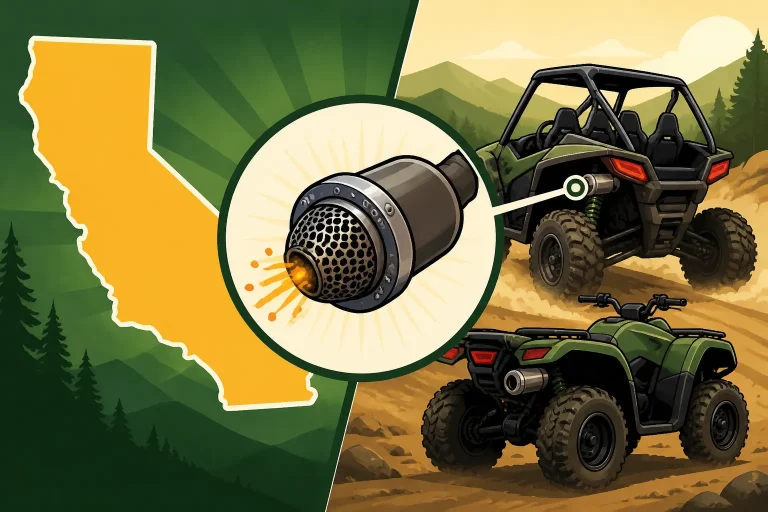
A race-bred ATV or UTV can sound louder than a trail machine, but “competition” does not automatically mean it can ignore California’s OHV noise rules. The key questions are what kind of machine it is, when it was manufactured, and how its exhaust measures during a sound check. Knowing those details helps you avoid a failed check, a citation, or a last-minute exhaust change.
How California’s OHV sound limits apply
California restricts exhaust noise from off-highway vehicles operated in places where the rules apply, including public OHV riding areas. The familiar limits are 96 dBA for many newer machines and 101 dBA for certain older machines. Those figures are not a general allowance to make any vehicle louder: the applicable limit depends on the machine’s category and manufacturing date.
A competition model needs a closer look. A factory “race” label, a competition-style exhaust, or a rider’s description of a machine as a race bike does not by itself establish which limit applies. The vehicle’s type and manufacture date matter, and the sound check uses a prescribed procedure rather than a rider’s impression of how loud the machine seems.
| Machine category | Sound limit to check | What to keep in mind |
|---|---|---|
| Many OHVs manufactured in 1986 or later | 96 dBA | This is the common limit for newer machines. |
| Certain OHVs manufactured before 1986 | 101 dBA | The older-machine allowance is not a blanket exception for every modified vehicle. |
| Competition motorcycles manufactured on or after January 1, 1998 | 96 dBA | Competition status does not remove the sound limit. |
| Competition machines outside those categories | Confirm the applicable standard | Classification, manufacturing date, and current site rules may affect the answer. |
The table is a practical starting point, not a substitute for checking how your particular machine is classified. In particular, don’t assume an ATV or UTV follows a rule written for a competition motorcycle. Confirm the vehicle category and the rule used by the land manager or riding area before you travel. For a broader overview, see California Sound Limits for OHVs Explained and The 96-Decibel Limit on a California Trail.
What dBA means
Decibels measure sound, and “dBA” refers to a measurement weighted to reflect how people hear different frequencies. A higher number means louder sound, but the scale is not intuitive: a small numerical increase can represent a noticeable change. It’s also why judging compliance by ear is unreliable. Two machines that sound similar to a rider may produce different readings under the required test procedure.
The number on the rule is only meaningful alongside the testing method. California’s OHV sound testing uses a specific setup, including the meter’s position and the machine’s operating condition. A reading taken at a different distance, in a different location, or at an arbitrary engine speed may not tell you whether the vehicle will pass an official check. Measuring Sound at 20 Inches explains why distance and positioning matter.
A competition machine is not automatically exempt
Some competition motorcycles have a date-based sound standard. In particular, competition motorcycles manufactured on or after January 1, 1998 are subject to the 96 dBA limit. That cutoff matters because “competition machine” is not a single category with one universal sound allowance. A newer competition bike cannot rely on its race designation to claim the older, higher limit.
For competition machines manufactured before that cutoff, don’t guess based on the year alone. Check the vehicle’s category and the standard the riding area applies. Older-machine provisions and competition-specific rules can be easy to confuse, especially when people use “race bike,” “competition bike,” and “OHV” interchangeably. The related topics Competition Machines Built After 1998 and One Hundred One Decibels for Older Machines help explain why the date and classification deserve attention.
A useful way to think about it is this: competition status may affect which category applies, but it does not mean no sound limit applies. If the vehicle is unusual, modified, imported, or missing clear model information, get confirmation before you arrive rather than expecting a ranger or gate attendant to sort it out on the spot.
Why a race-bred exhaust can fail
Competition machines are often built for performance, weight savings, or track use. That can mean a less restrictive exhaust, a different muffler, or tuning that produces more noise than a stock trail setup. Those changes may suit a closed-course setting but cause trouble when the machine is used on public land.
Common reasons a vehicle exceeds the applicable limit include:
- A modified or aftermarket exhaust that is louder than the original system.
- A worn, damaged, or missing muffler component.
- A deteriorated or missing packing material in a silencer that uses packing.
- An exhaust leak, loose joint, or damaged connection.
- Tuning changes that increase noise.
- A part marketed for competition use that does not meet the standard required where you ride.
An exhaust can appear complete and still be too loud. Likewise, a replacement part may fit the machine but not bring its sound within the applicable limit. A seller’s description, a race-use label, or a claimed sound level under a different test procedure is not proof that the machine will pass California’s check.
Replacing the muffler is not always the first or only answer. Inspect the full system for loose fasteners, leaks, damage, and missing components. If the muffler uses replaceable packing, follow the manufacturer’s service instructions; worn packing can change the sound even if the exhaust shell looks intact. Choose a replacement that is suitable for the machine and the applicable riding rules, rather than relying only on performance claims.
California’s sound rules also do not replace other equipment requirements. A machine can pass a sound check and still have a separate compliance problem, such as a missing spark arrester where one is required. See California Spark Arrester Requirement Explained for that separate issue. Noise and fire-prevention checks are different; passing one does not establish that the other requirement is met.
Why “it sounds stock” is not enough
Riders adapt to the sound of their own machine, especially after regular use. Helmets, wind, engine noise, and distance make it harder to judge volume accurately. A machine may also sound different under load than it does while stationary, while an official sound check follows its own method.
That is why a neighbor’s opinion, a phone recording, or a comparison with another rider’s bike should not be treated as a pass. They may help you notice an obvious problem, but they cannot establish a valid test result. A machine can sound quiet to its operator and still exceed the limit when measured correctly.
How to check a competition machine before riding
A pre-trip check is much easier than trying to solve a sound problem at the entrance to a riding area. Start by establishing the machine’s category and manufacturing date, then inspect the exhaust and use an appropriate measurement method.
- Identify the machine. Check its manufacturer information, model year, and vehicle type. Use the machine’s documentation or identification information rather than relying on how it is marketed.
- Find the applicable sound category. Determine whether the vehicle is treated as a standard OHV, an older machine, or a competition motorcycle covered by a specific date-based standard. If the category is unclear, ask the relevant land manager or riding area before your trip.
- Inspect the exhaust. Look for leaks, damage, loose connections, missing components, or worn silencer packing. Make sure any changes are compatible with the machine and the rules where you plan to ride.
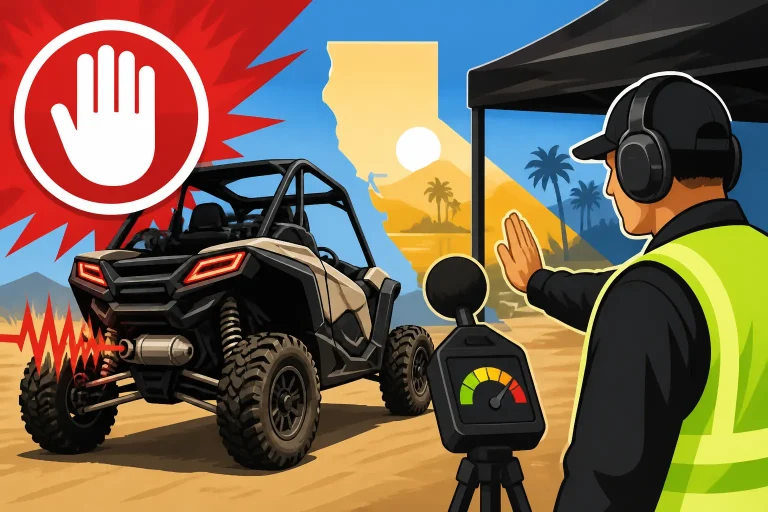
- Measure using the correct procedure. A casual reading from a phone or handheld meter may provide a rough warning, but it is not necessarily equivalent to an official check. Follow the required test setup and operating instructions.
- Leave room for uncertainty. If the reading is near the limit, don’t assume small differences in meter placement or conditions will work in your favor. Have the machine checked and corrected before setting out.
- Check the destination’s instructions. Sound rules and enforcement practices can vary by location. Confirm current requirements with the riding area, especially if the machine is modified or falls into a less common category.
A sound meter can be useful for screening an exhaust in a garage or shop, but a consumer device should not be confused with an official measurement. Some riders find meters through retailers such as Amazon; before buying, check whether the device has the functions and accuracy needed for the test you intend to perform. Even a suitable meter can give misleading results if it is placed incorrectly or used under the wrong conditions.
For the measurement itself, follow the prescribed procedure rather than improvising. The test’s distance, angle, surroundings, and engine operating conditions can affect the reading. California Sound Test Procedure and How a Ranger Measures Your Exhaust Noise cover the practical details to check. If your machine fails, Failing a Sound Check at a Gate explains why an on-site failure can disrupt a riding day.
When a machine is close to the limit
A reading just below the applicable limit is not a guarantee that every later check will produce the same number. Differences in test conditions, equipment, or the machine’s condition may affect the result. If the exhaust has developed a leak, the packing is deteriorating, or a component has loosened, noise can increase between checks.
If the machine is close to the limit, treat that as a reason to service it, not as a comfortable margin. Restore worn parts, repair leaks, and have the system checked using the method required for the vehicle. Avoid making last-minute changes that have not been tested; a poorly fitted insert or other improvised fix can create mechanical or safety problems as well as an uncertain sound result.
What to do if the rule or classification is unclear
Some questions are straightforward: a newer competition motorcycle falls under the 96 dBA limit, for example. Others are not. A competition-style ATV, a modified UTV, an older machine, or an imported vehicle may not fit neatly into the categories a rider expects. In those cases, seek a specific answer based on the machine’s type and manufacturing information.
When contacting a park or land manager, provide:
- The machine’s make, model, and model year.
- Whether it is a motorcycle, ATV, UTV, or another type of OHV.
- Whether it is identified as a competition model.
- Details of any exhaust modifications.
- The riding area and the date you plan to visit.
This makes it easier to ask a precise question: which sound standard applies to this particular vehicle, and what procedure will be used to check it? If you get an answer, keep a note of who provided it and what machine details you supplied. A general statement about “race bikes” may not address a specific ATV or UTV.
If the sound limit is not clear from the machine’s paperwork, don’t treat a race designation or aftermarket part description as permission to use a louder setup. Confirm the applicable standard before riding. A little preparation can prevent a costly or frustrating surprise at a checkpoint and helps keep noise from becoming a problem for other riders and nearby communities.
Disclaimer
This article is for general informational purposes only and does not constitute professional advice. Laws, prices and regulations vary by location and change over time. Consult a qualified professional for guidance on your specific situation.