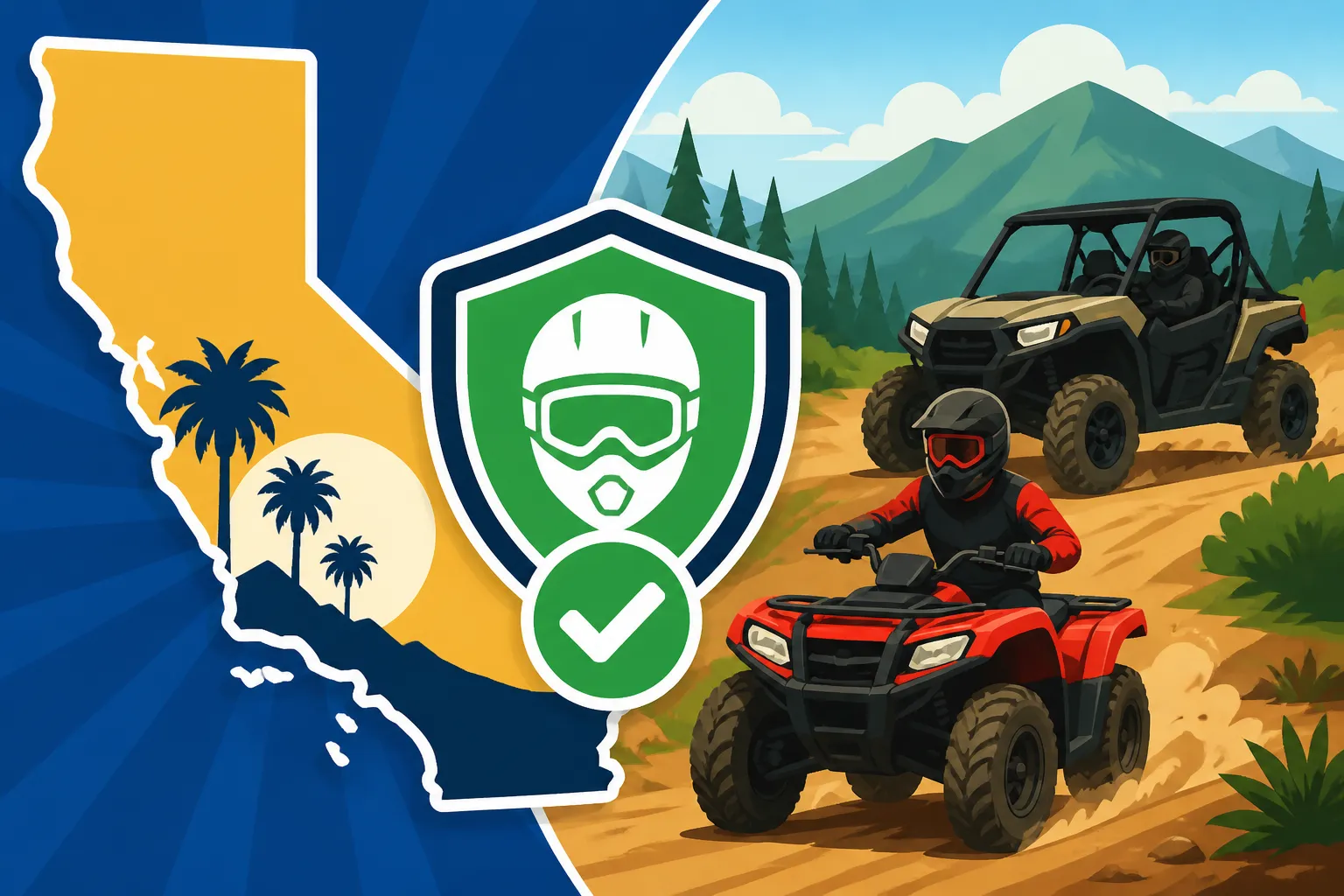
California ATV Safety Certificate Requirements
California ATV safety certificate rules can be confusing because a rider may need training proof, adult supervision, or both, depending on age and the machine. The key point is that a certificate is not a riding permit or a substitute for other age and equipment rules. Knowing what it covers helps families and visiting riders avoid arriving without the right proof.
Who needs a California ATV safety certificate
California’s youth safety requirements apply to off-highway vehicle riding on public lands, including many designated riding areas. For a rider under 18, the general requirement is to have completed an approved safety course and carry proof, or to ride under the direct supervision of an adult who has completed an approved course. Confirm the current rule and any site-specific requirements before riding.
A safety certificate is about training and safe operation. It is not the same as a vehicle registration, an OHV identification plate, or a permit for a nonresident machine. A certificate also does not give someone permission to ride on a closed trail or make an otherwise ineligible machine legal to operate.
| Situation | What to check |
|---|---|
| Rider is under 18 | Confirm whether the rider needs to carry an approved certificate or will ride under direct supervision of a certified adult |
| Rider is 18 or older | A youth certificate requirement generally does not apply, but all other operating rules still do |
| Rider is visiting from another state | Check whether the rider’s certificate is accepted in California and carry proof |
| Machine is a side-by-side or other ROV | Check the separate operator-age and passenger rules; an ATV certificate does not override them |
| Ride is at a particular park or event | Check the site’s rules, since event or rental procedures may add requirements |
The phrase “direct supervision” matters. It means more than having a certified adult somewhere in the group or at the campsite. The adult needs to be in a position to observe and supervise the young rider. If the adult and youth plan to ride separate routes or get far apart, do not assume the supervision requirement is met.
Age can affect which rules apply, but reaching a particular birthday does not automatically make every machine appropriate or remove all restrictions. The rider’s age, vehicle type, supervision arrangement, and the place where the ride takes place all matter. Check the details in [California Rules for Riders Aged 14 to 18] and [California Minimum Age to Ride an ATV] before planning a ride with a young operator.
The rules for a side-by-side can differ from the rules for a quad. A side-by-side is commonly treated as a recreational off-highway vehicle, or ROV, and has its own operator-age and passenger requirements. A certificate does not bypass those restrictions. For a youth driving a UTV, check California ROV Operator Age Limit as well as the safety-certificate rules.
What counts as an approved certificate
The useful question is not simply whether a rider took “an ATV class.” It is whether the course and its certificate satisfy California’s requirements. Training providers may offer courses for different machines, skill levels, or jurisdictions, and a completion card from an unfamiliar program may not establish that the course is accepted for California riding.
Before enrolling, check that the provider identifies the course as appropriate for the rider’s vehicle and that its certificate is recognized for the purpose required in California. Ask what proof the rider receives when the course is completed and whether the certificate can be accessed again if the original is lost. If the provider cannot explain whether the certificate meets California requirements, check with the relevant state or riding-area authority before relying on it.
A proper safety course is useful beyond satisfying a paperwork rule. It can cover protective gear, controls, braking, turning, terrain, and safe riding habits. Young riders often need practice matching speed and control to the trail rather than simply learning how to start the machine. A certificate is evidence of training, not proof that the rider is ready for every route or machine.
A course certificate also does not replace parental judgment. A rider can meet the training requirement and still be too inexperienced for steep hills, deep sand, traffic around a busy staging area, or a machine that is difficult to control. Choose terrain and a vehicle that fit the rider’s height, strength, experience, and ability to reach and use the controls safely.
Certificates from outside California
Visitors should not assume that every out-of-state card is automatically accepted. Some training certificates may be widely recognized, while others may be tied to a particular state, provider, or course. Check the issuing organization and ask whether the certificate is acceptable for California OHV use before traveling. The same caution applies to online course records: make sure the document identifies the rider and course clearly enough to serve as proof.
If a youth will rely on an adult’s certificate instead, the adult should verify that their own training qualifies and that they can meet the direct-supervision requirement during the ride. A parent’s experience operating an ATV is not necessarily a substitute for completing a qualifying safety course.
For additional details, see Out-of-State Safety Certificates in California and California Safety Certificate for Visiting Riders. Those checks are especially useful when a family travels with a mix of California and out-of-state riders, or when a youth has completed a course through a provider based elsewhere.
How to prepare before riding
A little preparation prevents a common problem: arriving at the riding area with the right machine but no usable proof of training. Use this checklist before leaving home.
- Confirm the machine category. Determine whether the youth will operate an ATV or an ROV such as a side-by-side. Do not assume that rules for one automatically cover the other.
- Check the rider’s age and supervision plan. Decide whether the young rider will carry their own certificate or ride under the direct supervision of an adult with an accepted certificate.
- Verify the course and certificate. Confirm that the course is recognized for the California requirement and that the certificate or completion record is available.
- Check the riding area. Review the rules for the park, public land, or organized event. A site may have additional procedures or restrictions.
- Pack proof where it can be found. Keep the certificate accessible, rather than buried in a bag or stored only in an account that may be difficult to open without a signal.
- Review the machine’s fit and condition. Check that the rider can reach the controls and that the machine is appropriate for their size and skill.
- Discuss boundaries and signals. Agree on where the youth may ride, how the group will stay together, and what to do if someone becomes separated.
Carrying a paper copy can be helpful, even if the provider also offers an electronic record. A phone may lose power, lack service, or be difficult to use at a checkpoint. Keep a copy protected from water and sand, and make sure the name on the certificate matches the rider’s identification or other records when possible.
The certificate is only one part of a youth rider’s paperwork and preparation. A machine may also need the correct California identification, while an out-of-state machine may require an accepted permit or other documentation. For that side of the trip, see California’s Nonresident OHV Use Permit and California OHV Reciprocity: Only Two States. Safety training and vehicle authorization address different things, so having one does not replace the other.
Renting or joining an organized ride
Rental shops and event organizers may ask questions about age, training, or supervision before handing over a machine or allowing a rider to participate. Their requirements can be stricter than the minimum rule that applies to public-land riding. Confirm requirements with the business or organizer before booking, especially when a minor will operate the machine.
Do not assume a rental counter’s course or briefing automatically provides the certificate required for later riding. Ask what the training covers, who issues the record, and whether the rider receives proof to take away. A safety orientation may explain the rental machine and local boundaries without being the same as an approved safety course.
If a young rider will use a rented ATV, confirm the minimum age, supervision conditions, vehicle size, and who is allowed to operate it. The rental agreement may limit the rider to a specific area or require an adult to remain nearby. If the machine is a side-by-side, ask about the separate ROV age rules and passenger limits.
Common misunderstandings to avoid
“The adult has a certificate, so the youth can ride anywhere.”
No. Adult supervision addresses only the youth safety requirement. The ride still has to comply with land-access, route, vehicle, equipment, and site rules. The adult must also supervise directly, not simply be present somewhere in the area.
“A certificate makes a youth old enough for any machine.”
No. A certificate does not cancel age restrictions for a particular vehicle type or make a machine suitable for a young rider. Check the separate requirements for ATVs and ROVs, and follow the machine’s safety instructions.
“An out-of-state course card must count.”
Not necessarily. Verify that the course and certificate are accepted for California use. If the rider plans to rely on the adult-supervision option instead, verify the adult’s certificate and plan the ride so direct supervision is practical.
“A certificate is the same as a California permit.”
No. A safety certificate proves training. A nonresident use permit or vehicle identification addresses whether a machine may be operated in California under the applicable rules. Visitors should check both issues rather than treating one document as a substitute for the other.
“Adults do not need to think about safety training.”
Even where an adult is not subject to the youth certificate requirement, training remains useful. Adults may also need a qualifying certificate if they are supervising a minor under the applicable rule. A supervising adult should confirm that their credential meets the requirement rather than relying on experience alone.
“If no one asks for the certificate at the entrance, it is not needed.”
A lack of a document check at one point does not change the operating rule. Keep the required proof available and follow the rules even when no ranger or staff member asks to see it.
The safest approach is to settle three questions before the trip: Is the certificate acceptable? Is the rider’s age allowed for this machine? Can the planned adult supervision be maintained on the route? If any answer is uncertain, check with the appropriate authority or riding area before riding. For a broader overview of youth requirements, see What a Rider Under 18 Must Carry in California.
Disclaimer
This article is for general informational purposes only and does not constitute professional advice. Laws, prices and regulations vary by location and change over time. Consult a qualified professional for guidance on your specific situation.