Trailer Parking on a Packed Weekend
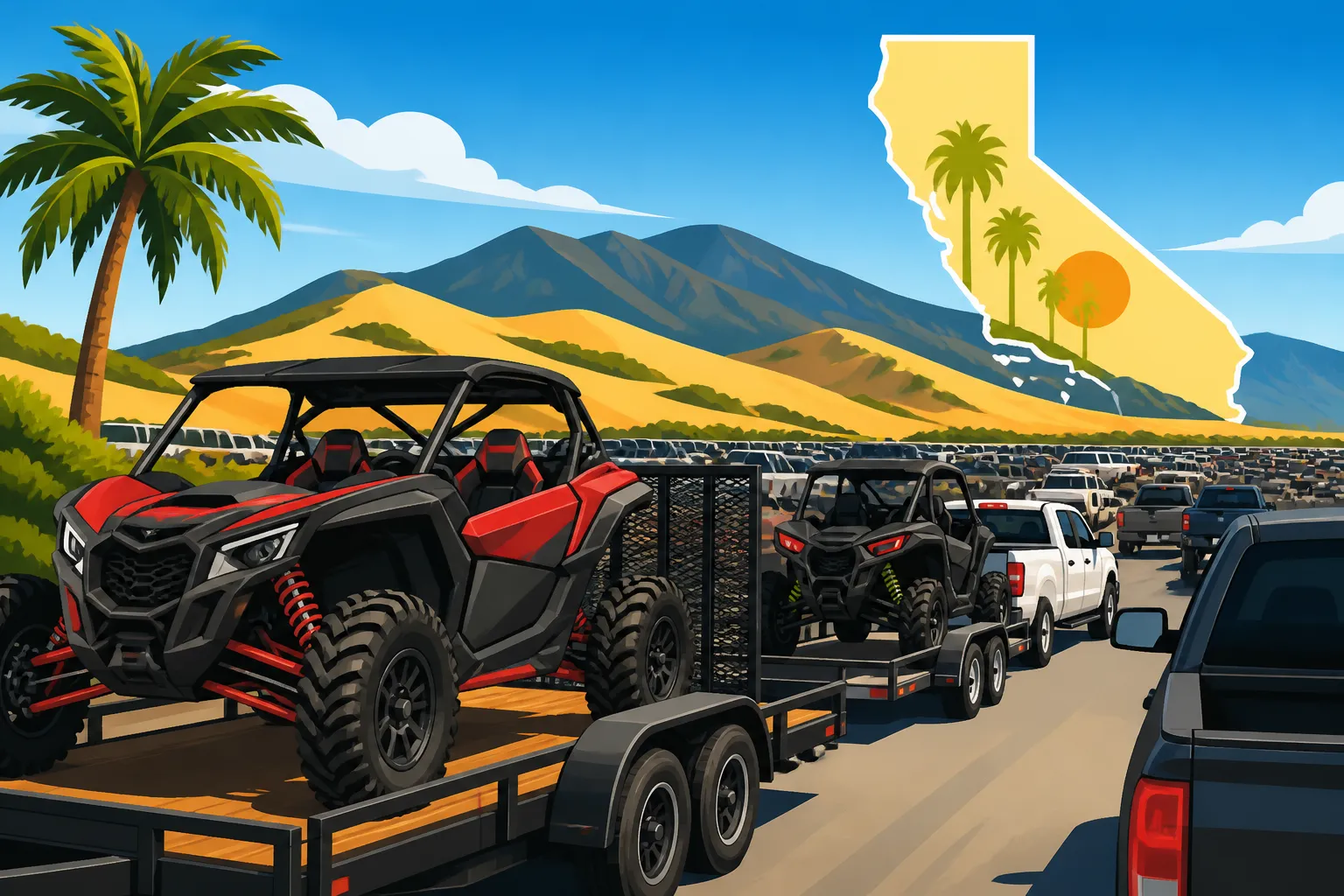
A packed weekend at a California riding area can turn the last stretch of your trip into the hardest part: trailers back up, familiar parking spots disappear, and a tight turnaround becomes a stressful three-point maneuver. This guide helps you plan where to park, arrive with a workable backup, and avoid blocking other riders or access routes.
Plan your parking before you leave
Check the riding area and its access details
Trailer parking is not the same at every California OHV destination. A broad desert staging area near Glamis has a different layout and set of challenges from a developed SVRA such as Hollister Hills or Prairie City. Even within one area, the available space can vary by campground, staging zone, entrance, and the kind of trailer you are towing. Don’t assume that a spot you used on a quiet weekday will be available on a holiday weekend.
Start with the riding area’s official information and identify the entrance, permitted parking or camping zones, posted restrictions, and any access updates. Look for details about trailer length limits, overnight parking, designated staging areas, and whether parking is allowed only in marked spaces. Rules and layouts can differ between public agencies and individual sites, so an old forum post or a friend’s memory may not reflect what you’ll find at the gate.
Next, decide whether your plan depends on day-use parking, a campground, or a dispersed area where that kind of camping is allowed. A campground reservation, where available, does not automatically mean you can park a tow vehicle and trailer anywhere you like nearby. Confirm how the site handles both the camping unit and the vehicle or trailer you are bringing. For a closer look at overnight planning, see Camping at a California SVRA.
If you are comparing destinations, it can help to start with California OHV Areas That Fill Up on Holidays. For specific busy-weekend examples, Glamis on Thanksgiving Weekend and Hungry Valley on a Weekend can help you think through the different pressures that come with a major dune trip versus a popular riding area closer to Los Angeles.
Make a primary plan and a backup plan
Before you hitch up, write down your preferred parking area and at least one alternative that is actually allowed for your trip. A vague backup such as “we’ll find something nearby” can leave you circling a crowded site with a full-size truck and trailer. A useful backup is a confirmed, legal option that does not depend on squeezing into an access lane or parking on ground that may be closed or private.
Use the map to understand the approach, but don’t treat a map pin as proof that a place is open, suitable for trailers, or available. An app such as onX Offroad can help you review the surrounding roads and terrain before the trip; pair that map view with current information from the land manager. If you expect weak reception, save the relevant map area for offline use before leaving service, then keep a separate copy of important directions and contact details.
Think through your backup in practical terms. If the first staging area is full, can you turn around safely? Is there another entrance that accepts your vehicle and trailer? Would your group be willing to unload at a different location and meet up later? If your alternate plan changes the riding area, check its access rules and closures too. California Trail Closures to Check First is a useful reminder that a route shown on a map is not necessarily open for riding on the day you arrive.
Choose a setup that fits the space
Match the parking plan to your trailer
The trailer that fits easily in your driveway may feel very different in a crowded staging area. Measure the full combination you are bringing, including the tow vehicle, trailer, hitch, and any rear-mounted equipment that affects your turning space. Consider how much room you need to open ramps, unload machines, and walk safely around the setup.
A short utility trailer may be straightforward to maneuver in a marked space, while a long enclosed trailer can need more clearance and a wider turn. A multi-machine setup can also take longer to unload and may occupy more room while gear is being organized. If you are towing a large trailer, look for an appropriate staging or camping area in advance rather than assuming every trailhead or day-use lot can accommodate it.
| Parking situation | What to check before the trip | Practical approach |
|---|---|---|
| Developed SVRA day-use area | Marked parking, entrance details, and posted restrictions | Arrive early and follow staff directions |
| Campground | Reservation rules, vehicle limits, and trailer placement | Confirm what your reservation covers |
| Desert staging area | Access roads, closures, surface conditions, and permitted zones | Choose a legal fallback before arriving |
| Small or narrow trailhead | Turnaround room and trailer suitability | Avoid committing to a route without a safe exit |
| Busy holiday weekend | Expected crowding and overflow guidance | Keep your primary and backup plans flexible |
The table is a planning aid, not permission to use a particular lot or road. A wide-looking space may be reserved, closed, soft, or unsuitable for a heavy tow vehicle. When details are unclear, contact the site or managing agency before the trip instead of testing the limits with a trailer in tow.
Think about turning, unloading, and the ground
A parking spot needs to work for more than the moment you pull in. You may need room to lower a ramp, remove tie-downs, move machines, and gather helmets and riding gear without stepping into traffic. If you have children or several riders in the group, decide where people should wait while the tow vehicle is maneuvering. Keeping everyone clear of the reversing area reduces confusion when visibility is limited.
Ground conditions matter, particularly in sandy desert areas. A spot that looks firm from the cab can give way under a loaded trailer, and trying to reverse repeatedly in loose sand may make the situation worse. Walk the area if it is safe and permitted to do so. Avoid blocking established routes, emergency access, other campers’ exits, or the path to a staging zone just because an open patch seems convenient.
For route planning, California Trail Maps and Where to Get Them can help you think beyond the ride itself. Use onX Offroad to inspect the approach and nearby roads if that is part of your planning routine, but confirm land access and parking rules with the responsible agency. A digital map can show terrain and routes; it cannot tell you that a full parking area has an open space waiting.
Arrive safely and park considerately
Time your arrival without rushing
On a packed weekend, arriving early can give you more choices and leave room to adjust if the first area is already busy. It also gives you time to ask staff or rangers for direction rather than making a hurried decision at the entrance. Check the site’s posted opening information before setting out, and avoid arriving so early that you are waiting where parking or queueing is not allowed.
Coordinate with your group before the drive. Agree on a meeting point, who will speak with staff if plans change, and what to do if one vehicle is delayed. If several rigs are travelling together, don’t assume there will be room to park side by side. A plan to take separate legal spaces and meet at a designated location may be safer and less disruptive than holding up traffic while the group tries to stay together.
If you arrive and see a queue, follow directions from staff and posted signs. Don’t use a road shoulder, entrance lane, or turnout as temporary storage for a trailer unless it is clearly permitted. A line of waiting vehicles can quickly block access for others, and a trailer that has to reverse out of a narrow lane may create a hazard for everyone behind it.
Take your time when positioning the trailer
Crowded lots are not the place to rush a backing maneuver. If a spot looks tight, get out and assess it before turning in. Use a spotter who can stay visible to the driver, agree on simple signals, and stop immediately if the driver loses sight of them. Keep bystanders, children, and pets well away from the truck and trailer while you are backing.
If the trailer cannot fit without crossing a boundary or blocking another vehicle, do not force it. Ask staff where an appropriate space may be available or return to your backup plan. A few extra minutes spent finding a suitable place is usually better than damaging equipment, trapping another vehicle, or having to move everything after you have unloaded.
After parking, check that the tow vehicle and trailer are not obstructing traffic, emergency access, a marked route, or another party’s ability to leave. Keep ramps and gear within your own usable area, and avoid spreading equipment across a neighboring space. Busy sites work best when people leave room for others to maneuver, even when the lot feels frustratingly full.
For a first visit, it may help to review how a particular area handles day use and camping. Hollister Hills Day Use and Camping offers destination-specific context, while California’s State Vehicular Recreation Areas can help you compare the kind of developed riding areas where marked facilities and site instructions may shape your parking plan.
Handle a full lot and leave without creating a problem
Know when to switch plans
Sometimes the primary parking area is simply full. If staff directs you elsewhere, follow that instruction even if the alternate location is less convenient. If there is no clear direction, ask before leaving the managed entrance area to search nearby roads. A nearby dirt turnout is not automatically public parking, and an apparently unused patch may be private property, closed habitat, or a route needed for emergency access.
Keep your alternate plan realistic. It might mean using a different authorized staging area, changing to another riding destination, or postponing the ride rather than leaving the trailer somewhere unsafe. This can be disappointing after a long drive, especially when the whole group is ready to unload, but an improvised parking spot can put vehicles, access, and the day’s ride at risk.
Cell service can be uneven in remote desert and mountain areas. Save the route information and key directions before you leave town, and don’t make the backup plan depend on loading a new map at the gate. If you use onX Offroad, checking the route and saving map information ahead of time can reduce the scramble when a connection is unreliable. Still, verify closures and site directions through official channels whenever possible.
Leave space for the next arrival
Before you depart, collect straps, trash, tools, and loose gear so nothing is left behind or blown into another parking area. Check around the trailer, particularly if you unloaded in low light or on uneven ground. Confirm that ramps are secured and that the trailer is ready for the surface and route ahead.
On the way out, follow the designated exit and any one-way instructions. Don’t cut across a staging area or ride an OHV through a parking lane unless that route is specifically allowed. Keep speeds low around pedestrians and vehicles, and be patient if other visitors are loading or waiting to leave. The same crowded conditions that made parking difficult may still be in effect at the end of the day.
A little preparation makes a busy weekend feel less chaotic: confirm the site’s rules, measure your setup, choose an allowed fallback, and leave room for others once you arrive. That approach works whether you are heading to the dunes near Glamis, a developed SVRA, or a smaller staging area where space is limited.
Disclaimer
This article is for general informational purposes only and does not constitute professional advice. Laws, prices and regulations vary by location and change over time. Consult a qualified professional for guidance on your specific situation.