California Dune Flags and Whips
A dune crest can hide an approaching ATV or UTV until the last moment, especially when the sand is busy and visibility is poor. A properly mounted whip and bright flag help other riders see you sooner. This guide explains common California dune-flag expectations, how to choose and check your setup, and why rules and conditions can differ by riding area.
Why dune flags and whips matter
The crest is the hazard
Dunes are not like a flat trail where you can see far ahead. A rider climbing one side of a ridge may be invisible to someone approaching from the other side. That is why a tall whip and a high-visibility flag are practical safety equipment, not just decoration. They help make your machine noticeable before it reaches the crest.
The risk is easy to underestimate when the sand looks quiet. A group may spread out, a faster rider may arrive from behind, or dust may reduce visibility just as you approach a ridge. A flag does not guarantee that another rider will see you, but it gives them a better chance of spotting your vehicle above the surrounding terrain.
The same concern applies to both ATVs and UTVs. A side-by-side can be larger than a quad, but its roof, roll cage, passengers, and bodywork can still blend into the shape of a dune. A flag mounted high enough to be visible above the vehicle and terrain can make your position easier to read.
What the whip and flag each do
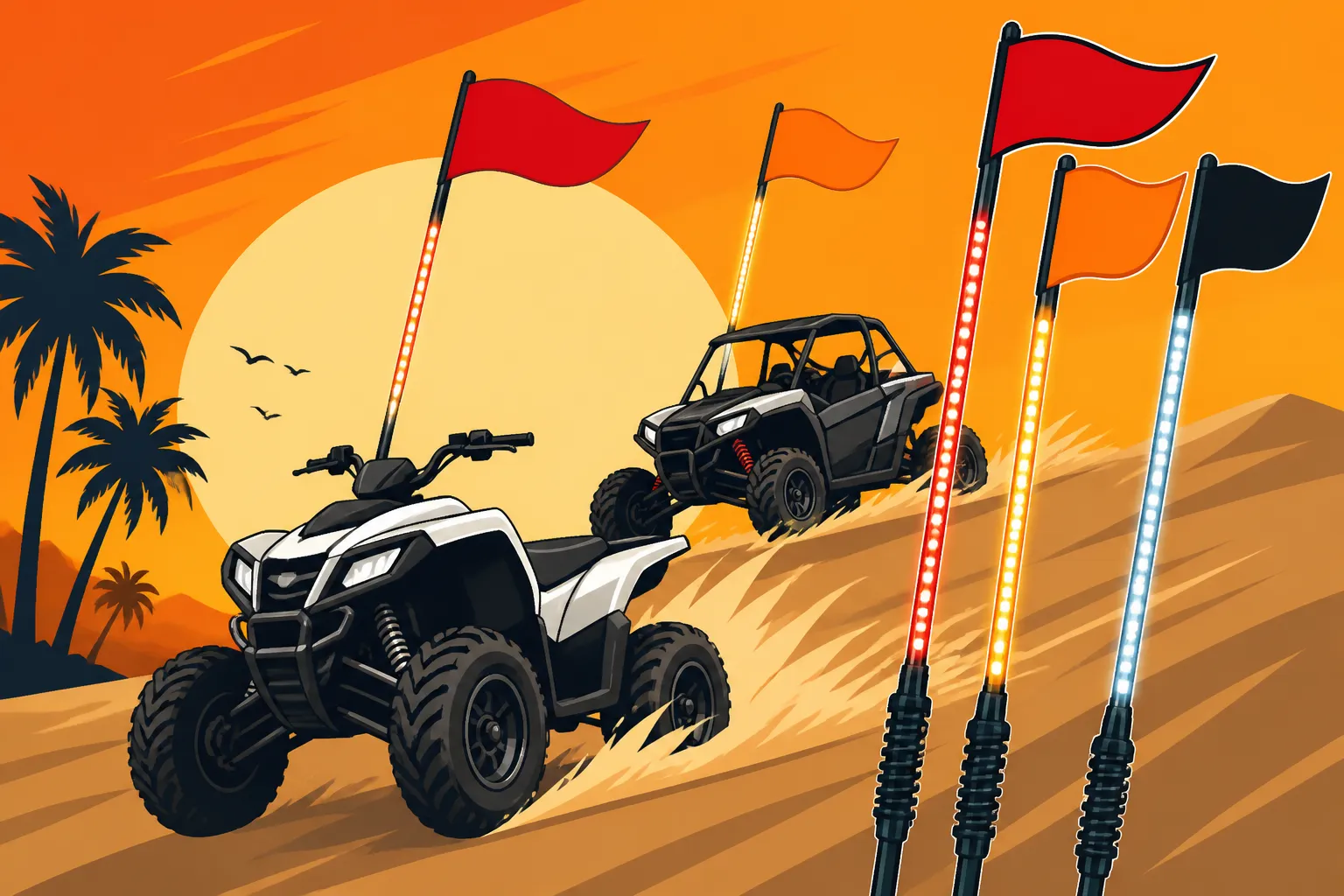
The whip is the flexible mast that raises the flag. Its height matters because a flag mounted too low can disappear behind the dune, vehicle, or dust. Flexibility matters too: a rigid pole can be more vulnerable to damage if it hits an obstacle or is caught by strong wind.
The flag is the visible marker at the top of the mast. Color, size, condition, and placement all affect how noticeable it is. A faded, folded, dirty, or torn flag can be much harder to pick out than a clean one, even if the mast itself is tall enough.
Think of the two parts as a system. A high mast with a small, dark, or damaged flag is not a good setup; neither is a bright flag mounted too low. For a broader look at how California dune requirements fit into riding preparation, see [California Dune Flag Requirements] and [Why Dune Riders Need an 8-Foot Whip and Flag].
Understanding California dune flag requirements
Height, color, and visibility
At major California dune areas, riders commonly encounter requirements for a whip and a high-visibility flag. A familiar baseline is a flag positioned at least eight feet above the ground, with an orange or red flag measuring at least six by twelve inches. These dimensions are often discussed in connection with the Imperial Sand Dunes, but you should not assume that one setup automatically meets every site’s rules.
Pay attention to how a particular area defines height. A requirement may describe the flag’s height above the ground, rather than simply the length of the whip sold in a parts catalog. A mast that is advertised as a certain length may sit lower once its mount, angle, vehicle suspension, or flag position is taken into account.
Color and condition are practical concerns as well as compliance details. Orange and red are common high-visibility choices, but a flag that is dirty, sun-faded, wrapped around the mast, or hidden by accessories will not do its job as well. If you ride in dust, inspect the flag during breaks instead of assuming it will remain visible all day.
Why dimensions are not the whole story
A flag can meet a minimum measurement and still be hard to see in real riding conditions. A vehicle may be parked on uneven ground, the mast may lean backward, or the flag may twist so that it presents only a narrow edge to approaching riders. Dust, glare, and a crowded crest can make those shortcomings more noticeable.
Before a trip, check the specific rules for the riding area and the vehicle you plan to bring. The Imperial Sand Dunes Recreation Area and a state vehicular recreation area may have different posted requirements or enforcement practices. Local notices at entrances and staging areas matter, particularly when restrictions or operating details change.
A useful comparison is to treat the rule and the safety goal as related but not identical. The rule gives you a minimum standard to meet; the safety goal is to remain easy to see from different directions and in changing conditions.
| Setup detail | What to check | Why it matters |
|---|---|---|
| Flag height | Measure from the ground as directed by the area’s rule | A short or poorly mounted whip may put the flag below the required level |
| Flag size | Check the dimensions specified for the riding area | A small flag can be difficult to see over a crest |
| Flag color | Use a highly visible color accepted at the site | Color contrast helps other riders spot you in sand and dust |
| Flag position | Confirm it is placed where the rule requires | A flag mounted too far down the mast may not qualify |
| Condition | Look for tears, fading, dirt, and tangles | Damage and poor visibility reduce its usefulness |
For detail on common size and placement questions, see [Flag Size on California Dunes], [Why Dune Flags Measure 6 by 12 Inches], and [Flags Within 10 Inches of Mast Top]. Check the current posted requirements for your destination before relying on any general measurement.
Choosing and mounting a whip for an ATV or UTV
Match the mount to your vehicle
A whip needs a secure attachment point that suits the machine. On a quad, riders often use a mount designed for the rear of the vehicle. On a UTV, the mount may attach to an approved point on the frame or another location intended for accessories. The right choice depends on the machine’s design, the manufacturer’s instructions, and the riding-area requirements.
Avoid assuming that a mount is secure simply because it fits. A loose clamp can rotate on rough terrain, while a poorly placed mount can interfere with a rear passenger, cargo, body panel, or moving component. Check that the whip cannot swing into a wheel or become caught on equipment when the suspension moves.
Before buying parts, consider how you transport the machine. A tall whip can be awkward under a garage door, in an enclosed trailer, or when the vehicle is loaded beside another machine. Some riders use a removable or folding arrangement for transport, but the mast still needs to be properly installed and raised before riding where a whip is required.
Install it so it stays upright and visible
Follow the whip and mount manufacturer’s installation directions, then inspect the finished setup with the vehicle on level ground. Look at the machine from behind and from each side. The flag should be easy to see, the mast should not be leaning unexpectedly, and the mount should not move when you gently test it.
Do not use the flag’s apparent height while the vehicle is on a stand as your only check. Tire size, suspension position, cargo, passengers, and uneven ground can affect the height once the vehicle is ready to ride. Measure in the configuration you expect to use, while also following the relevant site’s method for measuring.
If the mast is angled, bent, or mounted unusually far back, recheck both visibility and compliance. A flag that clears the roof when parked may be less visible once the UTV is climbing a slope. For additional guidance on height questions, see [California Whip Height Requirements]. If you are unsure whether a particular accessory combination meets the posted rule, ask the riding area’s staff before unloading and heading out.
Checking your flag before and during a ride
A simple pre-ride inspection
It is frustrating to arrive at the dunes, unload the machines, and discover that a flag is torn or a mount is missing a fastener. A quick inspection at home or at camp can prevent that last-minute scramble. Check the fabric, seams, flag attachment, mast, base, and fasteners before each trip.
A practical check takes only a few minutes:
- Confirm the flag is the correct color and size for your destination.
- Look for tears, loose stitching, fading, or dirt that obscures the flag.
- Check that the flag is secured near the required position on the mast.
- Inspect the mast for bends, cracks, or damage.
- Tighten the mount and make sure it does not rotate or wobble.
- Confirm the raised setup clears nearby cargo and does not interfere with passengers or vehicle parts.
- Recheck the flag after loading and unloading the machine.
If you carry a spare flag or replacement hardware, keep it somewhere accessible. A spare does little good if it is buried under camping gear or inside a locked storage box. For group trips, checking everyone’s setup before leaving camp is often easier than dealing with separate problems at a crowded access point.
Recheck after wind, transport, or a rough ride
A setup that passed inspection in the driveway may loosen after a long tow or a bumpy ride. Wind can twist the flag around the mast, and vibration can work fasteners loose. Stop in a safe place and inspect the whip if you notice unusual movement, a new rattle, or the flag disappearing from view.
Do not try to adjust a whip while moving or while stopped in an unsafe spot. Pull clear of active traffic and dunes, park securely, and make the adjustment only when you can do so without putting yourself or others in danger. If the mast is damaged or the mount will not hold, repair or replace it before continuing in an area where a whip is required.
A flag is also easier to maintain if you keep a few basic items with your riding gear: the appropriate tools for your mount, spare fasteners, and a replacement flag if you have one. These small preparations are especially useful on a long weekend at Glamis, where returning to camp for a minor repair can cost valuable riding time.
Riding with a flag in crowded or unfamiliar dunes
Use visibility as one part of safe riding
A whip and flag help with visibility, but they do not make it safe to charge over a crest without checking the terrain. Slow down as you approach a ridge, avoid blind jumps, and leave room for other riders to stop or change direction. A flag is a warning aid, not permission to ride without regard for sightlines.
Keep space between machines, particularly when following a group up a dune. If the rider ahead slows or stops unexpectedly, you need enough room to react. When visibility is reduced by dust, adjust your speed and spacing rather than relying on the flag alone to make your vehicle visible.
At a busy area, choose routes and stopping places carefully. Avoid parking where you block an approach, sit just below a crest, or create a surprise for riders coming from the other side. Review [Riding Etiquette on a Busy Dune] for ways to share popular terrain more safely, and check [California Rules for Riding Imperial Sand Dunes] before planning a Glamis trip.
Check the rules and route information for the area
California has several dune and sand-riding destinations, and the route layout, access points, and local operating details are not identical. A setup appropriate for one area does not automatically answer every question at another. Read the signs at the entrance, follow instructions from staff or rangers, and check any current notices before riding.
Mapping tools can help you understand an area’s roads, staging points, and nearby terrain before you arrive. For example, onX Offroad can be useful for planning where you intend to ride and orienting yourself around mapped routes. Treat a digital map as a planning aid rather than a substitute for posted closures, boundaries, or agency directions.
This matters when the landscape looks open but access is limited or conditions have changed. A route that appears convenient on a map may be closed, restricted, or unsuitable for your vehicle. Use onX Offroad alongside official area information, and keep checking signs on the ground. You can also explore [California Dune Riding Areas] when comparing destinations, then confirm each location’s requirements before setting out.
Before a trip, make the whip and flag part of the same checklist as registration, required permits, protective equipment, and machine condition. Keep a copy of the site’s rules available, especially if you are traveling with riders who have not been to that area before. onX Offroad can help your group discuss routes and landmarks in advance, while the posted rules and signs determine where you may ride.
A little preparation makes the flag more than something you remember at the gate. It gives you time to confirm the mast is high enough, the flag is visible, and the mount is secure before the dunes get crowded. Check again when you arrive, because transport and changing terrain can affect a setup that looked fine at home.
Disclaimer
This article is for general informational purposes only and does not constitute professional advice. Laws, prices and regulations vary by location and change over time. Consult a qualified professional for guidance on your specific situation.