California Riding in Summer Heat
California summer riding can turn enjoyable trails into a serious heat exposure problem, especially when the temperature climbs far from shade, water, and cell service. This guide explains how to choose a safer time and route, prepare your ATV or UTV, recognize heat illness, and make a clear plan for cutting a ride short when conditions become too demanding.
Why California summer heat changes an OHV ride
Desert heat affects riders and machines
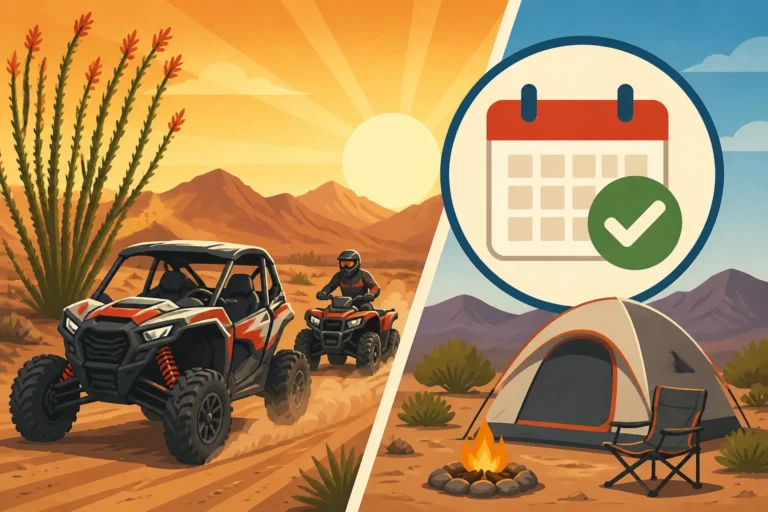
A ride that feels manageable in the morning can become exhausting by midday. In places such as Ocotillo Wells, the Imperial Sand Dunes, and the open desert around Barstow, shade may be scarce and reflective sand or rock can add to the strain. Even when the air feels tolerable at camp, the route itself may offer little relief.
Heat also makes ordinary riding tasks harder. A rider who is dehydrated or overheated may become less alert, slower to react, or more likely to misjudge a slope or turn. Dust, goggles, helmets, and protective clothing are important parts of riding, but they can make it harder to notice how quickly your body is heating up.
The machine has its own limits. Engines, tires, belts, and other components work under demanding conditions on slow, sandy, steep, or technical routes. Heat does not automatically mean a machine will fail, but a mechanical problem far from camp can turn a hot ride into a longer and more difficult situation. Leave room in the plan for a turnaround, a breakdown, or an unplanned stop.
Heat risks vary across California
“California summer riding” does not describe one uniform set of conditions. The desert around Glamis and Ocotillo Wells can feel very different from a shaded forest road in the Sierra foothills or a coastal route near Oceano. Elevation, shade, wind, humidity, sun exposure, and the surface under your tires all influence how demanding a ride feels.
A breezy day can be deceptive. Wind may make a rider feel cooler while sun exposure and exertion continue to take a toll. Conversely, a route with little breeze can feel oppressive even if it is not the hottest location in the state. Pay attention to the conditions where you will actually be riding, not only the forecast for the nearest town.
Before choosing a destination, consider how exposed the route is and whether there are realistic places to pause or return from. A shaded national forest road and an open desert loop call for different preparation. For broader destination planning, compare options in [California Riding Seasons by Region] and [California OHV Areas in the National Forests].
Plan the ride around the heat
Choose a shorter route and an earlier start
One of the simplest ways to lower heat exposure is to ride during the cooler part of the day and finish before the hottest conditions set in. Starting early is useful only if the group can get organized without rushing: fuel, water, helmets, machine checks, and route planning all take time. A hurried departure can lead to missed gear or a poor decision about the day’s route.
Make the first ride shorter than you think you need. A loop that seems easy on a map may take longer than expected because of sand, navigation, stops, or a slow rider in the group. Set a firm turnaround time before leaving camp, and do not extend the outing just because everyone feels fine at the start.
A shorter plan should not depend on reaching one particular landmark. Pick a route with a simple way back, and agree on a point where the group will turn around if anyone feels unwell or the machines begin to struggle. If you are visiting a new area, [California Trail Maps and Where to Get Them] can help you think through navigation, while [California Trail Closures to Check First] is a useful reminder to confirm that routes are open before you leave.
Check access, closures, and route details
Conditions and access can change because of fire danger, maintenance, weather, land management decisions, or other temporary restrictions. A trail shown on an older map may not be open when you arrive. Check the relevant land manager’s current notices before traveling, then check again before setting off if you have service.
Digital maps can help you identify route options, junctions, and nearby alternatives, but they should not be your only navigation plan. Riders sometimes use onX Offroad to explore routes and save maps for offline use before entering areas with unreliable reception. Download the information in advance, keep your device charged, and carry a backup map or a second way to navigate.
Look beyond the line on the map. Ask whether the route has steep climbs, soft sand, narrow sections, exposed ridges, or long stretches without an easy exit. A route that is reasonable in mild weather may be a poor choice in severe heat, particularly for newer riders or a group with children. If the route’s difficulty or length is uncertain, choose a more conservative option.
| Planning question | Why it matters in hot weather | Safer choice |
|---|---|---|
| How exposed is the route? | Sun and reflective ground can increase heat strain | Favor shorter routes with shade or places to pause |
| How far is the turnaround? | A long return can become difficult if someone feels unwell | Set a time-based turnaround before departing |
| Is the route open? | Closures can force detours or leave riders without the planned exit | Check land manager notices before the trip |
| Will navigation work offline? | Cell service may be absent in remote areas | Save maps in advance and carry a backup |
| Can the whole group ride comfortably? | A slower rider may be exposed longer than the rest | Match route and pace to the least experienced rider |
Prepare riders and machines before leaving
Carry water and make a practical gear plan
Bring more drinking water than you expect to use, and divide it so it remains accessible during the ride. A large container back at camp does not help much if the group is several miles away and already feeling unwell. Keep water where riders can reach it without unloading gear or stopping in an unsafe place.
Hydration is not just a last-minute response to thirst. Encourage everyone to drink regularly before and during the ride, especially after sweating. If the trip involves heavy exertion or prolonged sweating, consider how you will replace electrolytes as well as fluids. Follow product directions and avoid treating sports drinks, supplements, or any single hydration strategy as a substitute for shortening the ride when someone is overheating.
Gear should protect without adding avoidable discomfort. Wear the required protective equipment, including a properly fitted helmet, and choose clothing suited to the route and conditions. Do not remove safety gear while riding to feel cooler. Instead, take a proper break in a safe location, use shade where available, and reassess whether continuing is sensible. For desert-specific preparation, see [California Desert Riding Safety].
Inspect the ATV or UTV and pack for a delay
A quick pre-ride inspection is especially worthwhile when a hot-weather breakdown could leave the group exposed. Check fuel, tires, brakes, lights, controls, and any model-specific items described in the owner’s manual. For a UTV, confirm that seat belts and other safety equipment are ready for everyone who will ride. Address a known issue at camp rather than hoping it will hold up on the trail.
Pack for more than the planned ride time. Bring a first-aid kit, a way to communicate, basic recovery equipment suitable for the route, and enough water for an unexpected delay. Tell someone who is not riding where you are going and when you expect to return. If the group does not check in on time, that person should know whom to contact and where to start looking.
Route planning tools can help with this preparation, but they do not replace judgment. Some riders use onX Offroad to save an offline route and mark a planned turnaround or camp location. Before departure, make sure every rider understands the route, the expected return time, and what to do if the group becomes separated. A saved track is most useful when people know how to use it.
Recognize heat illness and respond early
Notice the warning signs before they escalate
Heat illness can begin with symptoms that are easy to dismiss as ordinary tiredness. Watch for unusual weakness, headache, dizziness, nausea, heavy sweating, muscle cramps, or a person who seems confused or unusually irritable. A rider who is struggling may not be the first to say so, particularly if they do not want to hold up the group.
Check on one another directly instead of relying on a casual “You good?” Ask how someone feels, whether they are dizzy or nauseated, and whether they can think clearly. Pay attention to behavior as well as appearance. A rider who is moving slowly, making uncharacteristic mistakes, or having trouble following simple instructions needs a break and an honest reassessment.
Heat stroke is a medical emergency. Confusion, fainting, seizures, loss of consciousness, or a very hot body are reasons to call emergency services immediately. Do not leave a severely ill person alone or ask them to ride back to camp. If you are unsure whether symptoms are serious, treat the situation cautiously and seek medical help.
Stop riding when someone is unwell
Move the person to the coolest safe place available and call for emergency help if symptoms are severe, worsening, or suggest heat stroke. Start cooling them while help is on the way: loosen or remove excess outer layers, use cool water or wet cloths if available, and improve airflow. Follow instructions from emergency dispatchers and do not delay a call while trying to manage a serious case on your own.
If the person is alert and able to swallow, offer small amounts of cool water. Do not force fluids into someone who is confused, faint, vomiting repeatedly, or unable to swallow safely. Avoid assuming that a few sips or a short rest means the person is ready to ride again. Even when symptoms improve, continuing into hotter or more exposed terrain can bring them back.
The group should stop too. One person’s symptoms affect everyone’s plan, and splitting up can make a bad situation harder to manage. Use the route plan to choose the safest way to reach help or return, and communicate your location as clearly as possible. For more on general riding preparation, [California OHV Areas With Beginner Trails] can help you choose a manageable outing when not everyone in the group has the same experience.
Make a flexible plan for the whole group
Set expectations before the ride
Agree on the day’s limits before anyone starts the engine. Decide the latest time the group will be out, how often you will pause, what conditions will trigger a turnaround, and who will make the call if a rider feels unwell. This prevents an awkward debate on the trail when people are tired and eager to keep going.
Give every rider permission to speak up without needing to prove they are tough enough to continue. A new rider may be reluctant to ask for a break if everyone else seems comfortable. Children and passengers may also have difficulty describing how they feel, so adults should check in frequently and be ready to end the ride early.
Keep the plan simple enough that everyone remembers it. Identify the meeting point, the return route, and what to do if the group separates. If a rider has a phone or GPS device, make sure they know how to share their location or use the saved route. With onX Offroad or another mapping app, it can help to review the route together at camp rather than expecting everyone to figure it out while riding.
Know when to cancel or switch activities
A good plan includes an option not to ride. If the forecast, fire restrictions, route exposure, or a rider’s health makes the trip feel unsafe, postpone the ride or choose a less demanding activity. The cost of changing plans can be frustrating, especially after arranging time off, travel, and camping. But a destination will still be there; a heat-related emergency on a remote route can affect the entire group.
You can also change the day without abandoning it. Spend the hottest part of the day resting at camp, maintain the machine, explore a nearby town, or take a shorter ride later if conditions allow and access is open. Do not treat a change in schedule as a failure. It is often the most practical response to conditions that are different from what you expected.
For destination ideas, compare the terrain and facilities before choosing a location in [California OHV Areas Open Year Round] or [California OHV Areas With Beginner Trails]. Those categories can help narrow the search, but they do not guarantee that a specific route is open or appropriate for a hot day. Check local conditions, plan conservatively, and leave yourself a straightforward way to stop early.
Disclaimer
This article is for general informational purposes only and does not constitute professional advice. Laws, prices and regulations vary by location and change over time. Consult a qualified professional for guidance on your specific situation.