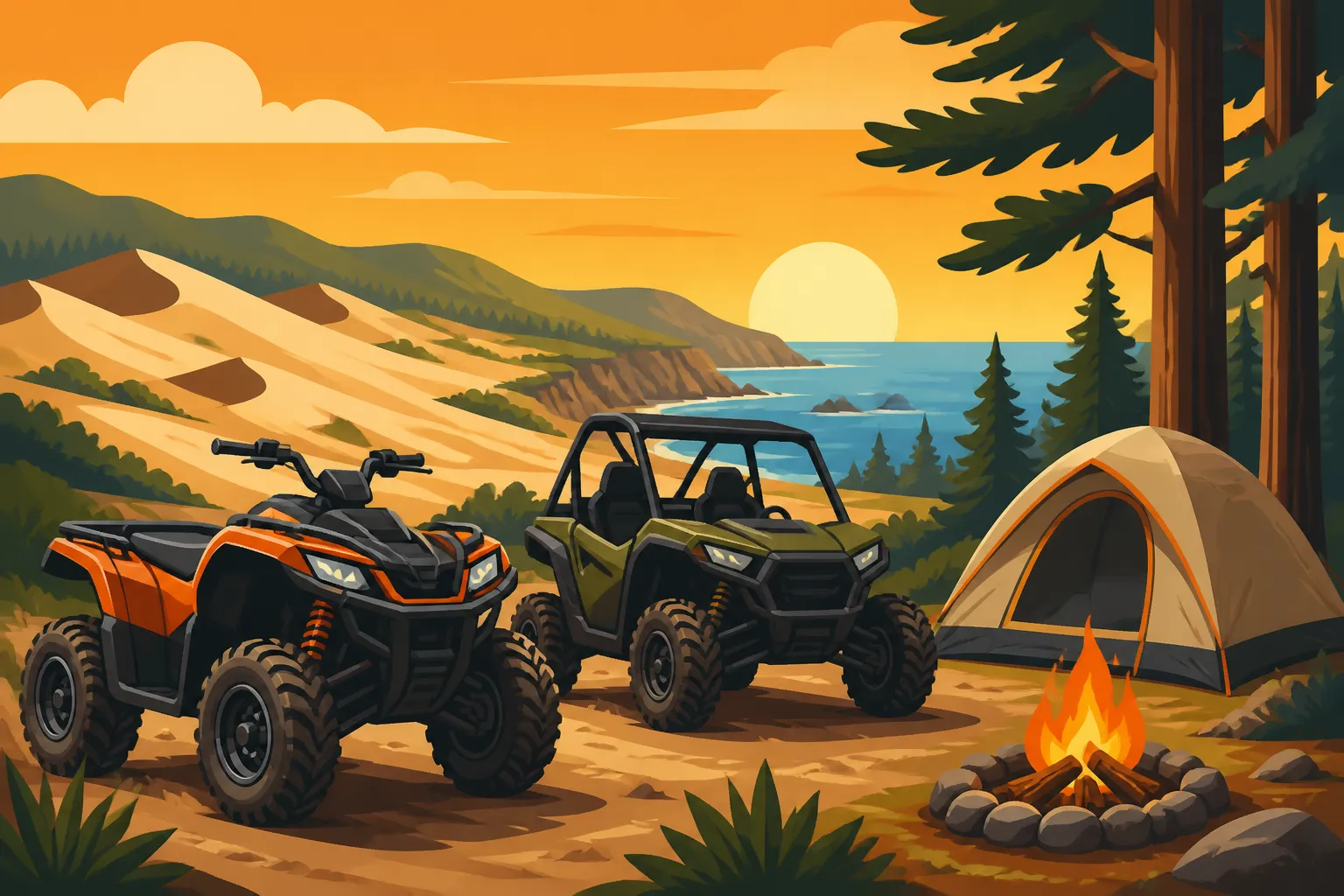
Camping at a California SVRA
Camping at a California State Vehicular Recreation Area can make an ATV or UTV weekend easier: you stay close to the riding, avoid towing back and forth, and can start early. The tricky part is that “camping at an SVRA” does not mean the same thing at every park. This guide helps you choose a location, check the rules, and prepare for a comfortable, responsible trip.
Understand what camping at an SVRA involves
Camping options vary by park
California’s State Vehicular Recreation Areas are managed for off-highway recreation, but their overnight facilities are not interchangeable. One park may have designated campgrounds, another may offer a more basic overnight experience, and some riding areas may not allow camping at all. Even within a park, the areas where you can camp, park a trailer, or ride from camp can differ.
That distinction matters when you are planning around a machine. A site that works for a small tent may not fit a truck and toy hauler. A campground close to a riding area may still require you to trailer your ATV or UTV to an approved staging area. Do not assume that because you can ride at a location, you can camp beside your machine there.
Start with the park’s official camping information, then confirm the details that affect your group: whether overnight stays are allowed, how sites are assigned, what vehicles fit, and whether facilities are available. The overview in [California's State Vehicular Recreation Areas] can help you compare the different riding areas before you commit to a particular trip.
Separate camping access from riding access
A campsite reservation, where one is required, does not necessarily answer every question about riding. You may need to confirm that your machine is permitted in the area, that you can reach the riding zone from camp, and that any route between the two is open to OHVs. If a route is closed or not designated for riding, a short-looking map connection is not permission to use it.
This is especially important when a campground sits near a town, public road, private land, or a section of a park with different rules. The safest assumption is that you will ride only on routes the park identifies as open to your vehicle type. If the campground and riding area are separated, ask whether you need to load up and trailer between them.
Use a park map as the authority for park routes and closures. A navigation tool such as onX Offroad can be useful for organizing a trip and viewing route context, but it should not replace posted signs, official maps, or current park instructions. Before setting off, compare your planned ride with the park’s guidance and adjust if anything conflicts.
Choose an SVRA that fits your camping style
Compare facilities, access, and riding terrain
A good destination is not simply the one with the most exciting terrain. It is the one that fits your riding ability, camping setup, travel distance, and tolerance for basic facilities. For example, a family with young riders may prefer a familiar campground and manageable trails, while a group with a large trailer may need to prioritize vehicle access and space.
Hungry Valley, near Gorman, is known for designated camping areas; check [Hungry Valley's Designated Campgrounds] for park-specific context. Hollister Hills, near Hollister, combines riding areas with camping options, but the arrangement and facilities should be confirmed for the part of the park you plan to use. [Hollister Hills Day Use and Camping] is a useful related topic when comparing an overnight trip with a day visit.
Ocotillo Wells in Imperial County offers a distinctly desert-style outing. Conditions, distances, and services can feel very different from a developed campground, so a plan that works at a foothill park may not work there. Check the local camping rules, especially if you are considering a longer stay; [Ocotillo Wells and California's Thirty-Day Camping Rule] discusses a park-specific issue that should not be generalized to every SVRA.
| Planning factor | Questions to ask before choosing | Why it matters |
|---|---|---|
| Overnight access | Is camping allowed in the area I want to visit? | Riding access does not automatically include camping access. |
| Site size | Will the site accommodate my tent, trailer, and tow vehicle? | A tight fit can make setup and departure difficult. |
| Machine access | Can I ride from camp, or must I trailer to a staging area? | This changes the day’s schedule and how you transport machines. |
| Facilities | Are restrooms, water, showers, or hookups available? | Facility expectations affect packing and comfort. |
| Terrain | Are routes appropriate for my group’s skill and vehicle type? | A challenging ride can quickly become stressful for beginners. |
| Conditions | Are closures, weather, or seasonal limits affecting access? | Conditions can change the plan even after you choose a destination. |
Match the destination to your group
Think about the least experienced person in your group, not only the most confident rider. A route that feels easy to an adult on a familiar machine may be too demanding for a new rider, a child, or someone riding a wide side-by-side. Look for a destination with options to shorten the day, return to camp, or take a break without feeling pressured to keep up.
If your group includes different machine types, check that the park’s routes and staging arrangements work for all of them. Narrow trails may not be appropriate for a wide UTV, and a technical hill can divide a mixed-ability group. Agree in advance on a regrouping plan and a turnaround point so that nobody feels obliged to attempt an unsuitable section.
Also plan for the non-riding parts of the trip. A long tow, a late arrival, or a campsite without the facilities you expected can wear everyone down before the first ride. If you are taking children, older family members, or first-time campers, prioritize a simple arrival and a comfortable base over squeezing in one more trail system.
Confirm reservations, sites, and park rules
Verify the booking process directly
Reservation systems and camping availability can vary by location and may change with operating conditions. Confirm requirements with the park or its official booking information before you leave home. Check whether you need a reservation, whether walk-up camping is an option, when check-in begins, and what happens if you arrive after the posted check-in window.
Read the site description carefully. “Campsite” can mean different things: a defined space, a more open camping zone, or an area with limits on vehicle placement. Make sure you understand whether the booking covers only the campsite or also includes vehicle entry, riding, or other park charges. Do not assume one payment covers every part of the visit.
For a broader look at booking considerations, see [California SVRA Camping Reservations]. Treat a reservation confirmation as one piece of your plan, not a substitute for checking access conditions. Before departure, verify that the park is open, your camping area is available, and any route you intend to use has not been affected by a closure.
Read the details that are easy to overlook
The fine print is where small misunderstandings become frustrating. Look for limits on the number of vehicles, people, or camping units; rules for additional trailers; restrictions on generators or fires; and quiet-hour expectations. Ask whether a tow vehicle can remain at the site and where extra vehicles should go.
Pay attention to the arrival and departure details, too. If you expect to arrive after dark, confirm whether late arrivals are allowed and how to find your site without driving through restricted areas. If you are bringing a large trailer, call ahead when the site description is unclear. A map illustration may not show the turning space you need in real life.
Keep confirmation details accessible, but do not rely on a phone screen alone. Save the relevant park information for offline reference or carry a printed copy, especially if you are travelling through areas with unreliable service. If a ranger or campground host gives instructions that differ from your assumptions, follow the park’s direction and ask for clarification before moving equipment.
Prepare your vehicle, trailer, and campsite
Plan for the footprint of your whole setup
Measure the space your setup needs before choosing a site. Include the tow vehicle, trailer, ramps, awning, and room to unload or turn around. A campsite that fits the trailer on paper may feel cramped once you account for the vehicle and the people moving around it. If your rig is long or difficult to maneuver, ask about access and turning space before booking.
Think through how you will unload and secure the ATV or UTV. Keep ramps on stable ground, leave room for another vehicle to pass, and avoid blocking access lanes or neighboring sites. If you need to reposition the trailer, do it slowly and with a spotter. A crowded campground is not a good place to rush a backing maneuver.
Pack so that essential items are easy to reach after you arrive. Put leveling blocks, wheel chocks, tie-downs, and basic tools where you can access them without unloading half the trailer. Before you drive off, check that the machine is secured, ramps are stowed, fuel containers are closed and restrained, and loose gear cannot shift during travel.
Make the campsite practical, not just comfortable
Set up the site with a clear separation between cooking, sleeping, and machine-related tasks. Keep helmets, goggles, and gloves in a clean, dry place so they are ready when the riding group is. Put keys, registration documents, and first-aid supplies somewhere that adults can find quickly but that younger children cannot handle unsupervised.
Bring a lighting plan for the campsite, but aim lights down toward your own area rather than into neighboring tents. A small lantern or headlamp is often easier to manage than leaving a bright floodlight on. Keep noise and generator use within the park’s rules and be considerate of people who may be trying to sleep before an early ride. For park-specific expectations at Hungry Valley, consult [Quiet Hours at Hungry Valley].
Weather can turn a tidy campsite into a difficult one. Desert wind can lift unsecured gear; coastal air can bring dampness; and foothill conditions can shift between warm afternoons and chilly nights. Use sturdy stakes where allowed, secure awnings, and keep sleeping gear dry. A simple packing checklist is more reliable than assuming you will find a replacement nearby.
Plan your rides around the campground
Know what is open and suitable for your machine
Before unloading, confirm which routes are open and whether they suit your ATV or UTV. A trail marked for motorcycles may not be appropriate for a wide side-by-side. A route shown on a general map may be closed, restricted, or outside the riding area. Park maps, posted signs, and staff instructions should guide your decisions.
Plan a realistic first ride rather than trying to cover the largest possible area. Choose a route that lets your group return to camp if someone is tired, a machine develops a problem, or the weather changes. Make sure every rider knows the meeting point and what to do if the group becomes separated. A simple plan discussed before starting can prevent confusion later.
Use onX Offroad or another mapping tool to help organize a route, check your position, and note possible waypoints. Download maps before leaving reliable service, and make sure someone in the group understands how to use the app. Still carry or consult official park maps: digital mapping can help you navigate, but it does not establish that a route is legally open.
Carry the essentials and keep the trip controlled
Carry the paperwork and equipment you need for your vehicle and the place you are riding. Requirements can depend on the machine, registration status, and location, so confirm them before the trip rather than relying on what another rider carries. [California OHV Registration Paperwork Checklist] can help you think through the documents to review.
Bring water, a basic first-aid kit, a charged phone or radio where appropriate, and the tools needed for ordinary problems such as a loose fastener or low tire. Tell someone at camp where you are going and when you expect to return. If you change the route, update the people waiting for you whenever you can.
Ride at a pace that allows everyone to stay together safely. Dust, blind corners, loose sand, and uneven ground can make a rider disappear from view quickly. Leave enough space between machines, slow down near campsites and staging areas, and stop in a safe place before checking a map or adjusting equipment. Do not continue into a route that feels beyond your ability simply because it is on the plan.
Manage water, sanitation, fire, and waste
Bring enough water for people and machines
Water planning is one of the easiest things to underestimate, particularly in hot or dry areas. Consider drinking water, cooking, handwashing, and any additional needs for children or longer stays. If the park does not provide potable water where you are camping, you will need to bring your own. Confirm available services rather than assuming a spigot, store, or refill point will be open nearby.
Keep drinking water separate from fuel and other vehicle supplies. Store it where it will stay clean and be easy to access during the day. Do not wait until everyone is thirsty to check whether the group has enough. A ride can last longer than expected because of a wrong turn, a minor mechanical issue, or a regrouping stop.
Sanitation also takes planning. Find out what restroom facilities are available and whether they are near your campsite or riding area. Pack hand sanitizer, soap where appropriate, and supplies for keeping the site clean. If your group includes children, talk through restroom plans before the ride so nobody is caught without a comfortable option.
Follow fire and waste rules carefully
Fire rules vary by park and conditions. Confirm whether campfires, charcoal, or portable stoves are permitted and whether there are restrictions during dry or windy periods. Use only approved areas and equipment, and never assume that a fire is acceptable because you see one at another site. If rules are unclear, ask park staff before lighting anything.
Bring sturdy bags for trash and secure them so wind and wildlife cannot scatter the contents. Pack out what the park does not provide a way to dispose of properly, including food scraps, broken gear, and vehicle-related waste. Do not leave oil, fuel, or maintenance fluids on the ground. If a machine leaks, contain the spill and follow park instructions for cleanup.
Keep food and scented items managed rather than leaving them loose around the campsite. This helps prevent mess, pests, and unpleasant surprises when you return from riding. Before leaving, do a slow walk around the site: check under the trailer, near the fire area, and around the place where you parked the machines. Leave the space in the condition you would want to find it.
Account for weather, comfort, and emergencies
Prepare for the conditions at your chosen area
California’s SVRAs span different climates and terrain, so the same packing list will not suit every destination. Desert heat can make shade, hydration, and early starts especially important. Coastal or fog-prone areas may feel cooler and damp, while higher or inland locations can have chilly nights. Check the expected conditions for the specific area and pack layers rather than relying on a broad regional forecast.
Wind deserves special attention when you are camping with a trailer, awning, or light shelter. Secure anything that can lift or blow away, and be ready to retract an awning if conditions worsen. Dust can get into bedding, food, and machine components, so use sealed storage containers and avoid leaving equipment exposed longer than necessary.
After rain, routes may become muddy, rutted, or temporarily closed. A trail that was manageable in dry weather can be difficult for a beginner after a storm. Check for park advisories and be willing to change the ride plan or spend the day at camp. [California Trail Closures to Check First] is a helpful reminder to verify access before setting out.
Have a plan for breakdowns and changing conditions
Before the ride, decide what your group will do if a machine stops working. Carry basic tools and identify the safest way to get help without sending one person off alone. Make sure every rider knows the campsite location, the planned route, and a meeting point. If the group has different skill levels, keep an experienced rider with the least experienced person.
Cell reception may be limited, so do not build your emergency plan around the assumption that every phone will work everywhere. Save important information before you travel and consider how you will communicate within the group. Tell a person who is not riding where you plan to go and when you expect to return, particularly if you are travelling a long distance from camp.
If weather, fatigue, dust, or mechanical trouble makes continuing a poor choice, turn back early. This can feel disappointing when you have driven a long way, but pushing on often turns a manageable problem into a much harder one. Leave enough daylight and energy to return to camp, secure your machines, and address issues while you still have time and help nearby.
Make your first SVRA camping trip easier
Use a simple arrival-to-departure plan
A little structure makes camp feel less chaotic. Before leaving home, confirm the reservation or camping arrangement, review the park rules, check the machine paperwork, and load supplies in the order you will need them. On arrival, find the approved camping area, confirm where machines may be unloaded, and set up the basics before anyone heads out to ride.
For the first ride, choose a short, familiar route and establish a check-in time. That gives everyone a chance to learn the terrain, understand the park layout, and see how long it takes to travel between camp and the riding area. If everything goes smoothly, you can plan a longer outing the next day with a better sense of distance and pace.
At the end of the visit, give yourself time to pack without rushing. Check that all trash is removed, fires are fully handled according to park rules, machines are secured, and no gear has been left behind. If you noticed an unclear sign, a difficult trailer turn, or a facility that was unavailable, make a note for your next trip while the details are fresh.
Keep expectations flexible
A successful weekend is not necessarily the one with the most miles ridden. Maybe the campground is busier than expected, the wind makes the afternoon uncomfortable, or a beginner in your group needs a shorter day. A flexible plan leaves room to adjust without turning every change into a disappointment.
For mixed groups, agree on a shared definition of a good trip. One person may want a long ride; another may be happy with a short loop and time around camp. Split into groups only if everyone understands the route, has suitable equipment, and knows where and when to meet. Never leave a less experienced rider to manage an unfamiliar area alone.
Finally, treat each SVRA as its own place rather than assuming rules from another park apply. Recheck camping access, facilities, closures, and riding rules whenever you visit somewhere new. That habit helps avoid the most common surprises: arriving with the wrong site setup, expecting unavailable services, or planning a route that does not work for your vehicle or group.
Disclaimer
This article is for general informational purposes only and does not constitute professional advice. Laws, prices and regulations vary by location and change over time. Consult a qualified professional for guidance on your specific situation.