Glamis and the Imperial Sand Dunes
The Imperial Sand Dunes can turn a weekend into a memorable ride—or a stressful one if you arrive without a plan for permits, soft sand, fuel, and camp access. This guide explains how to choose a riding area, prepare your ATV or UTV, understand the basic rules, and make a safer trip to Glamis and the surrounding dunes.
Understand Glamis and the Imperial Sand Dunes
Glamis is part of a much larger recreation area
“Glamis” is often used as shorthand for the Imperial Sand Dunes Recreation Area, or ISDRA, but the riding area extends well beyond the small settlement of Glamis. The dunes sit in Imperial County in Southern California, near the Colorado River and the Arizona border. The Bureau of Land Management manages much of the recreation area, including designated riding areas, access corridors, camping locations, and places where restrictions apply.
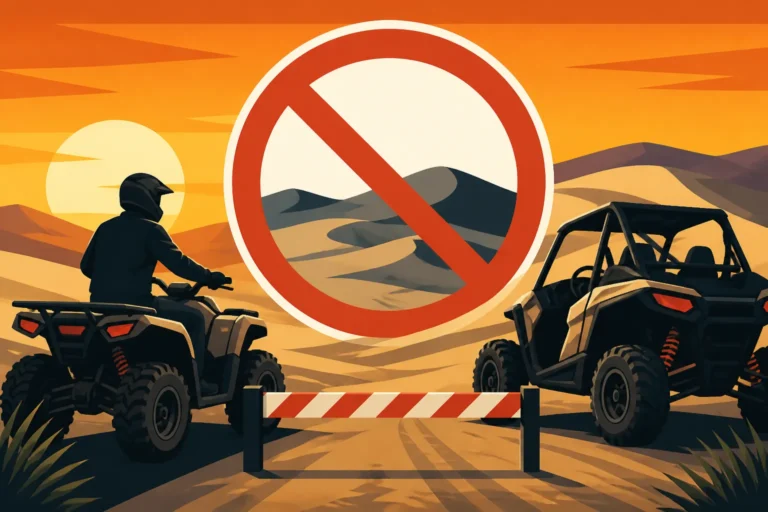
The landscape is not one continuous, unrestricted playground. It includes open sand, established roads, camping zones, sensitive habitat, and areas that may be closed or restricted. A route that looks rideable on a phone map may cross a boundary, a marked closure, or terrain that is unsuitable for your machine. Check current land-management information and signs when you arrive, and treat closures as boundaries rather than suggestions.
The broad region is described in [Imperial Sand Dunes, California's Biggest Dune Field]. That overview is useful for understanding the scale of the area, but planning still comes down to your specific destination, experience, vehicle, and group. If one person in your party is picturing easy rolling sand while another expects steep bowls and long-distance exploring, agree on a location and riding style before unloading.
Choose a zone that suits your group
The main riding zones differ in access, terrain, traffic, and the kind of base camp they offer. Some riders want a convenient place to meet friends and make short loops. Others are looking for room to explore, a quieter camp, or dunes suited to experienced riders. A zone’s name alone does not tell you whether it will suit a beginner, a wide UTV, or a family group.
Use this comparison as a starting point, not as a promise about conditions. Wind, traffic, weather, closures, and seasonal demand can change the feel of a place from one trip to the next.
| Area | Often suits | What to plan for |
|---|---|---|
| Glamis and Gecko Road | First-time visitors who want a familiar access point and established camping areas | Busy weekends, heavy traffic, and the need to confirm where riding and camping are allowed |
| Gordon's Well | Riders using the eastern part of the dunes or arriving via the I-8 corridor | Remote desert conditions and careful fuel, water, and recovery planning |
| Buttercup | Visitors exploring the southern end of the recreation area | Different access logistics from Glamis and a need to confirm local boundaries |
| Mammoth Wash | Riders seeking a more spread-out desert experience | Longer distances, fewer nearby services, and stronger self-sufficiency |
| Ogilby and nearby access areas | Visitors planning a trip around eastern access routes | Verify the exact destination, permitted routes, and current access information before setting out |
For a closer look at the relationship between popular zones, see [Gecko Road, Glamis and Buttercup]. You can also use [California Dune Riding Areas] to compare Glamis with other places to ride in the state. Think about the camp-to-trail distance, not just the ride itself: driving a loaded trailer or a large motorhome over unfamiliar sandy access roads can be a very different challenge from riding an ATV on open dunes.
Pick a season and plan the trip around desert conditions
Cooler months are the usual focus for dune trips
The cooler part of the year is when many riders plan their Glamis trips, with activity commonly building in fall and continuing through winter and into spring. That does not mean every date feels alike. A holiday weekend may bring crowded staging areas and lines of trailers, while an ordinary weekday can feel much quieter. Wind, rain, visibility, and closures can also change the plan even during a popular riding period.
Instead of deciding only by calendar, ask what kind of trip you want. If your group is new to the dunes, a less crowded day may be easier for learning, communicating, and finding a comfortable pace. Experienced riders may enjoy the energy of a busy weekend but should expect more traffic around popular bowls, camp areas, and access roads. [Glamis From October to April] offers a useful seasonal overview, while [Glamis on Thanksgiving Weekend] focuses on one of the busiest kinds of visits.
Summer heat is a different planning problem. Sand and equipment can become extremely hot, and a breakdown or navigation mistake becomes more serious when the group is far from camp. If you are considering riding in hot weather, review [Heat Risk on Desert Sand] and be conservative about the length and timing of your ride. Do not assume that a familiar route will be safe simply because it was manageable in cooler weather.
Build your schedule around travel, not just ride time
A common first-trip mistake is counting only the time spent riding. The full day may also include a long drive, trailer setup, vehicle unloading, permit checks, a safety briefing, and finding a suitable route for everyone. If you arrive late, tired, and eager to make up time, you are more likely to rush the details that help prevent avoidable trouble.
Make a realistic arrival plan. Allow time to find camp in daylight if possible, inspect your machines, and agree on where to meet if anyone gets separated. Set a turnaround time before you leave camp, especially if your route takes you far from your starting point. A ride that begins as a short exploration can stretch out when the group stops to regroup, recover a stuck vehicle, or help another rider.
Check road and access conditions before towing. Routes into the region can be long and exposed, and a trailer issue on the way to the dunes can disrupt the whole weekend. Make sure your tow vehicle, trailer tires, lights, spare parts, and tie-downs are ready. If your plan includes several zones, avoid assuming you can move easily between them during the same outing; distances and access logistics may make a single well-planned base area more practical.
Select the right riding area and route
Match terrain to the least experienced rider
Dune riding can look deceptively simple from camp. The open sand invites people to accelerate, but dunes hide the ground on the other side of a crest. A rider who has not learned to read the terrain may approach a drop too quickly, fail to see traffic on the far side, or climb a face that is beyond their ability. Start conservatively and keep the group within the skills of its least experienced rider.
Before setting off, talk through basic group expectations. Agree on spacing, hand signals or radio procedures, a regrouping point, and what to do if someone cannot continue. Riders should not feel pressured to follow a faster machine into a steep climb or crowded area. If a member of the group is uneasy, choose a gentler route or make a shorter loop rather than treating discomfort as something to push through.
A map can help you orient yourself, but it does not replace local signs or judgment. Some riders use onX Offroad to review routes and save map information before losing cell service. Treat any digital map as a planning aid, not proof that a track is open, legal, or appropriate for your vehicle. Confirm route status with land-manager information and on-the-ground signs, and be ready to turn around if access is restricted.
Know the character of the main access areas
Gecko Road is a familiar point of reference for many visitors heading to the Glamis area. Its established access and nearby camping make it convenient, but convenience can also mean more activity, especially on popular weekends. Plan for vehicle traffic around camp and be patient when people are loading, unloading, or moving trailers through busy areas. Details about the area and its connections are covered in [Gecko Road, Glamis and Buttercup].
Gordon's Well is another well-known destination in the wider dune region. Its location makes it a natural choice for some visitors approaching from the I-8 side, but you should not confuse a recognizable access name with a complete plan. Know where your intended camp is, which roads you need, and whether the route is suitable for your tow vehicle and trailer. A large rig and a small ATV have very different requirements.
Mammoth Wash and Ogilby can appeal to riders looking for a different base or a more spread-out experience. More distance from familiar services means more responsibility for your group: carry enough water and fuel, have recovery equipment that matches your vehicles, and set a clear return plan. For any area, check the current map and land-management notices rather than following tracks simply because other vehicles have made them.
Prepare your ATV or UTV for sand
Inspect the machine before leaving home
Soft sand places sustained demands on an ATV or UTV. Before the trip, inspect tires, wheels, steering, suspension, brakes, lights, belts where applicable, battery connections, and fluid levels. Look for loose fasteners, worn components, damaged wiring, and leaks. A problem that seems minor in a garage can become a difficult repair when the machine is hot, sandy, and several miles from camp.
Bring basic tools and parts matched to your machine. The right kit depends on the vehicle, but may include tire repair supplies, an air source, hand tools, spare fuses, a belt for a belt-driven UTV, and equipment for basic recovery. Test anything you plan to rely on before the trip. Finding out that a compressor does not connect to your valve stem while you are parked in deep sand is an avoidable headache.
Tire pressure is a setup decision, not a universal number to copy from a stranger. Use the manufacturer’s guidance and consider your machine, tire, load, and terrain. Reducing pressure without understanding the limits can cause a tire to debead or damage a wheel; leaving tires unsuitable for the terrain can make handling and traction worse. [Soft Sand and Tire Pressure] explains why riders treat this as a deliberate adjustment rather than a guess.
Carry equipment for heat, visibility, and recovery
Dunes are visually dramatic, but they can also make other riders difficult to see. Follow posted requirements for flags and whips, and make sure your setup is secure and visible. A flag that has worked loose or a whip that has been damaged may no longer serve its purpose. Review [Why Dune Riders Need an 8-Foot Whip and Flag] before departure, and check current requirements for the area you plan to ride.
Pack more water than you expect to need, along with sun protection and clothing suitable for changing conditions. A helmet, eye protection, gloves, and appropriate riding gear are basic parts of a responsible setup. Keep drinking water available while riding rather than buried at the bottom of a packed vehicle. For UTV occupants, check that seat belts, doors or nets, and restraints are in usable condition before each ride.
Recovery gear should be selected with the vehicle and group in mind. A tow strap, shovel, traction aids, and a working communication plan can help, but equipment is only useful if someone knows how to use it safely. Avoid standing in the path of a loaded strap or attaching recovery gear to an unsuitable point. If the group cannot recover a machine without putting people at risk, stop and seek appropriate help rather than escalating a small problem into an injury.
Understand permits, registration, and riding rules
Check what applies to your vehicle and where you ride
California OHV identification and registration requirements depend on the machine and how it is used. Do not assume that a plate or sticker from another state automatically covers every California riding situation. Visitors should check the applicable permit and reciprocity rules for their home state and intended riding area. The overview [California Rules for Riding Imperial Sand Dunes] is a useful starting point, but verify the details that apply to your machine and trip.
The ISDRA has its own permit considerations, and requirements can differ from ordinary state OHV identification. Some visitors need a recreation-area permit during the applicable season. Confirm the current rules, the permit’s coverage, and where it must be displayed before arriving. [ISDRA Permits and California's October Season] explains the seasonal permit context. Do not rely on an old permit, a friend’s paperwork, or an assumption that your tow vehicle and riding machine are treated identically.
Keep registration or permit documents accessible, preferably in a protected place where you can retrieve them if asked. A photo may be handy as a backup, but do not assume it will replace required documentation. If a ranger or law-enforcement officer checks your vehicle, being able to identify the machine and produce the relevant paperwork makes the interaction simpler. [Registration Checks at a Glamis Checkpoint] covers what riders may encounter at a checkpoint.
Respect boundaries, closures, and other users
The dunes include designated areas and restrictions intended to protect public safety, habitat, and other land uses. Watch for signs and barriers, and do not ride around a closed route because the detour looks inconvenient. Avoid disturbing vegetation, wildlife, or marked sensitive areas. A set of tire tracks is not evidence that a route is open, and a digital track may not reflect a current closure.
Ride at a speed that allows you to respond to the terrain and to other people. Crests, bowls, and intersections can conceal oncoming machines. Slow down where visibility is limited, avoid stopping in blind spots, and do not assume another rider can see or hear you. Be especially cautious around camps, access roads, and busy riding areas where vehicles may be moving in several directions.
Rules can also depend on the type of vehicle and the people riding in it. Check age, helmet, passenger, and safety-equipment requirements for your specific machine and group. A passenger should be seated in a position designed for passengers, with the required restraints in place. Do not carry someone on a machine that is not built or approved for that use. A brief pre-ride check of the rules is easier than sorting out a preventable problem at the dunes.
Camp comfortably and manage desert logistics
Choose a camp location with access in mind
A good camp is more than an attractive patch of sand. It should give your group a sensible place to park, unload, secure equipment, and rest without blocking traffic or creating a hazard. Consider the size of your trailer and motorhome, the turning room you need, the distance to your planned riding area, and how you will get help if a vehicle becomes stuck. The most convenient spot for one rig may be awkward for another.
Follow posted camping rules and use established areas where directed. Keep machines, trailers, and gear organized so people can move around camp safely, particularly after dark. Store fuel and equipment securely, and prevent loose items from becoming windblown litter. Quiet hours and other campground rules matter because people come to the dunes for different reasons, and noise carries across an open desert.
If you are considering a base near Gecko Road, read [Camping at Gecko Road] and check current area information before committing. The same principle applies elsewhere: confirm access and camping arrangements before you tow in. Do not count on finding your ideal site late on a busy weekend, and have a backup plan if the preferred area is full or unsuitable for your vehicle.
Bring supplies for a place with limited conveniences
Plan as if you will be responsible for your own water, food, first aid, basic repairs, lighting, and communications. Services and cell coverage can be limited or inconsistent across the region, so do not build a safety plan around being able to call someone instantly. Tell a person who is not riding where you are going and when you expect to return, especially if your group plans to travel away from camp.
Keep food and drinking water accessible, and separate everyday supplies from emergency reserves. A cooler that is emptied during the first afternoon will not help on the drive home. Likewise, a first-aid kit is most useful when it is easy to reach and someone knows where it is. Consider carrying a paper map or other offline navigation backup in addition to a phone. onX Offroad can be useful for reviewing and saving maps ahead of time, but download what you need before you lose service and verify access restrictions independently.
Have a departure plan that includes cleanup and a final vehicle check. Walk the camp area for trash, secure all cargo, and inspect trailer connections and tires before leaving. Dust and sand can make it harder to notice a loose strap or a small item left behind. A few minutes of checking at camp can prevent a roadside problem later in the drive.
Ride more safely in changing dune conditions
Use conservative judgment around crests and bowls
A dune crest blocks your view of what lies beyond it. Approach with enough control to stop or change direction if you discover another vehicle, a person, or an unexpected drop. Avoid charging over a crest simply because the slope on your side looks manageable. The safe speed depends on sightlines, traffic, surface, and your ability—not on how quickly another rider is moving.
Do not follow another vehicle so closely that you lose sight of the ground or have no room to respond. Leave space between machines, especially when climbing or descending. In a UTV group, keep a safe interval and agree on where to stop if a driver has trouble. If you are riding with beginners, take breaks in visible, safe locations rather than stopping in a traffic line or just beyond a blind crest.
Night riding adds another layer of difficulty. Headlights do not reveal every change in slope, and other riders can be harder to judge. If you plan to ride after dark, check whether it is allowed where you are, make sure required lighting works, and choose routes suited to the group. Consider ending the ride before visibility becomes poor rather than treating darkness as a reason to hurry back.
Be ready for stuck vehicles and unexpected separation
Getting stuck is a familiar possibility in soft sand, but panic and repeated throttle can make the situation worse. Stop and assess before spinning the tires deeper. Clear sand from around the tires, reduce unnecessary load if safe, and use suitable recovery tools. Keep bystanders well away from wheels and straps, and never place someone where a vehicle could roll or a strap could snap toward them.
A separation plan should be agreed on before the group rides. Choose a recognizable meeting point, set a time to regroup, and make sure each rider knows the plan if radios or phones fail. In a large group, assign a lead rider and a sweep rider so no one is left behind without anyone noticing. Parents or guardians should keep children within a level of supervision appropriate to the child’s experience and the terrain.
If a vehicle is damaged, a rider is injured, or weather and visibility deteriorate, change the plan. Continuing to the next landmark is not always the safest choice. Use maps as orientation tools, tell the group why you are stopping, and select the safest available route back or a place to wait for help. onX Offroad may support offline navigation, but it cannot assess the condition of a vehicle, confirm that a route is currently open, or replace sound decisions in the field.
Plan a first Glamis visit step by step
Make the key decisions before you leave
A smooth first trip starts with a few decisions made at home. Pick a zone, identify a legal access point, confirm the rules and permit requirements, and decide whether your machine is suited to the terrain. Choose a camp location that can accommodate your trailer and group. If you are still comparing destinations, [Where to Ride an OHV in California] can help put Glamis in context with other state riding areas.
Next, match the outing to the people coming. A group with a first-time rider, a young driver, or a large side-by-side should not plan the same route as an experienced group on smaller machines. Discuss the day’s pace, the likely terrain, and who has authority to call a stop. Make sure everyone understands that turning around is a reasonable decision, not a failure.
Finally, check the practical details: fuel range, food and water, tire condition, safety equipment, recovery gear, navigation, documents, and expected weather. Share the plan with someone outside the group. If your route or camp changes, let that person know when practical. Preparation will not remove every uncertainty, but it reduces the number of avoidable problems you have to solve in the sand.
Use a simple day-of checklist
Before unloading, walk around the tow vehicle and trailer. Check the hitch, safety chains, lights, tires, straps, and cargo. Once the machines are off the trailer, inspect them again rather than assuming they survived the drive without shifting or loosening. Confirm helmets, goggles, flags, and required safety equipment are in place before anyone starts the engine.
At the trailhead or camp, take a moment to orient the group. Point out boundaries, identify the planned route, confirm the turnaround time, and agree on what to do if someone gets separated. Keep the first ride short and easy enough to learn how the sand and traffic feel that day. Conditions can vary across the dunes, so do not treat yesterday’s route report as a guarantee.
When the group returns, check the machines for damage, overheating, loose parts, and sand buildup. Refill water, rest, and decide whether conditions still support another outing. Fatigue often creeps up gradually, particularly in heat and glare. Ending the day early can be the best decision you make—and it leaves you with a better chance of enjoying the next trip.
Disclaimer
This article is for general informational purposes only and does not constitute professional advice. Laws, prices and regulations vary by location and change over time. Consult a qualified professional for guidance on your specific situation.