Getting From a Campsite to the Dunes Legally
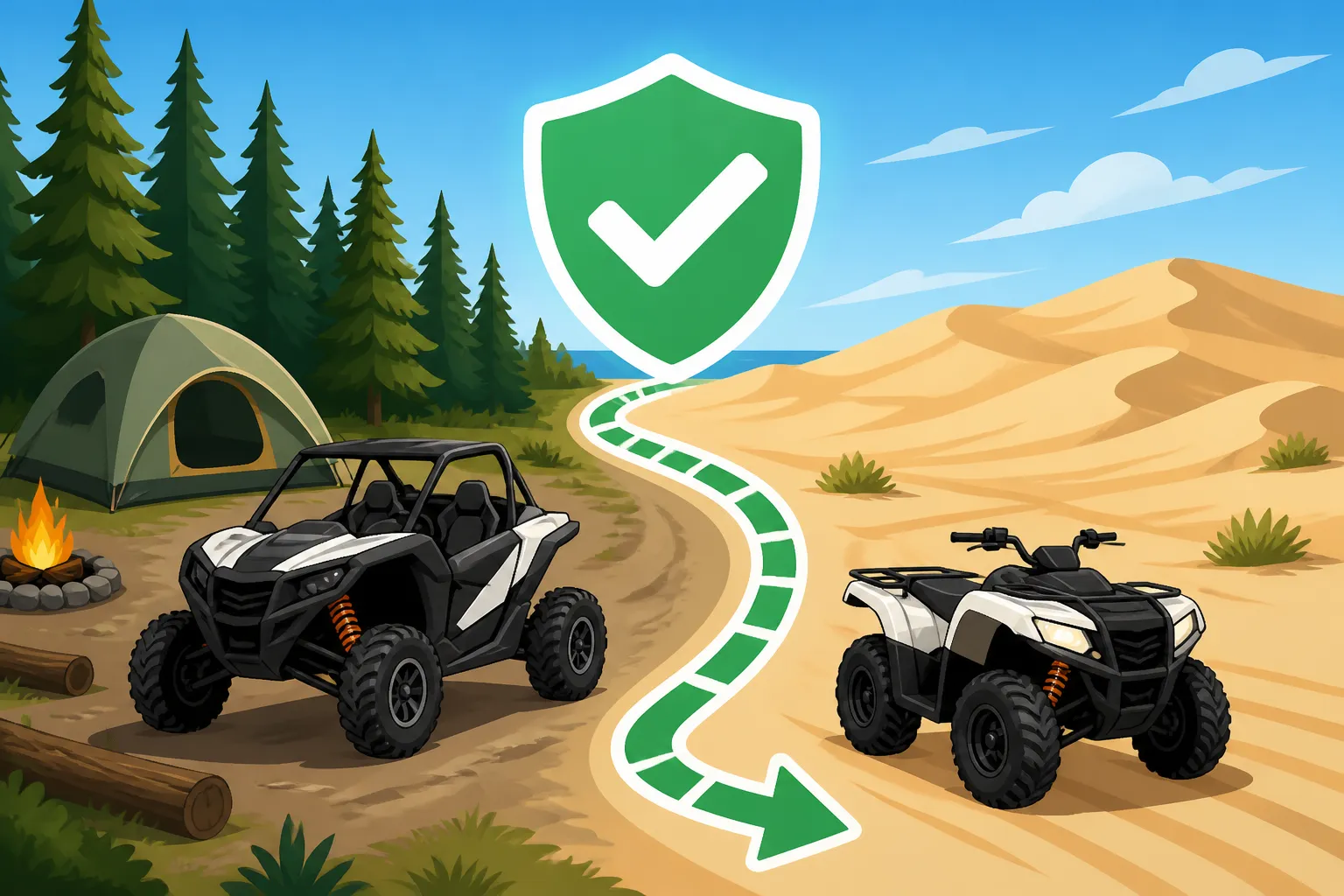
It's a common scenario, isn't it? You've got your off-highway vehicle (OHV) all loaded up at the campsite, the dunes are just a short distance away, and you're thinking, "Wouldn't it be great to just drive it right over there?" The frustration of having to trailer your machine for what seems like a stone's throw can be immense. This guide is here to shed light on the complicated reality of California's laws regarding OHV use on public roads, helping you understand when and how you can legally get your quad or side-by-side from your camp to the sandy playgrounds without breaking the bank on tickets.
The Dream vs. The Reality: Why Most OHVs Can't Just Drive to the Dunes
Let's face it, the image of just hopping on your ATV or UTV and cruising a short distance down a paved road to the trailhead or dune entrance is a tempting one. It's convenient, it saves time, and it feels like it should be allowed for such short distances. However, California's vehicle codes draw a very distinct line between off-highway vehicles and street-legal vehicles, and this distinction is the bedrock of why you generally can't simply drive your dirt machine on public roads. It's not about how far you're going; it's about the fundamental classification of your vehicle.
The Core Distinction: OHV vs. Street-Legal Vehicle
The fundamental issue is that off-highway vehicles, by their very design and registration, are not intended for street use. When you [Registering an OHV in California], you're getting an identification plate or sticker that allows you to ride on designated off-highway routes and in State Vehicular Recreation Areas (SVRAs), not public highways. These machines lack many of the features required for road safety and compliance in California, such as specific lighting, turn signals, rearview mirrors, and often even emission controls that differ from street vehicles.
Think about it this way: your ATV or UTV is built for rugged terrain, for powering through sand washes, climbing hills, and navigating trails. It's optimized for dirt, mud, and sand, not for sharing asphalt with cars and trucks. Even though many companies, like SuperATV, offer incredible aftermarket accessories to enhance your machine's performance and safety for off-road adventures, these additions rarely bridge the gap to full street legality in California. The state simply doesn't recognize most OHVs as candidates for conversion. You can add all the blinkers and horns you want, but the underlying vehicle classification remains the same.
California's Stance on Converting OHVs for Road Use
California has one of the strictest vehicle codes in the nation, and it makes converting a dedicated OHV into a street-legal vehicle a Herculean, if not impossible, task. For the vast majority of ATVs, dirt bikes, and UTVs, the answer to the question [Are ATVs Street Legal in California?] or [Can You Make a UTV Street Legal in California?] is a resounding "no." The state does not provide a straightforward pathway for these conversions because they are not manufactured to meet federal highway safety standards, which California heavily relies upon.
This isn't just about adding a license plate; it's about the entire certification process, the frame, the emissions, and the safety features. Attempts to register an OHV as a street-legal vehicle often hit a brick wall at the California DMV, which requires proof of federal motor vehicle safety standards (FMVSS) compliance for street registration. Since OHVs are built for off-highway use, they typically don't carry this certification. So, while your buddy in Arizona might have a street-legal side-by-side, bringing that machine into California often means it reverts to OHV status for state purposes, subject to California's strict rules.
Limited Exceptions: Combined-Use Highways and Designated Access Points
While the general rule is "no street riding," California's laws do acknowledge the practical need for OHV riders to access designated riding areas, sometimes requiring very brief, controlled interactions with public roads. These exceptions are specific, limited, and strictly enforced. They are not blanket permissions to drive your OHV anywhere on the pavement; rather, they are narrow pathways designed to facilitate access to legitimate off-highway recreational opportunities.
Understanding California's Combined-Use Laws
California Vehicle Code (CVC) Section 38026 is the legal framework that allows for these limited interactions. It permits local authorities (like county boards of supervisors or the Director of California State Parks) to designate specific, short segments of public highways as "combined-use highways." These are essentially small connectors, like a bridge over a river or a short stretch of paved road, that link an off-highway trail system or a staging area directly to another trail or to a camping area. The purpose is strictly for connecting off-highway recreational routes.
The key here is "designated." These aren't just any roads that look convenient; they must be officially marked and approved. You can't assume a road is a combined-use highway just because it's close to an OHV area. These routes are usually quite short, often with a [California's 3-Mile Combined-Use Cap] or less, designed only to facilitate access, not for extended travel. When using these routes, all vehicle code rules that apply to OHVs in general still apply, including [California Helmet Law for ATV Riders] and [California ATV Passenger Ban Explained] (for ATVs). You can find some of these designated routes listed under [California Combined-Use Highway List], but remember, these are dynamic and can change, so always check with local authorities or park management for the most current information.
Designated Routes and What They Mean for Riders
Beyond combined-use highways, certain OHV recreation areas, especially the State Vehicular Recreation Areas (SVRAs), might have specific, internally designated routes that allow OHVs to travel between different parts of the park, or from a campground to the riding area, often on paved or maintained dirt roads. These routes are explicitly posted and are part of the park's operational rules. For example, at Oceano Dunes SVRA, there are specific routes for accessing the sand from the entrance kiosk.
It's critical to distinguish these internal park roads from general public roads. Within the boundaries of an SVRA, the rules are managed by the park. Outside, it's state and local law. These designated park routes are designed to enhance the riding experience, allowing riders to move between camping, staging, and riding areas safely. However, venturing off these designated routes onto public streets outside the park's specific allowances will result in a citation. Always look for official signage and adhere to the posted limits and rules within these areas. Remember, your green sticker or red sticker is for off-highway use, and these designated routes are simply an extension of that authorized off-highway environment, not a street-legal conversion.
The Art of the Legal Crossing: Getting Over a Paved Road
Sometimes, you're not trying to drive along a road, but merely across it. Perhaps your campsite is on one side of a narrow county road, and the trail entrance is directly opposite. California law does provide for this, but again, with very strict stipulations designed to ensure safety for both the OHV rider and other road users. This isn't a free-for-all; it's a precisely defined maneuver.
Crossing Rules: Stopping, Angle, and Safety
California Vehicle Code Section 38025 specifically addresses the legal crossing of a highway by an OHV. It outlines several critical conditions that must be met:
- Complete Stop: Before entering the highway, you must bring your OHV to a complete stop. This means coming to a full halt, assessing traffic, and ensuring it's safe to proceed.
- Right Angle: You must cross the highway at approximately a right angle (90 degrees) to the direction of traffic. You cannot drive diagonally or parallel to the road for any distance. The goal is to minimize your time on the paved surface.
- Yield to Traffic: You must yield the right-of-way to all traffic on the highway that is close enough to constitute an immediate hazard. This means waiting for a clear break in traffic.
- No Driving Along the Road: The crossing must be a direct movement from one off-highway area to another. You are not allowed to travel along the highway for any distance, even a few feet, to position yourself for a better crossing or to reach a slightly different entry point.
- Visibility: While not explicitly stated in the code for crossings, common sense and safety dictate that you should only cross where you have clear visibility of oncoming traffic and where other drivers can see you. Avoid blind curves or hill crests.
These rules are non-negotiable. [California Rules for Crossing a Public Road] are in place to prevent accidents and ensure that OHVs, which are less visible and slower on pavement, do not become hazards to conventional vehicles. A ranger or [What a California Sheriff Checks Roadside] will be looking for strict adherence to these points.
When a Crossing Is Not Permitted (and the Penalties)
Just because you can cross some roads doesn't mean you can cross all roads. For instance, crossing a freeway or a divided highway that has limited access points is generally not permitted or safe. The law specifically refers to "highways," which can include many public roads, but the intent is for crossings to occur on less busy, undivided roads where it's genuinely feasible and safe. You certainly won't be crossing Interstate 5 on your quad!
Ignoring these crossing rules can lead to significant consequences. [California Fines for Riding on a Highway] can be substantial, and violating vehicle codes can result in your machine being impounded. Beyond the legal penalties, the safety risks are paramount. An OHV is simply not designed for sudden stops or high-speed maneuvers on pavement, and a collision with a street vehicle can have catastrophic outcomes. It's simply not worth the risk to yourself or others to bend these rules. Always err on the side of caution and safety.
The Practical Solution: Trailering Your Rig to the Sand
Given California's strict regulations, the most reliable, safest, and overwhelmingly legal way to get your OHV from your campsite to the dunes, or any designated riding area, is by trailering it. While it might feel like an extra step, it eliminates legal ambiguity, ensures your safety, and protects you from potential fines and vehicle impoundment.
Why Trailering Remains the Safest and Most Legal Option
Trailering your off-highway vehicle is the undisputed champion for legal transport to your riding destination. When your ATV or UTV is on a trailer, it's legally considered cargo, and your tow vehicle is the one navigating public roads. This completely bypasses the complex web of OHV street legality, combined-use highways, and crossing restrictions. It offers peace of mind, allowing you to focus on the fun ahead rather than constantly worrying about whether you're breaking the law.
Furthermore, trailering ensures your machine arrives at the dunes in prime condition. Driving an OHV on pavement, even for short distances, can cause unnecessary wear and tear on tires and suspension components that are designed for off-road punishment, not smooth asphalt. It also prevents potential damage from road debris. Consider investing in a good quality trailer and secure tie-downs to protect your investment. Brands like SuperATV offer a range of accessories for UTVs and ATVs, but none of these can replace the legal and practical benefits of simply trailering your machine where it needs to go. For more detailed advice, check out [Trailering Instead of Riding in California].
Alternative Permits and How They Help
While there isn't a permit that makes your California-registered OHV street legal for general driving to the dunes, non-residents might encounter something called the [California's Nonresident OHV Use Permit] if they're visiting from out of state without a reciprocal permit (like those from Oregon or Nevada). This permit allows your out-of-state machine to operate legally off-highway in California, but it doesn't grant any special road-use privileges beyond what a California-registered OHV already has (i.e., very limited combined-use and crossing exceptions).
Additionally, specific areas like the Imperial Sand Dunes Recreation Area (ISDRA), commonly known as Glamis, require special permits beyond your standard OHV registration. These are called [ISDRA Permits and California's October Season], and they are for use within the dunes, not for driving on public roads to get there. They ensure the ongoing maintenance and management of these incredible riding areas. So, while these permits are crucial for enjoying your destination, they don't change the fundamental rules about how you get your machine to the entrance of the riding area. You'll still need to trailer it to the designated staging points before offloading and hitting the sand.
Here's a quick look at the permissible road uses for OHVs in California:
| Scenario | Legality for OHVs in California | Key Conditions/Limitations |
|---|---|---|
| Driving on a regular city/county street | Generally Illegal | OHVs are not registered for street use. Most lack required features. |
| Driving on a designated Combined-Use Highway | Permissible | Must be explicitly designated by local authority; usually short segments (e.g., [California's 3-Mile Combined-Use Cap]). |
| Crossing a paved public road | Permissible | Must be at a right angle, complete stop, yield to traffic, no driving along the road. |
| Driving on Forest Service roads | Varies | Check Motor Vehicle Use Maps ([California OHV Areas in the National Forests]) for specific roads; some open to OHVs, others only highway vehicles. |
| Driving within an SVRA | Permissible | Within designated riding areas and specified internal access roads, not general public roads outside the park. |
| Driving on private property | Permissible | With landowner permission; OHV registration not required for strictly private land use. |
| Driving on a road with a [California Sanctioned Event Permit Explained] | Conditionally Permissible | Only for specific events, under strict conditions and permits. |
This table should help clarify when you can, and absolutely cannot, be on a public road with your OHV. Remember, when in doubt, trailer it! It's the safest bet for a hassle-free day of riding.
Disclaimer
This article is for general informational purposes only and does not constitute professional advice. Laws, prices and regulations vary by location and change over time. Consult a qualified professional for guidance on your specific situation.