Roads a California County May Open
Oh, the dream of just hopping on your quad or UTV and cruising down a scenic country road to hit a trail, right? For many of us in California, that dream often crashes head-first into the harsh reality of our state's notoriously strict off-highway vehicle (OHV) laws. It's incredibly frustrating to know your machine can handle the toughest terrain but can't legally drive a mile down a paved or even dirt road to get to it. This guide is here to unravel the complexities of California Vehicle Code that does allow counties to open specific roads for OHV use, explaining the process, the limitations, and how you, as a rider, can advocate for more access.
The Reality of Street Legality for OHVs in California
Let's be brutally honest: most ATVs and UTVs aren't designed or certified for street use, and California's laws reflect that. It's a common point of contention and confusion for riders, especially when you see vehicles with out-of-state plates seemingly cruising through towns. But the truth is, what's allowed in Arizona or Utah often isn't permitted here, and that can really dampen your spirits when planning a ride.
Why Your Quad or UTV Isn't "Street Legal" Here
California's definition of a "street-legal" vehicle is stringent, encompassing requirements for things like emissions, lighting, braking systems, horn, mirrors, and even tires, all designed for on-highway safety standards. Most off-highway vehicles, by their very nature, simply don't meet these criteria. They're built for dirt, sand, and rocks, not asphalt and traffic. The engines might be too loud, the tires not DOT-approved, and the lights not bright enough or positioned correctly for highway use. It’s not just a matter of slapping a license plate on it; it’s a fundamental difference in vehicle design and regulatory compliance. This disparity is why [Why a Stock UTV Cannot Be Plated in California] is such a common question, and why the answer is almost always a resounding 'no.'
You might see folks from out of state with a license plate on their UTV, and it can really grind your gears. Why can they do it, but you can't? Well, many other states have different rules, sometimes allowing OHVs to be registered as street-legal if they meet a minimal set of modifications. But those registrations generally don't hold water once you cross the California border for daily use. While there are a few very narrow exceptions for nonresidents, generally speaking, [An Arizona Street-Legal UTV in California] will still get you pulled over if you're riding it on public roads here. It’s not about your machine's capability, but its legal classification within California.
The Limited Exceptions: Combined-Use Highways
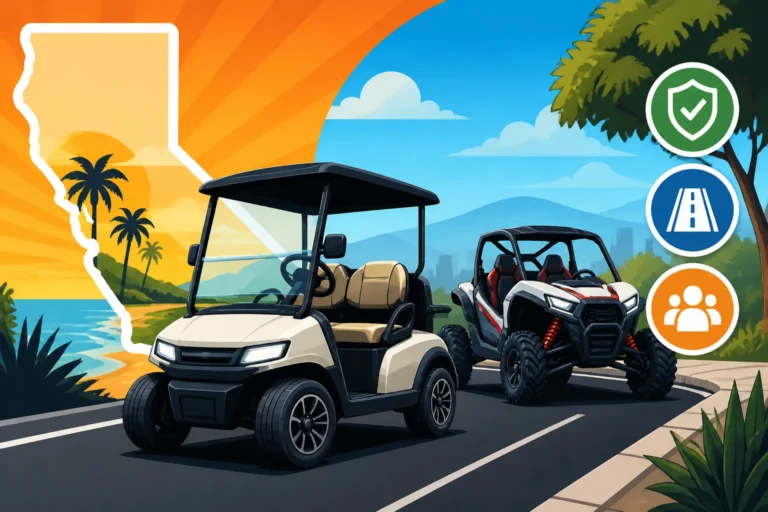
Despite the general ban, California does have a legal mechanism for limited OHV use on public roads: the concept of "combined-use highways." These aren't freeways or bustling city streets; rather, they are specific, designated segments of roadway, typically within or adjacent to OHV recreation areas. The idea is to allow riders to connect trails, access services, or reach staging areas without having to load their machines onto a trailer every time.
However, these designations come with significant limitations. Often, you'll encounter a [California's 3-Mile Combined-Use Cap], meaning you can only travel a very short distance on these roads. The signs for [California's Combined-Use Highways] are specific, usually featuring an OHV symbol, and you must adhere strictly to the posted rules and speed limits. These aren't carte blanche invitations to ride anywhere; they are highly controlled access points designed to facilitate recreation, not general transportation. Even then, your OHV still needs to be properly registered with a current California Green or Red Sticker, and you must follow all other OHV rules, like helmet laws and spark arrester requirements.
How California Counties Can Designate Roads for OHV Use
So, if the state is so strict, how do any roads get opened up at all? The power lies with local agencies, specifically county boards of supervisors, to make these designations. It's not a simple process, nor is it a quick one, but it is a legal pathway that has provided some relief in certain areas.
The Legal Framework: CVC 38026
The backbone of this authority is California Vehicle Code (CVC) section 38026. This section is what empowers local authorities, primarily county boards of supervisors, to formally designate certain portions of unincorporated county roads for combined use by both highway-legal vehicles and registered off-highway vehicles. It's not a free-for-all; there are specific criteria. The designation must primarily serve OHV recreation, connection to trails, or access to services for OHV users. It also comes with the critical caveat that such a designation can only occur after a thorough safety review. This means they can't just pick any road; it has to be a route that makes sense from an operational and safety standpoint for both types of users.
This section essentially provides a specific, legal loophole for OHV access on what would otherwise be off-limits public roads. It's a recognition that in some rural or recreational areas, such access is beneficial and can be managed safely. Without CVC 38026, the default would be a complete ban on OHVs on all public roads, which would severely limit the practicality of many riding areas. It’s also crucial to remember that this code applies to "unincorporated" county roads, meaning roads not within city limits, where local city councils would hold similar, though typically stricter, authority.
The Role of Local Agencies and CHP Approval
Getting a road designated for OHV use isn't as simple as a county supervisor waking up one morning and saying, "Let's open that road!" It's a multi-step bureaucratic process that requires significant due diligence. First, the local agency – typically the county's board of supervisors – must initiate the process. This usually involves public hearings, community input, and detailed studies on traffic patterns, safety, and environmental impacts. They need to assess if the road is truly suitable, considering factors like blind corners, pedestrian traffic, and existing vehicle speeds.
After the local agency does its homework and makes a preliminary designation, the proposal then must go to the California Highway Patrol (CHP) for review and approval. This is where [Why CHP Approval Gates a California Route] becomes absolutely critical. The CHP conducts an independent safety review, looking at things like sight distances, typical road conditions, accident history, and the overall suitability for mixed-use traffic. If the CHP determines that opening the road poses an undue risk to public safety, they can deny the designation, effectively putting the brakes on the county's plans. Their role is to ensure that while recreational opportunities are considered, safety for all road users remains paramount. This dual approval process is designed to prevent hasty decisions and ensure a high level of scrutiny before any road is officially opened to OHVs.
What Kinds of Roads Can Be Opened?
Understanding that roads can be opened is one thing, but knowing which roads are even candidates is another. You won't see OHVs cruising down multi-lane highways or busy main streets in urban areas. The focus is almost exclusively on roads that directly serve the OHV community's needs.
Focus on Unincorporated County Roads and Trails
The primary candidates for these combined-use designations are typically found in the more rural, less populated parts of a county. Think about the types of roads you encounter on the way to a popular riding area: these are often dirt or gravel roads, sometimes maintained by the county, sometimes less so. [Riding Unincorporated County Roads in California] is precisely what CVC 38026 addresses. These are roads that don't have heavy traffic volumes, often wind through natural landscapes, and are already used to some extent by people accessing trails or remote properties. They might be old logging roads, fire roads, or service roads that connect a network of established OHV trails.
Similarly, [Riding a California Forest Service Road] can sometimes fall under these provisions, although roads within federal lands (like National Forests) have an additional layer of federal regulations that must be considered and coordinated with local county efforts. The key is that these roads are usually off the beaten path, where the impact on general traffic is minimal, and the benefit to the OHV community is significant. They serve as conduits within existing recreational zones, rather than creating new access points in densely populated areas.
Connecting Communities and Trail Networks
The real value of these designated roads often comes from their ability to bridge gaps. Imagine you're at a popular staging area, and just a mile or two down a quiet county road is another trail system, or perhaps a small general store where you can grab a cold drink and some fuel. Before these designations, that short hop would require loading up your machine, driving a very short distance, and unloading again – a colossal waste of time and effort. [Segments That Connect a Trail to Lodging] or local services are prime examples of the practical applications of these rules.
These designated routes are all about enhancing the user experience and improving accessibility to the surrounding areas. They allow riders to extend their adventures, visit local businesses, or move between different sections of a larger trail network without breaking the law or resorting to unsafe practices on undesignated roads. It's about creating a more cohesive and enjoyable recreational experience, one that supports both riders and the small communities that often rely on OHV tourism. For example, some counties around popular riding spots in the Sierra Nevada foothills or the vast deserts of Southern California might look at opening such segments to foster local economic activity, allowing riders to reach a diner or gas station safely.
Challenges and Considerations for Opening Roads
While the idea of opening more roads for OHV use sounds fantastic to riders, the reality of implementing such changes is fraught with challenges. It's a complex balancing act that involves multiple stakeholders, significant costs, and often, strong opinions on all sides.
Balancing Access with Safety and Environmental Concerns
One of the biggest hurdles counties face is the inevitable pushback from residents and environmental groups. While OHV enthusiasts advocate for greater access, others voice legitimate concerns about noise pollution, dust, increased traffic, potential environmental damage, and public safety risks. The "Wilderness" designation, for instance, explicitly excludes motorized access, and even areas not formally designated can still be environmentally sensitive. Every proposed road designation triggers the California Environmental Quality Act (CEQA) review process, which can be lengthy and expensive. This means conducting detailed studies on impacts to air quality, wildlife, water resources, and cultural sites.
Navigating these concerns requires a delicate hand and a commitment to robust mitigation strategies. For example, SuperATV, a brand known for its aftermarket accessories, also offers products like dust deflectors and quieter exhaust options, which can help address some of the noise and dust concerns that might arise when OHVs share routes with residents. However, even with the best equipment, the perception of impact can be hard to overcome. It's a constant effort to demonstrate that responsible OHV use can coexist with environmental protection and community well-being. This balance is why proposals for new routes can take years to move forward, if they move forward at all.
The Expense and Effort for Local Jurisdictions
Designating a road for OHV use isn't just a matter of changing a line on a map; it comes with tangible costs and ongoing responsibilities for the local county. First, there's the initial expense of the studies, public outreach, and legal processes required for the designation and CHP approval. Then, once a road is open, there are costs associated with proper signage, clear mapping, and educating both OHV riders and highway vehicle drivers about the new rules.
Beyond initial setup, there's the long-term commitment to enforcement and maintenance. Law enforcement, typically the county sheriff's department or CHP, needs to be adequately staffed and trained to patrol these new combined-use routes, ensuring compliance with speed limits, helmet laws, and other OHV regulations. This is especially true for things like ensuring [Carrying Registration Paper on the Sand] or on a designated route. Furthermore, increased OHV traffic, particularly on unpaved roads, can accelerate wear and tear, leading to higher maintenance costs for grading, dust control, and pothole repair. Counties, especially those in rural areas with limited budgets, often struggle to allocate the necessary resources, making them hesitant to take on additional responsibilities that could strain their finances. This financial burden is a significant barrier to opening more routes, regardless of recreational demand.
Your Role in Advocating for More OHV Access
It's easy to feel powerless when faced with California's complex regulations, but riders do have a voice. If you want to see more roads opened for OHV use, you have a crucial role to play in advocating for change. It takes collective effort and consistent engagement to make a difference.
Engaging with Local Government
Your county supervisors are your most direct point of contact for local road designations. They are elected officials who represent your community, and they respond to their constituents. Don't just complain from the sidelines; get involved. Attend local county board meetings, especially when topics related to public land use or recreation are on the agenda. Write letters, send emails, or even request a meeting with your supervisor to express your interest in expanding OHV access on specific, well-researched county roads. When you engage, be prepared with facts: identify specific roads that would logically connect trail systems or services, explain the economic benefits of OHV tourism to the local area, and demonstrate your commitment to responsible riding.
It's also important to understand the county's planning and public works departments. They are the ones who conduct the studies and make recommendations to the supervisors. Building a positive relationship with these departments, sharing insights from a rider's perspective, and offering to collaborate can go a long way. Show them that OHV riders are responsible community members who care about safety and the environment, not just about having fun. This kind of engagement is far more effective than simply demanding access.
Supporting OHV Advocacy Groups
While individual efforts are important, there's immense power in numbers. Supporting and joining established OHV advocacy groups in California is one of the most effective ways to champion your cause. Organizations like the California Off-Road Vehicle Association (CORVA), for example, have decades of experience navigating the political landscape, working with state agencies like the California Department of Parks and Recreation's Off-Highway Motor Vehicle Recreation (OHMVR) Division, and advocating for rider rights at both state and local levels. These groups often have paid staff and volunteers who are experts in environmental law, land use policy, and legislative advocacy.
When you support these groups, you're contributing to a collective voice that policymakers cannot ignore. They track proposed legislation, organize rider days at the state capitol, and directly engage with agencies on behalf of the OHV community. They can also provide you with specific guidance on how to most effectively participate in local planning processes. For example, they might have insights into [What the OHMVR Division Actually Does] and how their grants can be leveraged for trail improvements and access. By pooling resources and coordinating efforts through these organizations, riders can present a unified front, increasing the likelihood that their concerns and requests for expanded access are heard and acted upon.
Understanding Designated Combined-Use Routes
To help clarify the types of roads and the permissions involved, here's a table outlining the common characteristics and requirements for designated combined-use routes versus typical off-highway trails.
| Feature | Designated Combined-Use Route (County Road) | Typical Off-Highway Trail (SVRA, BLM, Forest Service) |
|---|---|---|
| Legal Authority | CVC 38026, County Board of Supervisors, CHP Approval | OHMVR Division, BLM, Forest Service, State Parks |
| Primary Purpose | Connect trails, access services (fuel, lodging), link communities | Recreation, challenging terrain, scenic routes |
| Vehicle Types | Registered OHVs (Green/Red Sticker), Highway Vehicles | Registered OHVs (Green/Red Sticker), some non-motorized |
| Speed Limit | Posted road speed limits (often 15-25 mph for OHVs) | Variable, often lower, sometimes no posted limit |
| Length | Usually short segments (e.g., [California's 3-Mile Combined-Use Cap]) | Can be extensive, part of larger networks |
| Surface | Paved, gravel, or dirt county roads | Dirt, sand, rock, varied natural terrain |
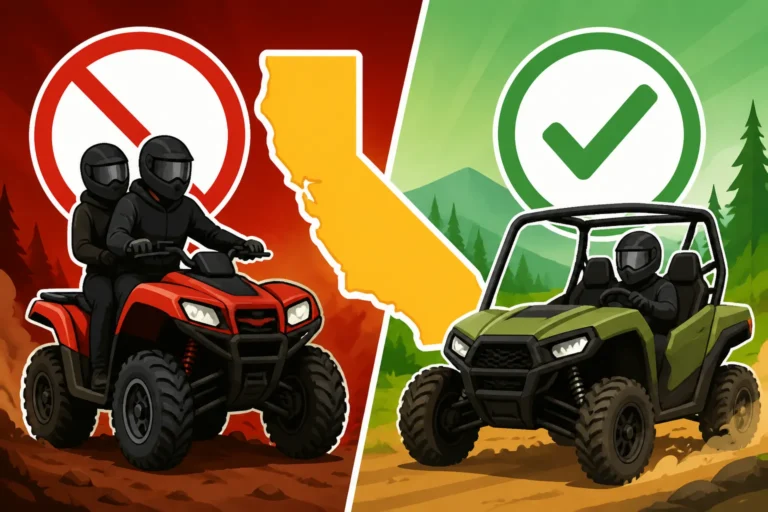
| Key Requirements | OHV registration, helmet (if ATV), all traffic laws, may require additional lights/reflectors if dark. No passengers on ATVs. | OHV registration, helmet, spark arrester, sound limits. [California's ATV Passenger Ban Explained]. |
| Enforcement | CHP, County Sheriff, Park Rangers | Park Rangers, Forest Service Law Enforcement, BLM Rangers |
| Examples | Connecting roads in Inyo County, segments near Hollister Hills | Glamis, Oceano Dunes, Hungry Valley SVRA, Forest trails |
Disclaimer
This article is for general informational purposes only and does not constitute professional advice. Laws, prices and regulations vary by location and change over time. Consult a qualified professional for guidance on your specific situation.