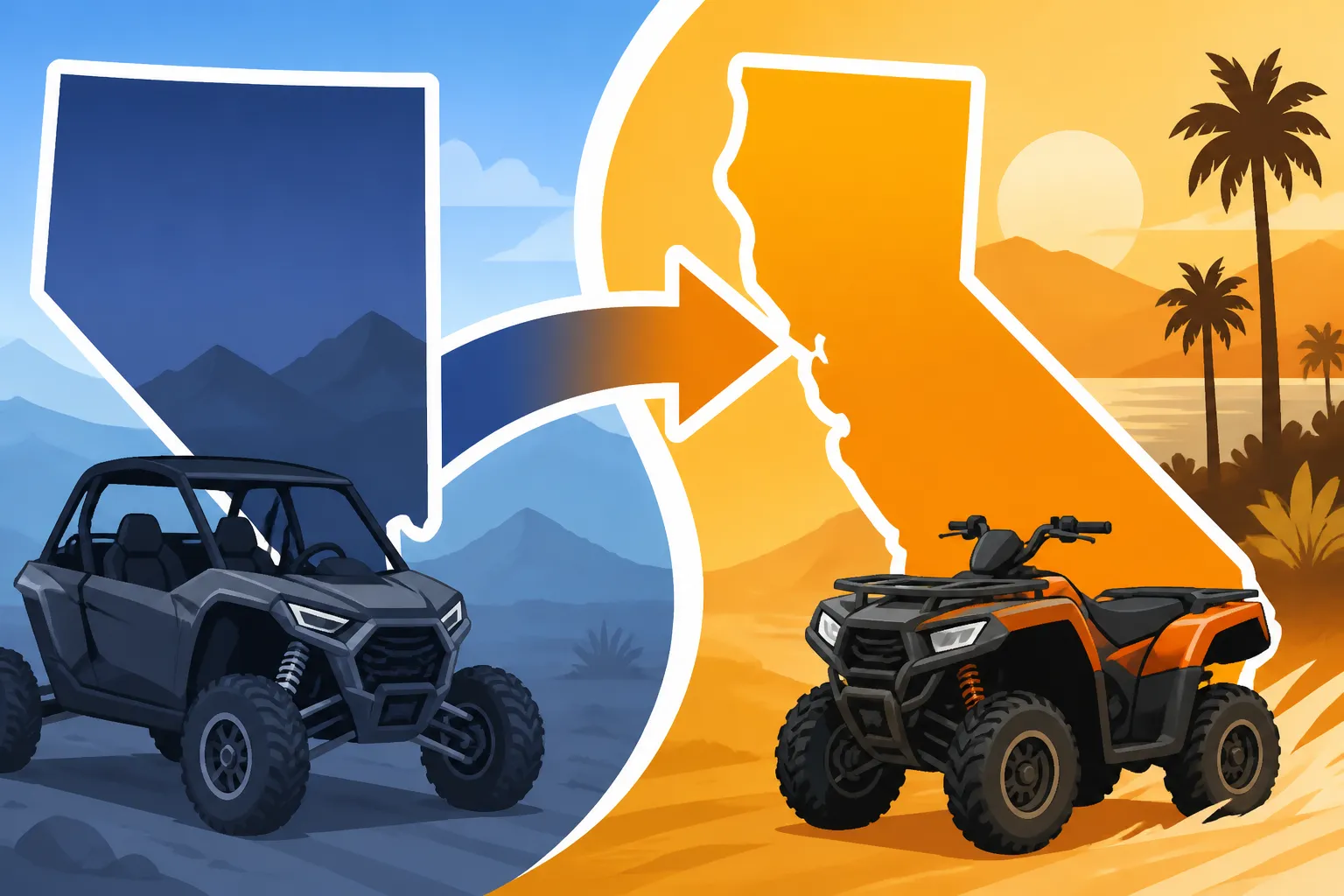
Moving a Nevada-Registered Machine to California
Moving to California can be an absolute dream for many, bringing with it the promise of sunshine, stunning landscapes, and incredible off-highway vehicle (OHV) riding opportunities. But if you’re bringing your Nevada-registered ATV or UTV with you, you might quickly find that the Golden State’s unique rules can turn excitement into a frustrating puzzle. You might think a quick trip to the DMV is all it takes, or that your Nevada registration will carry over just fine, only to discover a whole new set of requirements. This guide is designed to clarify the process, helping you seamlessly transition your Nevada-registered machine into California's system so you can hit the trails without a hitch.
The Harsh Reality: Why Your Nevada OHV Registration Won't Cut It in California
One of the biggest misconceptions people have when moving their OHVs across state lines, especially from a neighboring state like Nevada, is that their existing registration will somehow transfer or be recognized in California. Unfortunately, for most casual riders and typical OHVs, this simply isn't the case. California has a very specific system, and it requires nearly all OHVs operating on public lands within its borders to be registered under its own program.
California's Limited Reciprocity Explained
California's approach to out-of-state OHV registrations is, let's just say, highly selective. Many states offer some form of reciprocity where a valid registration from one state is honored in another for a limited time. California, however, operates differently. While it does have a nonresident OHV use permit, which we'll touch on briefly, it only extends true reciprocity to very few states – primarily Oregon and Nevada, but only if those states' programs are deemed "similar" to California's and if the machine would otherwise qualify for a Green Sticker. For the vast majority of Nevada OHV owners, this means your standard Nevada registration will not be sufficient for general riding on California public lands.
This often comes as a surprise, especially when you consider how easy it is to drive a Nevada-plated car into California. But an OHV isn't a street-legal vehicle in this context. The rules are entirely separate and designed with different objectives in mind. So, while you might be able to pop over the border for a weekend ride with a Nevada permit to certain areas, if you're truly moving here and plan on regular riding, you need California identification. Thinking your Nevada registration will exempt you from California's system is a common mistake that can lead to a roadside citation. For more on the specific states California does offer reciprocity to, you might want to read [Moving From Oregon With a Permitted Machine].
Why California Requires Its Own Identification for Off-Highway Vehicles
California's strict registration requirements for OHVs aren't just about bureaucracy; they're fundamentally tied to funding and land management. The fees collected from OHV registrations, like the [California OHV Registration Cost], directly support the state's extensive network of OHV parks and riding areas. These funds go towards trail maintenance, law enforcement patrols, educational programs, and facility improvements, all managed by the OHMVR Division. If every out-of-state machine could ride freely without contributing, the system wouldn't be sustainable.
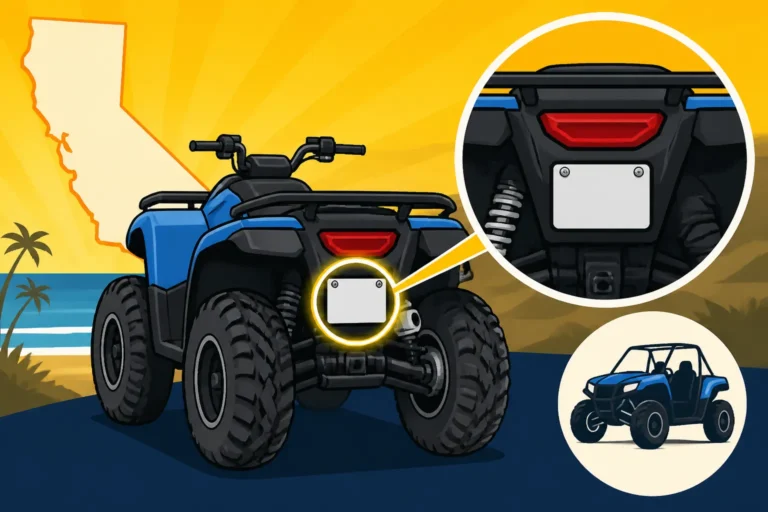
Furthermore, California has a unique system that involves issuing an OHV ID plate, not just a decal like many other states. [Why California Issues a Plate, Not a Decal] This plate, along with the corresponding Green, Red, or Tan sticker, is how law enforcement and rangers quickly identify if a machine is legally registered and what its usage limitations are. This visible identification is crucial for managing access and ensuring compliance with emissions standards and riding seasons, which are particularly complex in California. Without a California ID plate and sticker, your Nevada machine lacks the visible markers that prove its eligibility for the state's riding areas.
Navigating the California Registration Process for Your Nevada Machine
Once you've accepted that your Nevada registration is unlikely to pass muster for long-term use in California, the next step is to get your machine properly registered here. This process involves a few key steps, from gathering documentation to getting your vehicle verified and submitting the necessary forms and fees. It might seem daunting, but breaking it down makes it manageable.
Gathering Your Essential Documents and Information
The foundation of a smooth registration process is having all your paperwork in order. For an OHV coming from Nevada, you'll need to prove ownership and ensure the machine itself can be identified. Start by gathering the following:
- Nevada Title: This is paramount. The title proves legal ownership of the OHV. Make sure it's in your name and free of any liens, or that you have the proper lien release documentation. If you bought the machine recently and the title hasn't been transferred into your name yet, that needs to happen first, or you'll need the original owner's properly signed-off title. For more on this, check out [Titling an Off-Highway Vehicle in California].
- Bill of Sale: Even if you've owned the machine for years, a bill of sale can be an incredibly helpful supplementary document, especially if there's any ambiguity in the title or if the Nevada title system differs slightly from California's expectations. If you purchased the OHV privately, ensure you have a clear [California OHV Bill of Sale Requirements] in hand. If you bought it from a dealer, your purchase agreement will suffice. If you find yourself in a situation where you need to create a formal bill of sale for your records, or other legal documents related to ownership, services like LawDepot can provide templates.
- Previous Nevada Registration: While it won't be valid for riding here, your last Nevada registration card serves as an additional piece of evidence of your ownership and that the machine was legally operated.
- Application for Title or Registration (Form REG 343): This is California's primary form for applying for OHV registration. You'll fill this out with all your personal information and details about your OHV. Getting this right the first time can save you a lot of hassle. [What California's Form REG 343 Asks For] has more details.
- Statement of Facts (Form REG 256): You may need this form for various reasons, such as declaring the purchase price for sales tax purposes if a bill of sale isn't sufficient, or explaining certain circumstances of ownership.
- Proof of California Residency: While not always explicitly asked for as a separate document for OHV registration, having a California driver's license or ID, or other utility bills, helps establish your residency for tax purposes and general administrative clarity.
Make copies of everything! It’s a good habit whenever dealing with state agencies.
The Critical Vehicle Verification Step
Before California will issue an ID plate and sticker for your Nevada machine, it needs to confirm that the OHV actually matches its paperwork and isn't stolen or illegally modified. This is where the vehicle verification process comes in.
Vehicle verification for an OHV in California involves a physical inspection of your machine. A qualified verifier will check the Vehicle Identification Number (VIN) on the frame and often the engine number as well, comparing them against the numbers on your Nevada title and any other ownership documents. They're looking for consistency and legitimacy.
Who can perform this verification?
- California DMV Employees: You can often get this done at a DMV field office, but it's crucial to check if the specific office handles OHV verifications and if you need an appointment.
- California Highway Patrol (CHP) Officers: CHP also performs verifications.
- Licensed Vehicle Verifiers: These are private individuals or businesses licensed by the DMV to perform verifications. They often offer mobile services, which can be incredibly convenient, especially if trailering your OHV to a DMV office is difficult.
- Authorized OHV Dealers: Some dealerships are authorized to perform verifications for machines they are processing for registration.
Make sure you have your OHV easily accessible for inspection. The verifier will typically complete and sign Section C of the [California Vehicle Verification on Form REG 31] for you. This signed form is a critical piece of your application packet.
Submitting Your Paperwork and Paying the California Fees
Once you have your Nevada title, bill of sale, the completed REG 343, and the verified REG 31, you're ready to submit your application. This is typically done at a California DMV field office or through an authorized registration service.
The fees you'll pay generally include:
- The base registration fee: This is a biennial (two-year) fee that covers the state's OHV program.
- CHP fee: A portion goes to the California Highway Patrol for enforcement.
- OHMVR Division fee: This supports the Off-Highway Motor Vehicle Recreation Division.
- Any applicable sales or use tax: If you recently moved to California and purchased the OHV out-of-state within a certain timeframe, or if you acquired it here without having paid California sales tax, you will likely owe California use tax. The amount is based on the purchase price. Be prepared to provide proof of purchase price on your bill of sale or Statement of Facts.
- Potential penalties: If you delay registering your machine after becoming a California resident, you might incur late penalties.
When submitting, clarify if you need to schedule an appointment specifically for OHV registration, as not all DMV offices handle these transactions daily. Be patient; the process can take some time, especially if there are any discrepancies or missing information. Remember, getting your [California OHV Registration Appointment at the DMV] is often the first hurdle. For a detailed breakdown of what goes into the cost, see [California's $54 OHV Registration Fee Broken Down].
Understanding California's Sticker System for Your Out-of-State OHV
Once your Nevada machine successfully navigates the California registration process, it won't just get an ID plate; it will also be assigned a colored sticker: Green, Red, or Tan. This sticker system is uniquely Californian and dictates when and where your OHV can be ridden on public lands. Understanding which sticker your machine will receive is crucial, as it impacts your riding opportunities.
Green, Red, and Tan: Which Sticker Will You Get?
The type of sticker your OHV receives is primarily determined by its model year and its compliance with California's strict emissions standards. This is where moving an out-of-state machine can sometimes get complicated, as not all machines manufactured for sale in Nevada necessarily meet California Air Resources Board (CARB) requirements.
- Green Sticker: This is the most desirable sticker. A Green Sticker means your OHV meets California's emissions standards and can be ridden year-round on all designated OHV trails and areas. Generally, machines manufactured in 2002 or earlier, or newer machines that are certified as "California Green Sticker compliant" by the manufacturer (meaning they meet [What CARB Compliance Means in California]), will receive this sticker. Many older Nevada machines may qualify for this if they pre-date stricter emissions rules. [California's Green Sticker Explained] goes into more detail.
- Red Sticker: This sticker applies to OHVs manufactured in 2003 or later that do not meet California's emissions standards for year-round use. Most machines sold outside of California, even if they have some emissions controls, often fall into this category. Red Sticker machines are subject to seasonal riding restrictions, meaning they can only be ridden during certain times of the year (generally October 1 to May 31) and only in designated Red Sticker riding areas. There have been significant changes to these rules, so it's worth reviewing [Red Stickers and What Changed in California] for the latest information, especially concerning machines after January 2025.
- Tan Sticker: The Tan Sticker is much less common for individually owned machines. It's issued to OHVs that do not meet California's emission standards but are used exclusively for organized, sanctioned events, such as races or rallies, or for specific agricultural purposes. If you're just planning on recreational riding, it's highly unlikely your Nevada machine will receive a Tan Sticker. For more specifics, see [California's Tan Sticker Machines].
The DMV agent processing your registration will typically determine which sticker your machine qualifies for based on the information provided on your title, any manufacturer's labels, and your REG 343 application.
Dealing with CARB Compliance for Newer Machines
California has the most stringent emissions regulations in the country, set by the California Air Resources Board (CARB). These regulations significantly impact which sticker your OHV receives, especially if it's a newer model.
If your Nevada-registered OHV was manufactured in 2003 or later, its CARB compliance status will be critical. Many manufacturers produce different versions of their OHVs: one set for sale in California (CARB-compliant) and another for the other 49 states (federal EPA compliant, but not necessarily CARB compliant).
If your machine was originally sold in Nevada, even if it has an emissions label, it might only be EPA-compliant and not CARB-compliant. In this scenario, your machine will almost certainly receive a Red Sticker, subjecting it to the seasonal riding limitations. This can be a major adjustment for riders used to year-round access in Nevada. It's not about whether your machine runs clean or has a catalytic converter; it's about whether it received the specific CARB certification from the manufacturer. There's generally no way to "convert" a non-CARB compliant machine into a CARB-compliant one after purchase. Knowing this upfront will help you understand the riding seasons available to you once your machine is registered in California.
| Sticker Type | Model Year Criteria | Emissions Compliance | Riding Privileges |
|---|---|---|---|
| Green Sticker | 2002 or older, OR 2003+ | CARB Compliant | Year-round use on all designated OHV trails/areas |
| Red Sticker | 2003-2021 | Non-CARB Compliant | Seasonal use (Oct 1 – May 31) in designated Red Sticker areas |
| Tan Sticker | Any model year | Non-CARB Compliant | Limited to sanctioned events or specific ag use |
Note: Red Sticker rules are subject to change after January 1, 2025, with many older Red Sticker machines potentially becoming Green Sticker eligible.
Common Pitfalls and Smart Tips for a Smooth Transition
Moving your OHV to California doesn't have to be a headache, but being aware of common issues and having a few smart tips up your sleeve can make the process significantly smoother. California's system is thorough, and preparedness is your best friend.
Avoiding Penalties and Delays
One of the easiest ways to turn a simple registration into a costly ordeal is by delaying the process. Once you establish residency in California, there's an expectation that you'll transfer your vehicle registrations within a reasonable timeframe. For OHVs, this can translate into penalties if you wait too long.
- Sales/Use Tax: California is very diligent about collecting sales or use tax on vehicles brought into the state. If you recently purchased your OHV in Nevada and moved it to California, or if you've moved here and your OHV was purchased out-of-state without California sales tax being paid, you will likely owe use tax. This is typically collected at the time of registration. Failing to account for this can lead to delays or unexpected costs.
- Late Registration Penalties: The state can assess [California OHV Late Registration Penalty] if you exceed certain deadlines after moving. These penalties can add up quickly, so it's always better to address the registration as soon as possible after establishing residency.
- Riding Without Proper Registration: The biggest pitfall is simply assuming your Nevada registration will be fine and then riding your OHV on California public lands. Rangers and law enforcement routinely check for valid California ID plates and stickers. Getting caught without one will result in a citation and fines, potentially even impoundment, making your registration efforts much more expensive and stressful in the long run. Always ensure your OHV is properly identified before heading out to popular spots like Glamis or Oceano Dunes.
When Your Nevada Title is Missing or Flawed
Sometimes, you might discover your Nevada title is lost, damaged, or perhaps you bought the OHV from a private seller years ago and never officially transferred the title into your name in Nevada. This can complicate the California registration process significantly.
- Lost Title: If your Nevada title is missing, your first step should be to contact the Nevada Department of Motor Vehicles (DMV) to apply for a duplicate title. You cannot register an OHV in California without proof of ownership, and the title is the primary document. For more on handling lost titles in California, you can refer to [Replacing a Lost California OHV Title].
- Improperly Transferred Title: If the Nevada title was never properly transferred to your name (e.g., the seller didn't sign it correctly, or you never submitted it to the Nevada DMV), you'll need to rectify this. You might have to contact the previous owner to get a corrected signature or additional documentation. In some cases, California might allow alternative proofs of ownership, such as a sworn statement or an extensive bill of sale, especially if you used a service like LawDepot to create a very thorough document that clearly outlines the chain of ownership. This is often an exception and requires working closely with a DMV representative or a licensed vehicle registration service.
- Liens: If there's an active lien on your Nevada title, you'll need to ensure that the lienholder is aware of your move and is willing to work with the California DMV to transfer the lien, or that you have a lien release from them.
These situations can add considerable time and complexity, so it's always best to have a clean, clear title in your name before you even start the California registration process.
Considerations for Resale and Future California Ownership
Once your Nevada OHV is successfully registered and titled in California, you'll find that future transactions become much simpler.
- Easier Resale: Having a valid California title and current registration makes selling your OHV within California significantly easier. Buyers in California will expect a California title, and it streamlines the transfer process for them, as they won't have to go through the out-of-state conversion themselves.
- Organized Documentation: Keep all your registration paperwork, including the application forms, verification documents, and receipt of fees, in a safe place. This creates a clear history of your OHV's registration in California, which can be invaluable if you ever need to replace a lost title, renew your registration, or prove ownership. For information on renewing, see [Renewing California OHV Registration].
- Continuous Compliance: Remember that California OHV registrations are biennial, meaning they need to be renewed every two years by June 30th. Mark your calendar to avoid future late penalties and ensure your OHV remains legal to ride on California's beautiful trails and dunes.
Disclaimer
This article is for general informational purposes only and does not constitute professional advice. Laws, prices and regulations vary by location and change over time. Consult a qualified professional for guidance on your specific situation.