Checking a VIN Before Buying a Used Quad
Buying a used quad or UTV can feel like navigating a minefield. You're excited about the prospect of hitting the trails, but also wary of ending up with a lemon, a stolen machine, or one riddled with hidden problems. This guide is all about empowering you with the knowledge and steps to perform a thorough Vehicle Identification Number (VIN) check, ensuring your potential off-road adventure starts on solid, legal ground.
Why a VIN Check Is Absolutely Non-Negotiable When Buying Used
Look, I've been around the block a few times, both on and off the trails, and I can tell you that the excitement of a great deal can sometimes blind us to potential headaches. That shiny, used quad might look perfect, but its history could be anything but. A VIN check isn't just a suggestion; it's your first, best line of defense against a nightmare scenario. Think of it as peeking behind the curtain before you commit to the show.
Protecting Yourself from Stolen Machines
This is perhaps the most critical reason for a VIN check. Unfortunately, off-highway vehicles (OHVs) are attractive targets for thieves, and buying a stolen machine, even unknowingly, can lead to serious legal trouble for you. Imagine this: you've just spent your hard-earned cash, registered your new-to-you quad, and you're out at Glamis or Hungry Valley, only for a ranger to run your VIN and discover it was reported stolen years ago. Not only do you lose your money and the machine, but you could also face questioning or even charges for possession of stolen property. It's a gut-wrenching experience, and one that's entirely avoidable with a proper VIN verification. A VIN check through law enforcement databases can immediately flag a stolen vehicle, saving you immense heartache and financial loss.
Uncovering Hidden Liens and Ownership Issues
Another huge headache a VIN check can prevent is buying a machine with a lien against it. Just like cars, OHVs can be used as collateral for loans. If the previous owner never paid off their loan, that lien could transfer with the machine, making you responsible for the debt. This scenario is far more common than people realize. You might think you own the quad free and clear, but if a financial institution has a claim on it, they could repossess it. Imagine driving your new side-by-side home from the seller, only to find out a few weeks later that a bank still holds the title. A comprehensive VIN check can often reveal if there's a lien holder listed on the title, giving you the chance to demand the seller resolves it before you hand over any money. If you're using a service like LawDepot to draft a bill of sale, ensuring the VIN is clean beforehand is crucial for a legally sound document.
Revealing Salvage or Rebuilt Titles
Sometimes, an OHV has been in a major accident, suffered flood damage, or been deemed a total loss by an insurance company. When this happens, it's often issued a "salvage" title. While a salvage title doesn't necessarily mean the machine is junk, it does indicate significant damage history. Some enterprising individuals might rebuild these machines, making them look good on the surface, but the underlying structural integrity or mechanical components could be compromised. Without knowing its history, you might pay top dollar for a machine that's inherently riskier or will require extensive repairs down the line. A VIN check will often reveal if a machine has a salvage or rebuilt title, giving you the information needed to make an informed decision or negotiate a much lower price based on its true condition.
Locating and Verifying the VIN on a Quad or UTV
Alright, so you're convinced that checking the VIN is critical. Now, where do you actually find this magic number? And more importantly, how do you know it hasn't been tampered with? This isn't just about finding a number; it's about confirming its authenticity.
Common VIN Locations
The VIN is a 17-character code (for machines built after 1981) that uniquely identifies a vehicle. On most quads and UTVs, you'll find it stamped in a few key places.
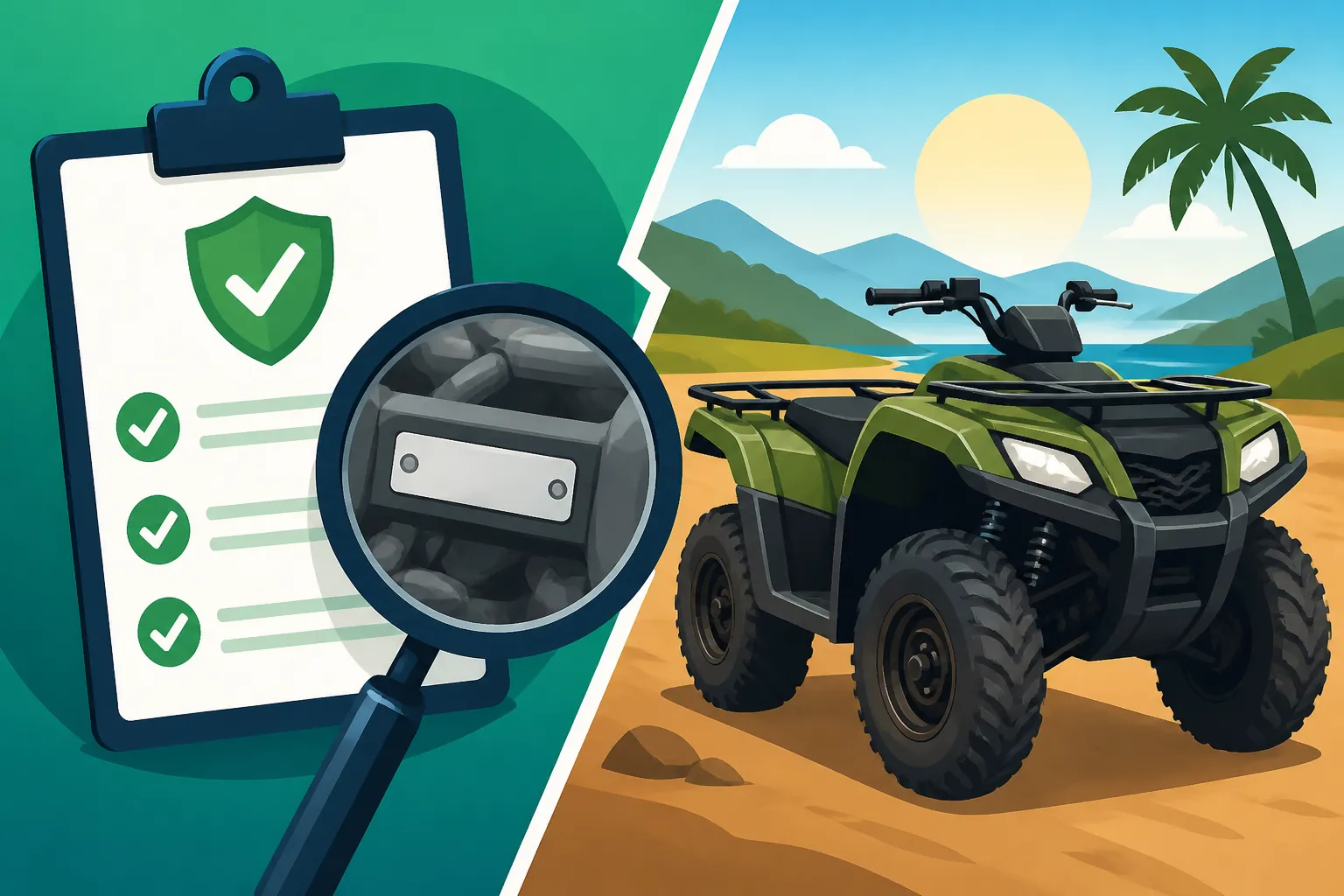
- On the frame: This is the primary location. For ATVs, look on the front frame tube, often near the steering head (where the handlebars connect to the frame). It might be stamped on the right-hand side. For UTVs, check the frame rails, often under the driver or passenger seat, or near one of the wheel wells. It's typically a permanent stamp, not just a sticker.
- Engine casing: Many manufacturers also stamp a partial VIN or engine number directly onto the engine block. While not the full VIN, this can be a good cross-reference.
- Manufacturer's label: There might be a sticker or plate, often on the frame or under the seat, that also displays the VIN along with other manufacturing information, like the gross vehicle weight rating (GVWR). However, always prioritize the stamped VIN over a sticker, as stickers are easier to remove or replace.
- Original documents: The VIN will be listed on the machine's Certificate of Title, registration documents (like California's Form REG 343), and any bill of sale.
Matching VINs on Multiple Locations and Documents
This step is crucial. You need to verify that the VIN stamped on the physical machine matches the VIN on all supporting documentation provided by the seller, especially the title. If the seller only has a [California OHV Bill of Sale Requirements] but no title, be extra cautious. If there are any discrepancies, even a single digit, walk away. It's a huge red flag. A mismatched VIN could indicate:
- Fraud: The machine might be stolen, and the seller is trying to pass off another machine's paperwork.
- Salvage/Rebuild Issues: Parts from different machines might have been combined, creating a "franken-machine" with a confusing history.
- Clerical Errors: While less common for a full VIN, mistakes can happen. However, it's the seller's responsibility to get these corrected before the sale.
Also, examine the stamped VIN itself. Are the numbers and letters clear and evenly spaced? Does it look like there's been grinding, welding, or any other attempt to alter the numbers? Any sign of tampering is a deal-breaker. A legitimate VIN will be crisp and uniform.
Deciphering the VIN: What the Numbers and Letters Mean
Once you've found the VIN and verified its consistency, it's time to understand what this string of 17 characters actually tells you. It's not just a random sequence; it's a coded message about the machine's origins and specifications.
The World Manufacturer Identifier (WMI)
The first three characters of the VIN make up the World Manufacturer Identifier (WMI).
- The first character identifies the geographic area of the manufacturer (e.g., 1 for USA, J for Japan, Z for Italy).
- The second character identifies the country within that area.
- The third character identifies the specific manufacturer.
For example, a VIN starting with "1HF" typically indicates a Honda manufactured in the USA. This helps confirm the brand and general origin, which should align with what the seller is claiming the machine is.
Vehicle Descriptor Section (VDS)
Characters four through nine form the Vehicle Descriptor Section (VDS). These characters provide details about the vehicle type, engine, model, and other features. The exact meaning of these characters can vary greatly between manufacturers. For an OHV, this section might encode information about:
- Body style (e.g., ATV, UTV, dirt bike)
- Engine type and displacement
- Gross Vehicle Weight Rating (GVWR)
- Series or line of the model
- Brake system type
The ninth digit is often a "check digit," a mathematical calculation based on the other 16 digits, used to detect fraudulent or erroneous VINs. Most online VIN decoders will automatically verify this digit.
Vehicle Identifier Section (VIS)
The last eight characters (10-17) are the Vehicle Identifier Section (VIS). This section is unique to each vehicle and includes the model year and the specific factory where it was assembled, along with the sequential production number.
- Character 10: Model Year: This character indicates the model year of the machine. It uses a sequence of letters and numbers (excluding I, O, Q, U, Z, and 0). For example, "A" was 1980, "B" 1981, and so on. This is crucial for verifying the age of the machine and ensuring it aligns with the seller's claims. For California residents, knowing the model year is particularly important because it can determine whether the machine qualifies for a [California Green Sticker Explained], [California Red Sticker Rules Today], or [California Tan Sticker Eligibility].
- Character 11: Plant Code: This character identifies the specific manufacturing plant where the vehicle was assembled.
- Characters 12-17: Sequential Production Number: These are the unique serial numbers assigned to the vehicle as it rolls off the assembly line, ensuring that no two vehicles have the exact same VIN.
Understanding these sections allows you to quickly cross-reference details about the machine with the VIN's decoded information. If the VIN says it's a 2018 Yamaha, but the seller claims it's a 2022 Honda, you know something is seriously wrong.
How to Conduct a Thorough VIN Check
Now that you know what to look for and what the VIN means, let's get down to the practical steps of running a check. You have a few options, ranging from free basic lookups to more comprehensive paid services.
Free Resources: The Basic Lookup
For a quick, initial check, you can often use free online VIN decoders. Many websites offer services where you simply type in the VIN, and it will decode the WMI, VDS, and VIS, giving you details like the manufacturer, model, year, and engine type. This is a great first step to confirm the basic identity of the machine against the seller's description.
However, these free services typically do not check for stolen status, liens, or salvage titles. They are purely for decoding the VIN's inherent information. Think of it as verifying the machine's birth certificate, not its criminal record.
Paid Services: The Deep Dive
For a truly comprehensive check, you'll want to invest in a paid VIN history report. These services pull data from various sources, including DMV records, insurance companies, and law enforcement databases. Some popular options for vehicles (and often OHVs) include Carfax or AutoCheck. While I can't recommend specific pricing or features, these services typically offer:
- Title History: This is where you'll see if the machine has ever had a salvage, rebuilt, flood, or other branded title. It will also show previous ownership transfers, which is vital for understanding its past.
- Lien Information: These reports can flag any active liens against the vehicle. This is critical for avoiding taking on someone else's debt.
- Stolen Vehicle Check: The report will indicate if the VIN has been reported as stolen.
- Accident History: Details about reported accidents, including the severity and repair estimates, might be included.
- Odometer Rollback: Some reports can flag inconsistencies in mileage readings over time, which could indicate odometer fraud.
- Recall Information: You might also find information about any open recalls for the specific model.
It's important to remember that these reports are only as good as the data they receive. Not all accidents are reported to insurance, and private sales might not always update official records perfectly. However, they are still your best bet for a detailed history.
Verifying with the California DMV and Law Enforcement
In California, you can also take proactive steps directly with official agencies, though some information might require the seller's cooperation.
- California DMV: While you can't just walk into a DMV office and ask them to run a VIN for a machine you don't own, the seller can request a vehicle record search. This would show the machine's title status, any recorded liens, and past registration history. When you are ready to [Transferring a California OHV Registration], the DMV will do its own check, but it's better to know before you commit. If the seller is hesitant to provide this, consider it a red flag.
- Law Enforcement (Non-Emergency): For a stolen vehicle check, in some jurisdictions, a law enforcement agency (like the CHP or a local sheriff's department) might be willing to run the VIN through their database for stolen vehicles. This is usually done on a non-emergency basis. Always call their non-emergency line first to inquire about their policy. Never put an officer in an awkward position by just showing up and demanding a check.
| VIN Check Type | Information Provided | Cost | Ease of Access | Key Benefit |
|---|---|---|---|---|
| Free Decoder | Manufacturer, Model, Year, Engine Type | Free | Immediate online results | Quick verification of basic machine identity |
| Paid History | Title status (salvage, rebuilt), Lien history, Stolen reports, Accident history, Odometer issues, Recall info | Varies | Online purchase, results typically within minutes | Comprehensive risk assessment, uncovers hidden issues |
| DMV Records | Title status, Lien holders, Registration history | Varies | Requires seller's cooperation (or ownership post-sale) | Official state records, definitive title information |
| Police Check | Stolen vehicle status only | Free (non-emergency) | Requires cooperation from law enforcement | Direct confirmation of stolen status |
Red Flags and What to Do Next
Even after running the VIN, you need to pay close attention to the overall situation. A VIN check is one piece of the puzzle; the rest is common sense and careful observation.
Obvious Signs of Tampering
Beyond mismatched numbers, be on the lookout for physical signs of VIN tampering:
- Grinding marks: Anywhere near the VIN stamp, especially if it looks like original metal has been removed.
- New welds or paint: Around the VIN area that doesn't match the rest of the frame.
- Inconsistent fonts/spacing: If the numbers and letters in the VIN don't look uniform, or the spacing is off, it could indicate alterations.
- Missing manufacturer stickers: While stickers aren't primary VIN sources, their absence or obvious removal in conjunction with other red flags can be suspicious.
If you suspect any tampering, walk away immediately. It's not worth the risk.
Seller's Reluctance to Cooperate
A legitimate seller will have nothing to hide and will be happy to assist with any verification steps. If the seller:
- Refuses to provide the VIN before you meet.
- Is hesitant to show you the original title or registration.
- Won't let you physically inspect the VIN on the machine.
- Discourages you from running a paid history report or contacting the DMV.
- Claims the [California OHV Registration Without a Title] is "no big deal" without a clear explanation and path to obtaining one.
- Tries to rush the sale.
These are all major red flags. A trustworthy seller understands your need for due diligence.
Discrepancies in the Story
Does the seller's verbal account of the machine's history match what the VIN check reveals?
- If they say it's a one-owner machine, but the history report shows multiple owners.
- If they claim it's never been damaged, but the report indicates a salvage title or significant accident history.
- If the model year decoded from the VIN doesn't match what they're telling you.
Any major inconsistencies between the seller's story and the facts uncovered by the VIN check should give you serious pause. Don't let a "great deal" override your gut feeling. There's always another quad out there. After all, you want to be riding the trails, not dealing with legal entanglements.
Disclaimer
This article is for general informational purposes only and does not constitute professional advice. Laws, prices and regulations vary by location and change over time. Consult a qualified professional for guidance on your specific situation.