California Rules for Riding Near Livestock
Livestock can react unpredictably to an ATV or UTV, and a startled animal can put riders, handlers and the animal at risk. California’s rules require you to control your machine, slow down or stop when approaching livestock, and keep your distance. Here’s how to handle an encounter safely and what to check before riding.
What California requires near livestock
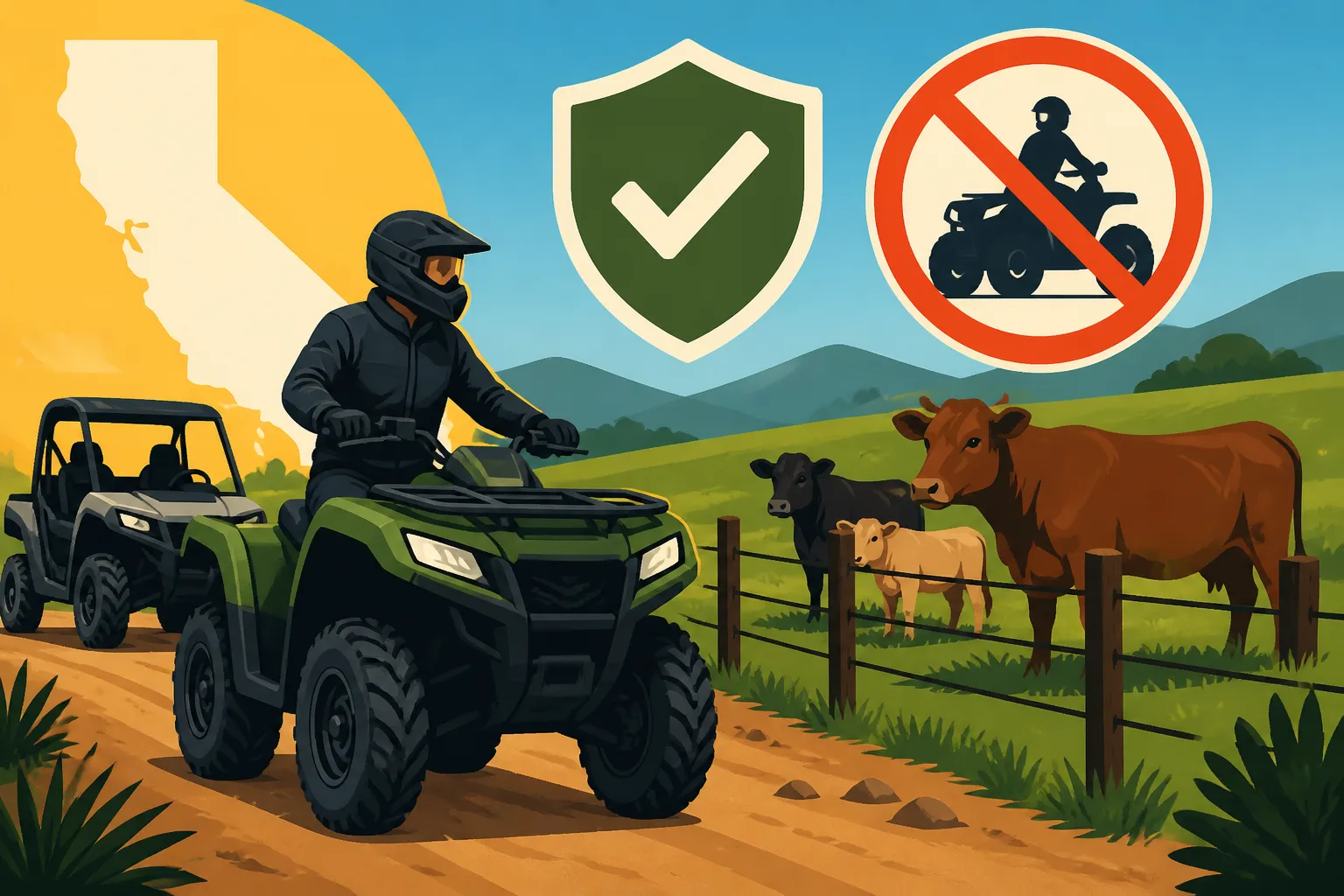
California law prohibits operating an off-highway vehicle negligently or willfully to pursue, harass, endanger or injure an animal. Riders must maintain proper control and reduce speed or stop when approaching livestock or ridden animals to avoid frightening them. According to the California Department of Parks and Recreation and the California State Legislature, the speed limit is 15 miles per hour within 50 feet of any concentration of animals.
That limit is a maximum, not a target. If animals look unsettled, a slower approach—or stopping altogether—is the safer choice. A horse may bolt, cattle may bunch or run, and even a well-behaved dog can react to engine noise. Livestock may also be harder to see around a bend, in tall vegetation or near a gate.
The rule applies to how you ride, not just the number on your speedometer. Keep control of your vehicle, avoid sudden acceleration, and don’t ride in a way that chases or crowds animals. If a group is moving along a trail, give it room rather than trying to pass through the herd.
A practical approach is to:
- Ease off the throttle as soon as you see animals or a handler.
- Stop if you’re unsure whether continuing would frighten or crowd them.
- Wait for a safe signal or clear opening before moving past.
- Leave plenty of space and avoid revving, honking or making abrupt movements.
- Keep your machine pointed away from the animals while you wait, where the terrain allows.
You don’t have to be close to an animal for your machine to cause a problem. Noise, movement and dust can all contribute to a reaction. If an animal becomes agitated, back away slowly if there is room; don’t try to squeeze past or pursue it.
The livestock rule is one part of responsible trail use. Routes may cross private land or areas with limited access, so confirm where you’re allowed to ride before setting out. California Rules for Crossing Private Land and Riding a Closed Route in California explain why a visible track or open gate does not necessarily mean a route is available to OHVs.
How to pass without frightening animals
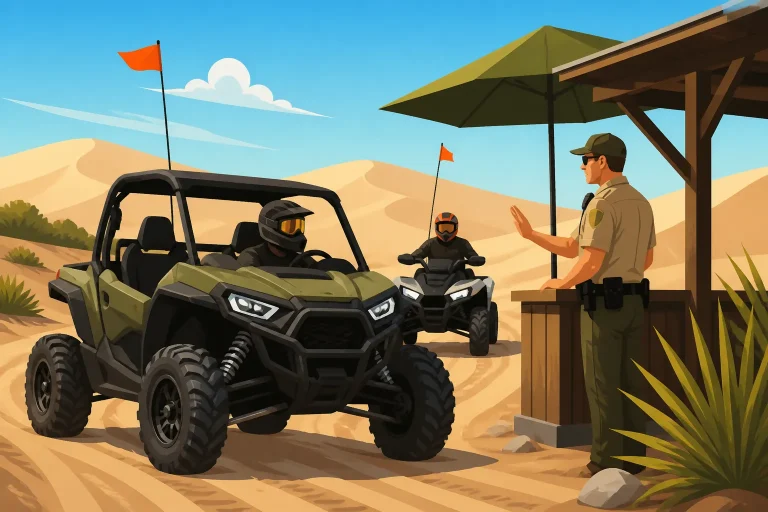
There isn’t one safe distance that works for every animal, setting or situation. The important thing is to avoid crowding them and to respond to what they’re doing. A handler may be able to tell you when it’s safe to proceed, so pause and follow their directions rather than assuming they’ve seen you.
Stop when the trail is narrow
On a narrow trail, don’t try to pass livestock if that would bring your machine close to the animals or leave them with no room to move. Stop at a distance that lets the handler manage the situation. Keep the engine quiet if you can do so safely, and wait until the trail is clear.
Avoid stopping in a spot that blocks the animals’ route or creates a sudden obstacle. If you need to reposition, do it slowly and carefully. When there isn’t a safe way through, wait or turn around rather than pressuring the group to move.
Give ridden animals extra consideration
A horse or other ridden animal may react to a machine even if the rider appears calm. Approach slowly, make your presence apparent without startling anyone, and stop if the rider asks. Don’t pass close behind an animal, accelerate beside it or follow it at a short distance.
If you’re riding with a group, tell the others to stop as well. One rider waiting while another continues forward can leave the handler facing machines from more than one direction. Keep the group together and move only when there is enough room to pass calmly.
Avoid chasing or crowding
Following livestock to get a better look, trying to move them off a route, or riding alongside them to keep pace can create a dangerous situation. It can also violate California’s prohibition on using an OHV to pursue or harass an animal. Give animals a clear route away from you, and don’t turn a close encounter into a chase.
Dust can make matters worse by reducing visibility and unsettling animals. If the ground is dry, take care not to spin the tires or accelerate sharply near a herd. If you can’t pass without causing dust or commotion, wait until the group has moved away.
The same judgment applies around animals being handled or moved through a campground, road crossing or trail junction. The posted speed limit doesn’t guarantee that a particular speed is appropriate in those conditions. Slow down further or stop if that’s what safe control requires.
Check your route and machine before the ride
Seeing livestock near a route doesn’t automatically tell you whether you’re allowed to ride there. A trail may cross private property, be closed to motor vehicles or have restrictions that aren’t obvious from the ground. Plan your route using current area information and obey signs, gates and closures. California Trail Maps and Where to Get Them and Where to Ride an OHV in California can help you prepare.
On public land, access rules and other equipment requirements may also apply. For example, the USDA Forest Service requires a properly installed, approved spark arrester for OHVs operated on National Forest lands. Check the rules for the specific area rather than assuming requirements are the same everywhere. See California Spark Arrester Requirement Explained for more on that equipment rule.
Make sure your registration or permit is in order for the land and machine you plan to use. The California DMV issues an identification certificate, also called a registration card, as proof of valid OHV registration. Riders from outside California should check whether their home-state registration qualifies or whether they need a California nonresident permit. California OHV Permits Explained covers the main permit options, and California’s Nonresident OHV Use Permit focuses on the visitor permit.
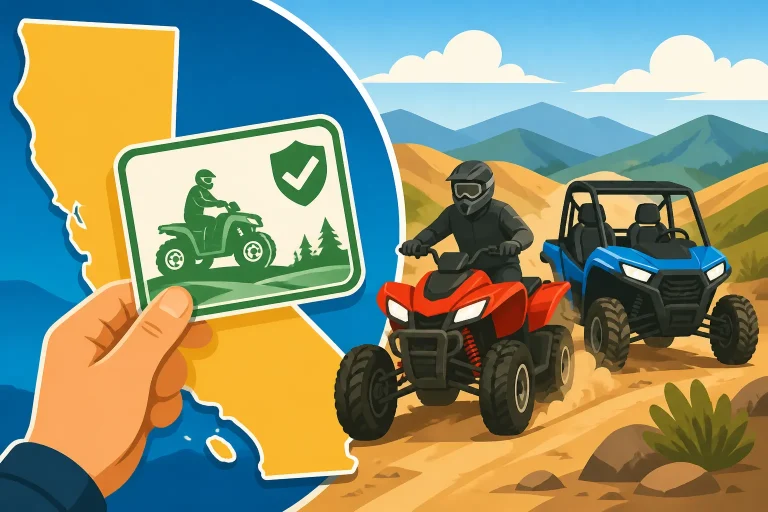
For an ATV, the California DMV and the Department of Parks and Recreation require the Green Sticker or Red Sticker to be securely fastened to the left rear quadrant on a permanent plastic or frame member, visible from the rear. For a California Nonresident OHV Use Permit, California State Parks requires the permit to be affixed to the left rear quadrant on a permanent plastic or metal frame member where it can be inspected from outside. Check that required identification is attached and legible before heading out.
A livestock encounter also makes basic vehicle control important. Use a machine you can handle at low speed, and don’t let passengers or other riders pressure you into passing when it isn’t safe. California State Parks does not permit a passenger on an ATV unless the manufacturer designed and provided that vehicle for multiple riders. California ATV Passenger Ban Explained covers that restriction. If you’re riding a UTV, California requires all occupants to wear seatbelts or safety harnesses while it is moving.
Helmets and other safety requirements still matter even when the ride is slow. California’s helmet rules for public-land riding are covered in California Helmet Law for ATV Riders. For a helmet intended to meet the federal safety standard adopted by California, the National Highway Traffic Safety Administration says it must display the “DOT” symbol indicating the manufacturer’s certification. If you’re shopping online, including on Amazon, check the helmet’s actual label and fit rather than relying only on a listing description.
| Before the ride | What to check |
|---|---|
| Route | Confirm that OHV use is allowed and check for closures, private property and posted restrictions. |
| Registration or permit | Carry the applicable proof and make sure required stickers or permits are properly displayed. |
| Machine control | Check that the vehicle is suitable for the route and that you can manage it at low speed. |
| Safety equipment | Confirm helmets and any vehicle-specific restraints or equipment are ready to use. |
| Riding plan | Agree that everyone will slow down or stop when livestock or ridden animals are nearby. |
If livestock are already on the trail
When you come upon animals unexpectedly, don’t assume they’ll move out of your way. Reduce speed immediately and stop if needed. Watch for a handler, give the group time to settle, and wait for a safe opportunity to continue. If there is no safe way past, turn back only when you can do so without bringing the machine closer to the animals.
If the animals begin to move toward you or scatter, avoid sudden acceleration or sharp turns. Don’t chase after them or try to herd them. Focus on keeping your own vehicle controlled and giving the animals space. If a handler is present, follow their directions.
Riders traveling together should use a simple group plan: the first person stops at a safe distance, signals the others to stop, and everyone waits until the path is clear. Don’t let a line of machines creep forward one at a time while the handler is trying to manage the group. If you’re riding with children or less experienced operators, discuss the plan before the trip and keep them close enough to follow your instructions.
Keep in mind that the legal limit of 15 miles per hour within 50 feet of a concentration of animals is not permission to travel at that speed in every encounter. California’s rule also requires proper control and reducing speed or stopping when approaching livestock or ridden animals to avoid frightening them. If conditions call for a complete stop, stop.
If a route repeatedly brings riders close to livestock, consider another legal route when one is available. Staying on authorized trails and respecting closures helps prevent conflicts with animals, landowners and other trail users. When in doubt, wait for clear guidance or choose a different route rather than trying to force a passage.
Disclaimer
This article is for general informational purposes only and does not constitute professional advice. Laws, prices and regulations vary by location and change over time. Consult a qualified professional for guidance on your specific situation.