California Supervision Rules for Riders Under 14
Riding with a child under 14 in California involves more than choosing a small quad. You need to know who must supervise, what that adult must carry, and whether the child can operate the particular machine. Here’s how to think through those rules for public OHV riding—and where ATV requirements differ from side-by-side rules.
What supervision means for an ATV rider under 14
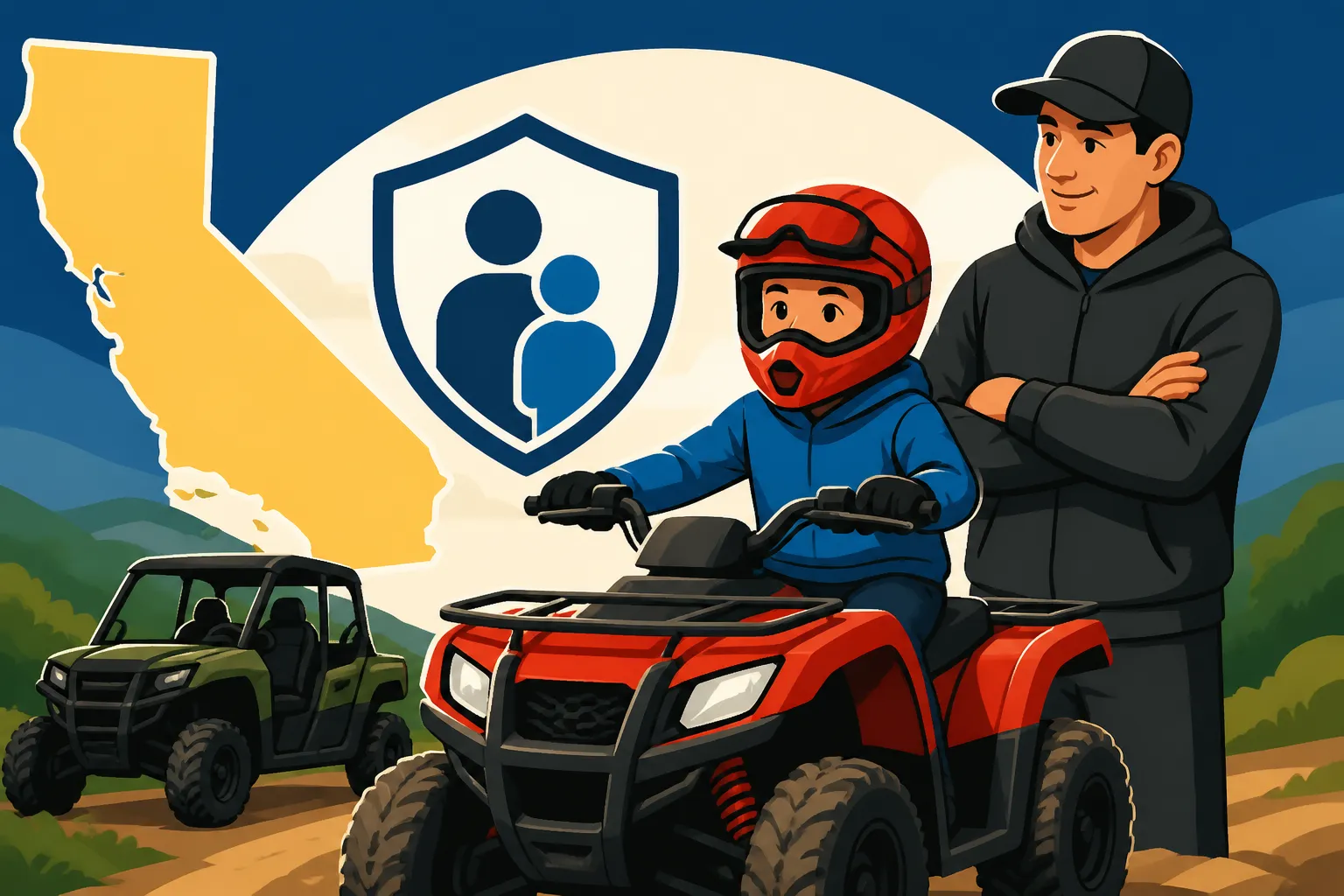
For an ATV rider under 14, plan on direct supervision by an adult. In California, the youth safety-certificate rule also matters: an operator under 18 generally needs an approved ATV safety certificate or must be directly supervised by an adult who has one. For a young rider, an adult simply being somewhere in the riding area is not a sensible substitute for close oversight.
In practical terms, the supervising adult should be able to see the child, monitor how the ride is going, and respond quickly if the child needs help. Staying close enough to intervene is especially important on shared trails, in dunes, and anywhere other riders or vehicles may approach from different directions. A parent or guardian should not assume that watching from a camp, parking area, or distant trail junction meets the expectation of direct supervision.
The certificate requirement belongs to the adult when the adult is supervising a minor who does not have the required certificate. That adult should have proof available while riding, rather than relying on a memory of having completed a course. If the child has a certificate of their own, do not assume that it cancels any additional age-related supervision requirement that applies to riders under 14.
For more detail on the certificate requirement and options for visiting riders, see California ATV Safety Certificate Requirements and California Safety Certificate for Visiting Riders. A certificate or permit requirement is only one part of the rules; it does not make a machine appropriate for a child or remove the need for adult oversight.
Direct supervision is not the same as general supervision
A group ride can make it easy to lose track of a young rider. The child may fall behind, take a different route, or stop where the supervising adult cannot see them. Set a clear plan before starting: choose who is responsible for the child, agree on a pace, and decide what the child should do if separated from the group.
A responsible adult should also be able to focus on the child. If the adult is riding a separate machine far ahead, leading a large group, or managing several children at once, it may be hard to supervise closely. Consider having the child ride with an adult nearby and choosing a route that leaves room to stop safely without blocking other riders.
Choose the machine before choosing the route
A child’s age does not tell you everything about whether they can safely operate an ATV. The machine’s size, controls, power, and handling all matter, as do the child’s strength, coordination, judgment, and experience. Follow the manufacturer’s age and size guidance, read the owner’s manual, and make sure the child can reach and operate the controls correctly while seated.
A machine that is too large or powerful can be difficult for a young rider to control, even at low speed. A child should be able to use the throttle and brakes smoothly, steer without losing a firm grip, and shift their weight as needed. If the child cannot reach a control comfortably or struggles to stop the ATV reliably, the machine is not a good fit.
Do not use the supervising adult’s judgment as a substitute for the manufacturer’s limits. Nor should a child be moved onto a larger machine simply because they have ridden a smaller one before. A gradual progression, close oversight, and a controlled practice area are safer than learning on a crowded trail or steep dune.
ATV rules are not side-by-side rules
An ATV is generally a straddle-style machine, often designed for one rider. A side-by-side is a recreational off-highway vehicle, or ROV, with seats and controls similar to a small vehicle. The rules for operating one should not be assumed to apply to the other.
California sets a minimum operator age of 16 for an ROV on public OHV land. That means a child under 14 should not be the driver of a side-by-side on those lands. A child may be able to ride as a passenger if the vehicle is designed for passengers and all applicable safety requirements are followed, but passenger rules are a separate issue from permission to drive. See ROV Operators at Sixteen and California Rules for Riding With Kids on Board before planning a family ride in a side-by-side.
| Situation | What to plan for |
|---|---|
| Rider under 14 operating an ATV on public OHV land | Direct adult supervision, an appropriate machine, and compliance with certificate rules |
| Rider under 18 without an approved ATV safety certificate | Direct supervision by an adult who holds the required certificate |
| Rider under 14 operating a side-by-side on public OHV land | Do not plan for the child to drive; California sets a minimum operator age of 16 for ROVs |
| Child riding as a side-by-side passenger | Check seat, restraint, helmet, and passenger requirements for the vehicle and riding area |
| Visit to a particular trail or recreation area | Check current rules with the land manager; site restrictions can add practical limits |
Prepare for a public-land ride
Before leaving home, confirm that the riding area allows your machine and that the child’s age, equipment, and supervision plan fit its rules. A registration sticker or permit does not act as a safety certificate, and a certificate does not automatically provide access to every trail or riding area.
California’s OHV areas and other public lands may have different access conditions. Check the current information from the land manager for the specific place you plan to ride, including closures and any local restrictions. For background on the state’s riding credentials and access requirements, see California OHV Permits Explained and California’s Nonresident OHV Use Permit. If you are bringing an out-of-state safety certificate, confirm that it is accepted before the trip; do not assume that a registration decal from another state answers every California requirement.
A short preparation check helps prevent avoidable problems:
- Confirm who is supervising. Name one adult who will remain responsible for the child during the ride. Make sure that adult understands the route and can stay close enough to observe and assist.
- Check certificate and permit documents. Confirm what the child and supervising adult need for the planned ride, and keep required proof accessible. For practical document advice, see Carrying Paperwork on the Sand.
- Inspect the machine. Check the controls, brakes, tires, throttle return, and protective equipment. Use the owner’s manual to guide setup and maintenance.
- Choose a suitable practice area and route. Start with terrain and traffic levels that match the child’s skill. Avoid conditions that make it hard to keep the child in view.
- Agree on simple rules. Set a stopping signal, a safe following distance, and a clear instruction for what to do if the child becomes separated.
- Reassess as conditions change. Heat, dust, fatigue, traffic, and changing terrain can all make an otherwise manageable ride harder for a young operator.
Helmets and other protective equipment should fit the child correctly. A helmet that shifts, blocks vision, or is too loose is not a good fit. If you are purchasing gear through Amazon or another retailer, check the manufacturer’s sizing guidance and return policy, and make sure the product is appropriate for the activity and rider. Protective gear helps reduce risk; it does not make an unsuitable machine or route safe.
Pay attention to fatigue and group dynamics
Children may be less able than adults to recognize when they are tired, overwhelmed, or losing control. Keep rides short enough for the child’s ability, take breaks, and stop if the child is no longer following instructions or operating smoothly. Do not pressure a child to keep up with faster riders.
At a busy recreation area, identify a meeting point in case the group is separated, but do not use that as a replacement for close supervision. Choose routes where the supervising adult can keep the child in view, and avoid splitting the group across different trails. If the adult needs to leave the child’s immediate riding area, stop the ride and regroup first.
Common misunderstandings and what to verify
A few assumptions can lead families astray:
- “The child has a certificate, so no adult needs to supervise.” Do not assume that. For a rider under 14, plan for direct adult supervision and check the applicable rules for the location.
- “The adult is nearby, so that counts.” General proximity is not the same as being able to observe and respond. Stay close enough to monitor the child’s riding.
- “A side-by-side is just a bigger ATV.” It is a different vehicle category, with different operator rules. A child under 14 should not be the driver of an ROV on public OHV land.
- “A permit or registration covers the safety rules.” It does not. Registration, riding permits, safety certificates, age limits, and supervision are separate requirements.
- “A child can ride any machine if an adult is present.” Supervision does not override the manufacturer’s age guidance or make a machine that is too large or powerful appropriate.
Rules can depend on the machine type and the land where it is being operated. Before a trip, verify the current requirements with the relevant land manager and check the vehicle’s owner’s manual. If you are unsure whether a safety certificate or out-of-state document qualifies, confirm that before riding rather than trying to resolve it at an entrance or checkpoint.
For families riding on California public OHV land, the safest planning baseline is straightforward: keep a rider under 14 under close adult supervision, make sure the supervising adult meets the certificate requirement when applicable, and do not put a child behind the controls of a vehicle they are not legally allowed to operate. Check the rules for the exact riding area, because having the right paperwork does not replace good judgment or close supervision.
Disclaimer
This article is for general informational purposes only and does not constitute professional advice. Laws, prices and regulations vary by location and change over time. Consult a qualified professional for guidance on your specific situation.