Does California Honor Arizona OHV Registration?
An Arizona OHV registration may be valid at home, but that does not automatically make it valid for off-highway riding in California. California has limited reciprocity with other states, and Arizona is not included. Here’s what that means for your quad or UTV, when a nonresident permit may be needed, and what to check before you ride.
Does California honor Arizona OHV registration?
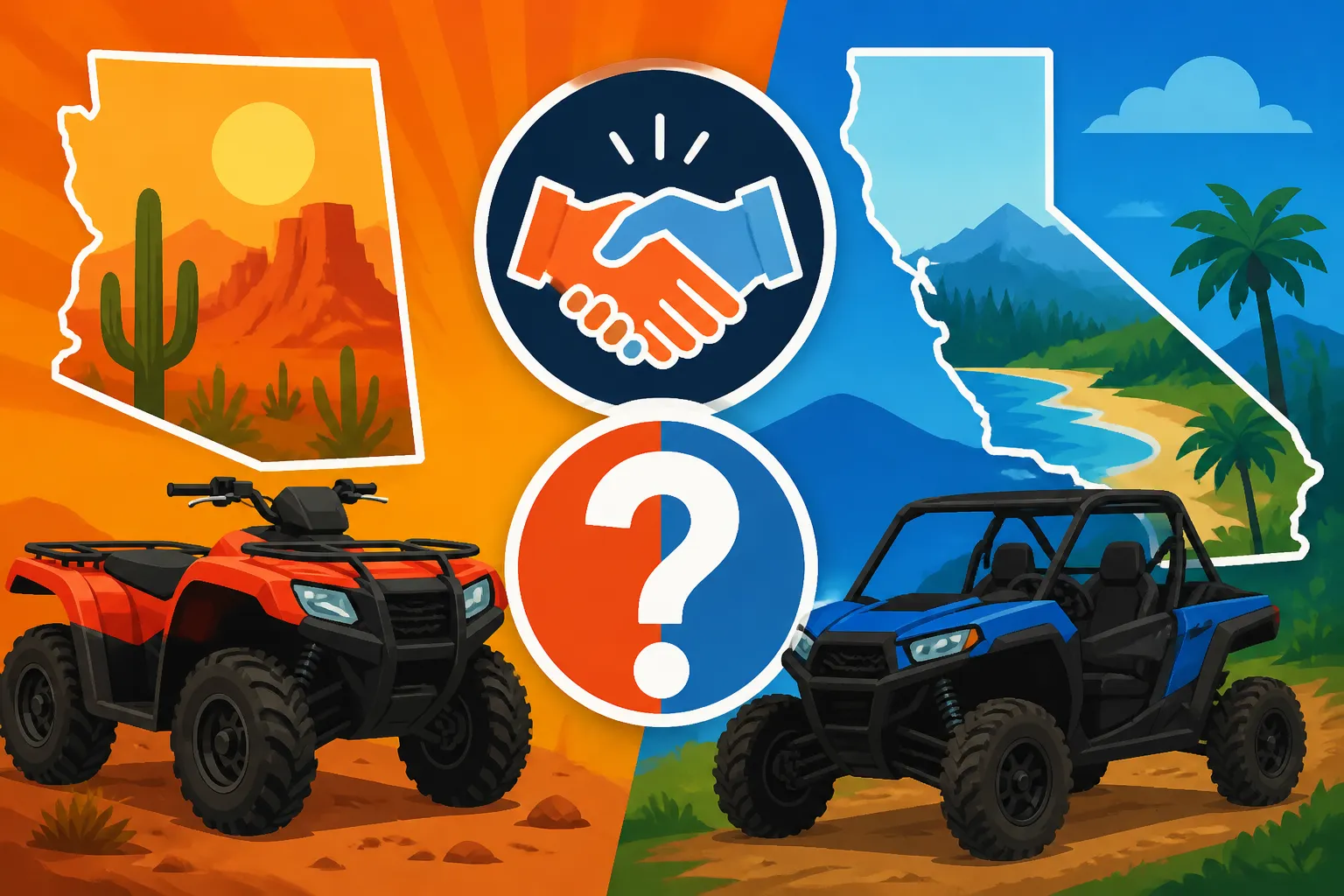
No. California does not treat Arizona OHV registration as a substitute for its own off-highway identification or a California nonresident OHV use permit. California’s reciprocity arrangement is limited to qualifying OHV registrations or permits from Oregon and Nevada. Arizona is not one of those states.
That means an Arizona OHV decal or registration document, by itself, does not meet California’s off-highway identification requirement when you bring a machine to ride on public land. The key distinction is where and how you intend to use the vehicle. A registration that allows you to operate in Arizona does not necessarily authorize off-highway use in another state.
| What you have | Does it automatically satisfy California’s OHV requirement? | What to check |
|---|---|---|
| Arizona OHV registration or decal | No | Whether you need a California nonresident OHV use permit |
| Qualifying Oregon or Nevada OHV identification | Generally covered by California reciprocity | Confirm the identification is valid and applies to your vehicle |
| Arizona highway registration and plate | Not the same as Arizona OHV reciprocity | Whether the vehicle is properly registered for highway use and whether its intended route is legal |
| California nonresident OHV use permit | Intended for qualifying visiting OHV riders | Current purchase, validity, and display instructions |
The practical rule is straightforward: if your Arizona quad or UTV is being brought to California for off-highway riding, do not rely on its Arizona OHV registration as proof that you have met California’s permit requirement. Review California OHV Reciprocity: Only Two States and California’s Nonresident OHV Use Permit before you leave.
This requirement concerns authorization to operate an OHV on covered California lands. It is separate from whether you can legally tow the vehicle into California, whether it is registered for street use, and whether a particular trail or recreation area is open to it. A permit does not override local closures, vehicle restrictions, or other riding rules.
Arizona OHV registration and highway plates are different
The word “registration” can refer to different things. An Arizona OHV registration or decal identifies a vehicle under Arizona’s off-highway program. A highway registration and license plate, where applicable, relate to operating a vehicle on public roads. One should not be assumed to replace the other.
If your UTV or other vehicle has a valid Arizona highway plate, that may affect how its road use is treated. But a highway plate does not automatically give you permission to ride every trail, dune, or off-highway recreation area in California. Some routes are limited to vehicles that are properly registered for highway use; other riding areas require OHV identification or a specific permit. Access rules depend on the land manager and the route.
Before you travel, identify which situation applies:
- Your vehicle is registered as an Arizona OHV, but not for highway use. Plan on needing the applicable California nonresident OHV permit for off-highway riding. Arizona’s OHV paperwork is not a California reciprocity credential.
- Your vehicle has an Arizona highway plate. Carry the valid registration documents, but check whether the intended area accepts a highway-registered vehicle and whether separate OHV identification is required for the use you have planned.
- Your vehicle has both types of Arizona paperwork. Do not assume that having both removes California’s permit requirement. Confirm the rule for the vehicle and the specific area.
- You plan to ride only on private land. Public-land OHV identification rules may not apply in the same way, but permission from the landowner and any other applicable requirements still matter.
For Arizona machines in particular, Why an Arizona Registration Will Not Do in California explains the reciprocity issue. If your question is really about a plated vehicle rather than an off-highway decal, Why a Street-Legal Plate Does Not Substitute can help separate registration from permission to use a particular route.
A road-legal vehicle also has to follow the rules for the road it uses. A plate does not make a closed road open to OHVs or convert an off-road route into a public highway. Similarly, an OHV permit does not make an otherwise restricted vehicle street legal. Treat registration, permits, and route access as separate checks.
What to do before bringing an Arizona quad or UTV
Handle the permit question before loading the machine. Waiting until you reach a recreation area can create avoidable delays, and the rules may be checked at entrances or on the riding area.
- Confirm how the machine is registered. Check whether the Arizona paperwork is for off-highway use, highway use, or both. Make sure the vehicle identification details on the documents match the machine.
- Decide where you will ride. Identify the recreation area, public land, or route you intend to use. Rules can differ between sites, and a permit does not guarantee access to every area.
- Check California’s current nonresident permit instructions. Use the official California State Parks OHMVR information to confirm eligibility, purchase options, permit validity, and display requirements. Fees and procedures can change, so verify the current details rather than relying on an old receipt or online discussion.
- Carry proof with the vehicle. Keep the permit and relevant registration documents available while traveling and riding. Follow the current instructions about whether the permit must be displayed on the machine.
- Check site-specific rules separately. Confirm opening status, permitted vehicle types, and any additional requirements for the riding area. For example, California’s State Vehicular Recreation Areas have site rules that are separate from reciprocity.
- Recheck before a later trip. A permit’s validity period and a recreation area’s rules are not necessarily the same. Confirm that your paperwork remains valid for the trip you are planning.
The steps are similar whether you are visiting for a weekend or making a longer trip. The main difference is how carefully you need to track the permit’s validity and any changes in your plans. If you switch from one riding area to another, check the second area’s access rules instead of assuming the first site’s requirements apply everywhere.
For visitors planning to ride at the Imperial Sand Dunes, review California Rules for Riding Imperial Sand Dunes as well as the permit requirements. A valid permit can address the state’s OHV identification requirement, but it does not replace area-specific rules or any separate requirements that apply to your trip.
Common assumptions that cause problems
“Arizona issued my registration, so California has to accept it.”
That is not how California’s limited reciprocity works. The state recognizes qualifying OHV identification from Oregon and Nevada, not Arizona. If you are unsure whether your document is the relevant kind of OHV identification, use California OHV Permit for Out-of-State Riders as a starting point and verify the current rule with the official program.
“My Arizona decal is still valid, so I do not need another permit.”
A decal can be current in Arizona without qualifying for use in California. Validity in the issuing state and reciprocity in California are separate questions. The fact that the decal has not expired does not change which states California recognizes.
“My UTV has a plate, so I can ride anywhere.”
A plate may relate to road registration, but it does not grant unrestricted access to off-highway routes or recreation areas. A vehicle can be road-registered and still face restrictions on where it may be driven. Check the route and land manager’s requirements before setting out.
“The permit is all I need to check.”
It is one part of trip preparation. You may also need to confirm that the riding area is open, that the vehicle is allowed, and that you meet other applicable rules. For instance, California’s Safety Certificate Rules may be relevant to younger riders, while area-specific restrictions can apply to everyone.
If you are comparing an Arizona vehicle with one registered in a state California recognizes, see Does a Nevada Decal Work in California? or An Oregon Permit on California Sand. Those comparisons can clarify why the state of issuance matters.
The simplest reliable plan is to treat Arizona OHV registration as Arizona documentation, not as a California permit. Confirm the California requirement for the machine, arrange the nonresident permit if needed, and check the riding area before you go. That avoids confusing a valid home-state registration with permission to ride in California.
Disclaimer
This article is for general informational purposes only and does not constitute professional advice. Laws, prices and regulations vary by location and change over time. Consult a qualified professional for guidance on your specific situation.