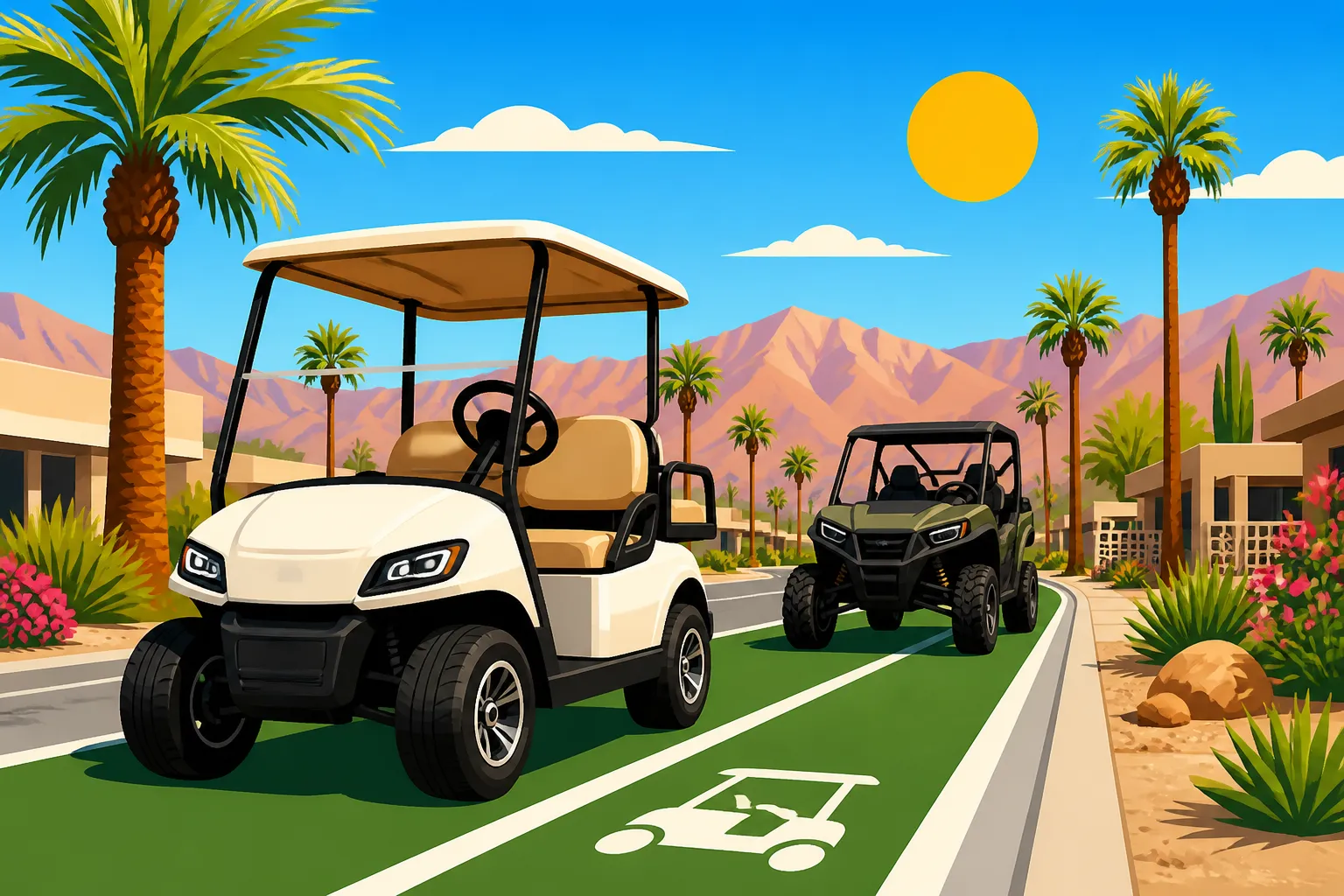
Palm Desert’s Golf Cart Lanes
Palm Desert offers a lifestyle many of us dream about, with sunny skies, beautiful courses, and a relaxed pace. But for many residents and visitors who love to hop in a golf cart for a quick trip to the market or a friend's house, understanding exactly where these vehicles can and cannot legally operate on public roads can be a real head-scratcher. This guide aims to clear up the confusion surrounding Palm Desert's specific golf cart lanes and the regulations that keep everyone safe and within the law.
The Unique World of Golf Carts on Public Roads in California
Before we dive into Palm Desert's specific rules, it's crucial to understand that a golf cart isn't just a slower car, nor is it a full-fledged off-highway vehicle (OHV) like the ATVs and UTVs we often discuss. In California, these vehicles occupy a very specific, often misunderstood, legal niche. Many people assume that because a vehicle has an engine and wheels, it can go anywhere a car can, or at least anywhere an OHV can. This simply isn't the case, especially when you're talking about golf carts on public streets.
The California Vehicle Code (CVC) has very distinct definitions that separate golf carts from other motorized vehicles. A standard golf cart, as defined, is built for traversing golf courses, not public roads. It's designed for low-speed travel, typically topping out at around 15-20 mph. This fundamental design difference is what dictates where they can and cannot legally go. Thinking of a golf cart like a miniature car can lead to serious fines or even accidents. It's a completely different classification of vehicle, with its own set of rules that vary significantly from those governing your trail-ready UTV or ATV. You can learn more about the broader context in [Golf Carts and NEVs in California].
Golf Carts Versus Neighborhood Electric Vehicles NEVs
It's easy to confuse a golf cart with a Neighborhood Electric Vehicle, or NEV. While they might look similar, especially some of the more souped-up golf carts out there, the law sees them very differently. An NEV is specifically designed and manufactured to meet federal safety standards for low-speed vehicles. This means they often come equipped with things like seatbelts, headlights, turn signals, brake lights, mirrors, and a Vehicle Identification Number (VIN) that allows them to be registered with the DMV. They typically have a maximum speed of 25 mph.
A golf cart, on the other hand, often lacks many of these safety features right out of the factory. If you've ever rented a basic golf cart at a course, you'll notice it's pretty bare-bones. To operate on designated public streets, a golf cart often needs to be modified to meet specific safety equipment requirements, or it needs to be an NEV from the start. This distinction is critical because an unmodified golf cart generally cannot legally operate on public streets, even in a city like Palm Desert, without specific local ordinances and designations. It’s not just about how fast it goes; it’s about how it was built and equipped to handle the demands of street traffic, even at low speeds. Don't be fooled by the aftermarket accessories that make your golf cart look more robust; legal compliance is about certified safety features.
The Strict Limits on Standard OHV Street Use
For those of us who love our ATVs and UTVs, it's important to draw a clear line here: golf carts on designated streets are not the same as making an OHV street legal. California has very, very strict rules about off-highway vehicles on public roads. Generally, your ATV or UTV, even if it's got all the bells and whistles from a company like SuperATV that make it a beast on the trails, is not permitted on public paved roads. [Are ATVs Street Legal in California?] and [Can You Make a UTV Street Legal in California?] explain this in detail.
The legal framework for OHVs on streets is incredibly narrow, typically limited to specific combined-use highway segments or crossing routes, and these are often capped at short distances, like three miles. These rules are designed to get you from one trail segment to another, not for daily errands. A golf cart, when used in a city like Palm Desert with specific ordinances, operates under a completely different set of CVC sections. It's not about being "street legal" in the same way a car is, but rather operating within a specially carved-out exception for certain low-speed vehicles in designated areas. Understanding this distinction is key to avoiding tickets and ensuring safety, whether you're driving a golf cart or trailering your UTV to the nearest riding area.
Palm Desert's Vision: The Designated Golf Cart Network
Palm Desert has long embraced a unique vision for local transportation, recognizing that its warm climate, flat terrain, and abundance of golf courses make golf carts a natural fit for everyday errands. This isn't just a casual trend; it's a deliberate, planned approach to urban mobility. The city has actively designated specific streets and lanes for golf cart use, creating a network that allows residents to commute for short distances without needing a full-sized vehicle. This forward-thinking approach sets Palm Desert apart from many other California cities where golf carts on public streets are a rare sight or simply illegal.
The primary goal of these designated lanes is to enhance the quality of life for residents by providing convenient, eco-friendly, and often more enjoyable transportation options. Imagine being able to cruise to your local coffee shop, the grocery store, or even a friend's house, all while enjoying the open air in your golf cart. This isn't just about convenience; it also helps reduce traffic congestion and encourages a more active, community-oriented lifestyle. It's a great example of how a city can tailor its infrastructure to its unique environment and resident needs.
How Palm Desert's Network Differs From Other Cities
What Palm Desert has achieved with its golf cart network is quite distinct compared to how other California cities might approach low-speed vehicle use. Many municipalities might have isolated segments where golf carts are allowed, often as part of a pilot program or to connect a specific golf course to a nearby residential area. However, Palm Desert has developed a far more extensive and interconnected system.
The difference lies in the scope and intent. Palm Desert hasn't just allowed golf carts; it has actively planned and invested in a network designed to be functional for daily living. This includes clear signage, often dedicated lanes, and a comprehensive understanding by local law enforcement and residents about the rules. Other cities might have a single street segment open, perhaps a [California's 3-Mile Combined-Use Cap] type of scenario, whereas Palm Desert has created a sprawling network. This commitment makes it a model for how golf carts can integrate into urban life, moving beyond mere recreation to become a genuine transportation alternative.
The Role of CVC Sections 21716 and 21115
Palm Desert's authority to designate these golf cart lanes stems directly from specific sections of the California Vehicle Code. Specifically, CVC Section 21716 permits a city or county to establish special lanes for golf cart operation on highways under its jurisdiction, provided certain conditions are met. This isn't a free-for-all; it requires a formal ordinance and clear justification. Additionally, CVC Section 21115 empowers local authorities to prohibit or restrict the use of certain vehicles on specific highways. When combined, these sections provide the legal framework for cities like Palm Desert to create and enforce their unique golf cart transportation plans.
These code sections are the bedrock upon which Palm Desert's network is built. Without them, even the most well-intentioned local initiative would quickly run afoul of state law. They dictate what types of vehicles qualify, what safety equipment is required, and what speed limits must be observed. For the average resident, this means peace of mind knowing that the city has done its homework and that their golf cart travels are legally sanctioned within the designated areas. It's a testament to the fact that careful planning and adherence to state law can create innovative local transportation solutions.
Navigating Palm Desert's Designated Golf Cart Lanes
If you're new to Palm Desert or just considering using a golf cart for local trips, understanding the physical layout and signage of the designated lanes is paramount. It’s not simply a matter of knowing that golf carts are allowed; it’s about knowing where exactly you can go and how to share the road safely. These lanes are integral to the city's infrastructure, and navigating them requires both awareness and adherence to specific rules.
You'll find these lanes clearly marked throughout the city. They're typically on local streets, not major thoroughfares, and are often adjacent to golf courses or connecting residential communities to commercial centers. The idea is to create convenient, low-stress routes for golf cart users, keeping them separate from faster-moving traffic where possible. This is a far cry from the open desert trails where you might push your modified UTV to its limits; these are urban streets, albeit with special allowances for golf carts.
Identifying Designated Lanes and Crossings
Spotting a designated golf cart lane in Palm Desert is usually quite straightforward. Look for specific signage indicating "Golf Cart Lane" or "Golf Cart Crossing." These signs are crucial because they delineate the legal operating areas. The lanes themselves may be physically separated from vehicle traffic by a curb or striping, or they might simply be a designated portion of the shoulder on a wider street. Pay close attention to these visual cues, as straying outside a designated lane can lead to fines. [Palm Desert's Golf Cart Lanes] are clearly indicated.
Crossings are equally important. You'll often find specific marked crosswalks or intersections where golf carts are permitted to cross main arterial roads to connect to another segment of the golf cart network. These crossings might be equipped with traffic signals specifically for golf carts or clear right-of-way rules. Always exercise extreme caution at these points, as you'll be interacting with faster vehicle traffic. Never assume drivers see you; make eye contact and proceed only when it's safe. It's a bit like learning new hand signals for trail riding, but instead, it's about understanding the specific visual language of Palm Desert's urban environment.
Speed Limits and Sharing the Road
In Palm Desert's designated golf cart lanes, speed limits are strictly enforced, and they are considerably lower than for regular vehicle traffic. Typically, golf carts are restricted to speeds of 15-25 mph, aligning with their design capabilities and safety standards. Exceeding these limits, even if your golf cart could go faster, is not only illegal but dangerous. Remember, these vehicles lack the robust safety features of a full-sized car.
Sharing the road safely means being predictable and visible. Even in a designated lane, you'll likely encounter bicyclists, pedestrians, and occasionally other slow-moving vehicles. Always drive defensively, use hand signals if your cart lacks turn signals, and be mindful of your surroundings. While the lanes are designated for golf carts, they are still part of the broader public infrastructure. For example, some residents might own a UTV from SuperATV for off-road adventures, but when they use a golf cart in Palm Desert, they must adhere to the completely different set of rules for the specific golf cart lanes, which includes strict speed enforcement. It’s a completely different riding experience.
| Vehicle Type | Typical Max Speed (mph) | Registration Required | Street Legal Status (CA General) | Primary Use Case |
|---|---|---|---|---|
| Golf Cart | 15-20 | No (typically) | Limited, via local ordinances/designated lanes | Golf courses, short-distance community transport |
| NEV / LSV | 25 | Yes (DMV) | Limited, on streets 35 mph or less | Neighborhood transport, commercial campuses |
| ATV / UTV (OHV) | Varies, can exceed 60+ | Yes (OHV Stickers) | Very Limited (crossings, combined-use) | Off-road recreation, trails, dunes, private land |
| Passenger Car | Varies | Yes (DMV) | Fully street legal | General public road travel |
Rules, Regulations, and Safety for Golf Cart Operators
Operating a golf cart in Palm Desert's designated lanes comes with a specific set of responsibilities. It’s not just about knowing where to go, but also how to behave and what equipment your cart must have to comply with the law. Just as you wouldn't head out to Glamis without your whip flag and proper safety gear, you shouldn't take your golf cart onto public roads without understanding the specific regulations. Ignoring these rules can lead to citations, just like riding your OHV where it's not permitted could result in [California Fines for Riding on a Highway].
The safety of everyone on the road, including pedestrians and cyclists, hinges on golf cart operators adhering to these guidelines. These rules are in place not to restrict your fun, but to ensure that this unique transportation option remains viable and safe for the entire community. It’s all about maintaining harmony between different modes of transport in a busy, active city.
Essential Equipment and Licensing Requirements
For a golf cart to be legally operated on Palm Desert's public streets, even in designated lanes, it typically needs to be equipped with certain safety features. These usually include:
- Headlights: For visibility, especially at dawn, dusk, or night.
- Taillights and Brake Lights: To signal your presence and intentions to other drivers.
- Turn Signals: Essential for communicating turns and lane changes.
- Rearview Mirror: To see traffic behind you.
- Windshield: To protect against debris and wind.
- Horn: To alert others to your presence.
- Seatbelts: For passenger safety, often required if the cart exceeds a certain speed or is an NEV.
Regarding licensing, operators must hold a valid California driver's license. This is a common misconception – just because it’s a golf cart doesn’t mean anyone can drive it. The rules are clear: if you’re operating a motorized vehicle on a public road, you need to be a licensed driver. While you don't need a special golf cart endorsement, your regular driver's license is mandatory. This is a similar principle to how you need a driver's license to tow your OHV trailer, even if you don't need one to ride the OHV itself. This also means that anyone under the legal driving age cannot operate a golf cart on these public streets, regardless of whether they're in a designated lane.
Avoiding Common Missteps and Penalties
One of the biggest pitfalls for golf cart operators in Palm Desert is assuming that because they see golf carts everywhere, all streets are fair game. This is absolutely not the case. Sticking strictly to the designated lanes and crossings is non-negotiable. Veering onto a major arterial street where golf carts are not permitted can result in a traffic citation. Another common misstep is carrying too many passengers or allowing children to ride in unsafe positions. Golf carts have specific seating capacities, and overloading them or allowing passengers to ride unsafely is incredibly dangerous and illegal. [California's Ban on ATV Passengers] explains why passenger rules are so strict for other off-highway vehicles, and similar safety principles apply here.
Another area where operators often get into trouble is ignoring traffic laws. While you're in a golf cart, you are still subject to all California traffic laws: stopping at stop signs, yielding to pedestrians, signaling turns, and not driving under the influence. DUI laws apply to golf cart operation just as they do to any other vehicle. The penalties for infractions can range from fines to having your golf cart impounded. It’s essential to treat your golf cart operation with the same respect for the law as you would driving your car or riding your OHV.
Future Trends and Community Impact of Golf Cart Lanes
Palm Desert's golf cart network isn't a static system; it's an evolving part of the city's infrastructure that continues to adapt to community needs and technological advancements. As more residents embrace this mode of transportation, and as vehicle technology improves, we can expect to see further developments and discussions around golf cart use. The success of Palm Desert's model serves as a case study for other communities considering similar initiatives, highlighting both the benefits and the ongoing challenges of integrating low-speed vehicles into urban environments.
This unique approach to transportation also has a significant impact on the community's character and environmental footprint. It fosters a more relaxed, neighborly atmosphere, where people are more likely to interact face-to-face rather than through a car window. It also contributes to the city's sustainability goals by reducing reliance on gasoline-powered cars for short trips.
Potential Expansion and Technological Advancements
As the popularity of golf cart transportation grows, there's always the potential for the designated network to expand, connecting even more residential areas, commercial centers, and recreational facilities. City planners continually evaluate routes and feasibility, seeking to enhance connectivity and safety. This could mean more miles of dedicated lanes, safer crossings, and perhaps even dedicated golf cart parking areas in high-traffic zones.
Technological advancements are also playing a significant role. Modern golf carts are becoming more sophisticated, with improved battery life, integrated GPS, and enhanced safety features. We might see more advanced NEVs with even greater ranges and comforts, blurring the lines between traditional golf carts and small electric cars. For instance, while SuperATV might be known for high-performance off-road parts, the future of street-legal golf carts could also see innovations in lightweight, durable components that improve safety and efficiency on paved surfaces, albeit within entirely different regulatory frameworks. These improvements could make golf cart transportation even more appealing and practical for a wider segment of the population.
Environmental and Social Benefits of Golf Cart Integration
The environmental benefits of a robust golf cart network are clear. For every short trip taken in an electric golf cart instead of a gasoline-powered car, there's a reduction in tailpipe emissions and a decrease in fossil fuel consumption. This contributes directly to cleaner air and a smaller carbon footprint for the community, aligning with California's broader environmental goals. It’s a quiet revolution, literally, as the hum of an electric motor replaces the rumble of an internal combustion engine.
Socially, the integration of golf carts can foster a stronger sense of community. When people are moving at a slower pace, in open-air vehicles, they are more likely to wave to neighbors, stop for a quick chat, and engage with their surroundings. It creates a more pedestrian-friendly environment, encouraging outdoor activity and making local businesses more accessible. This kind of thoughtful urban planning helps to create a vibrant, connected community, transforming mundane errands into enjoyable experiences. It exemplifies how local initiatives can profoundly enhance both ecological health and social well-being.
Disclaimer
This article is for general informational purposes only and does not constitute professional advice. Laws, prices and regulations vary by location and change over time. Consult a qualified professional for guidance on your specific situation.