Why Dune Riders Need an 8-Foot Whip and Flag
A dune flag can seem like a small piece of gear, but it helps riders spot vehicles hidden by crests and changing sand. California dune areas may require a whip and flag, and a setup that is too short, loose, or poorly placed can fail the purpose even if you brought one. Here’s how to choose, mount, and check yours before riding.
Why dune riders use a whip and flag
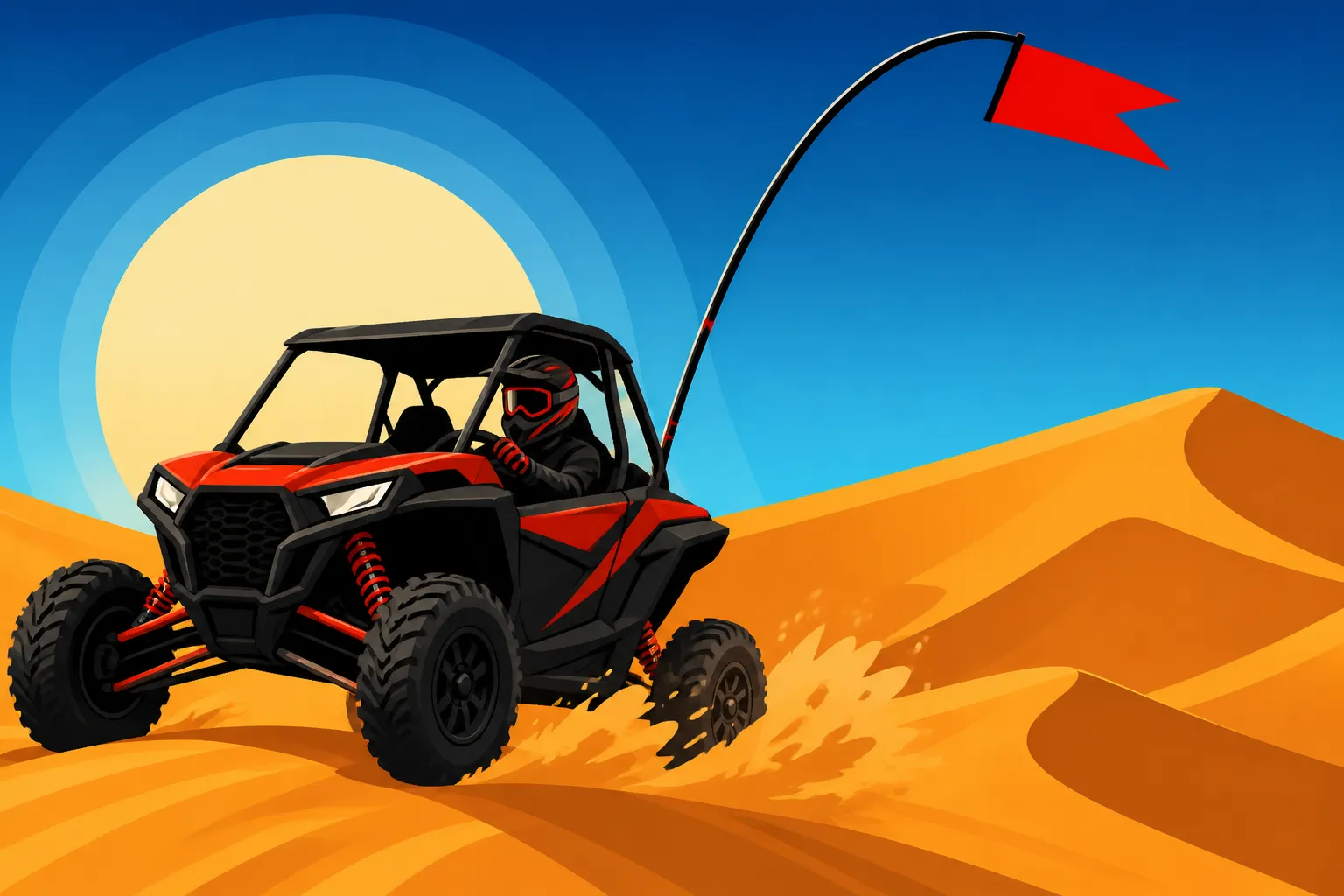
Dunes create blind spots. A rider climbing one side of a crest may not see a vehicle approaching from the other side until both are near the top. A flag raised above the machine can become visible sooner than the rider, roll cage, or handlebars, giving others an extra warning to slow down or change course.
That visibility matters on busy dunes, where riders may be traveling in different directions and where the shape of the sand can hide both machines and people. A whip helps keep the flag elevated, while the flag’s bright color and movement make it easier to notice against a landscape with few visual landmarks.
The equipment is a safety measure, not a guarantee. A flag cannot show whether another rider has seen you, and a tall whip does not make it safe to charge over a crest. Approach blind rises cautiously, keep a lookout for other users, and avoid crossing a dune when you cannot see the route ahead. The flag adds visibility to careful riding; it does not replace it.
California dune areas can have specific equipment rules. The expected setup generally includes a whip mast that raises the flag to the required height and a flag that meets size and placement requirements. Check the rules for the particular area you plan to ride, since a state rule, land manager’s conditions, or a site-specific notice may affect what is accepted. The details of the requirement are covered in California Dune Flag Requirements and California Whip Height Requirements.
A flag is also separate from your riding permit or vehicle identification. Having one does not make an unregistered machine legal to ride, and a permit does not replace required safety equipment. If you are visiting California, check whether your home-state identification is accepted and what permits the riding area requires. California’s Nonresident OHV Use Permit explains the visitor permit question; California Rules for Riding Imperial Sand Dunes covers the broader rules at the Imperial Sand Dunes.
What the 8-foot requirement means
The phrase “8-foot whip” is easy to interpret as meaning that the whip itself must be exactly eight feet long. In practice, what matters is the required height of the flag once the whip is installed on the machine and the machine is sitting on the ground. A pole’s advertised length may not equal its installed height: the base, mount, flexible section, and position of the flag all affect the final measurement.
Before buying a whip, look for the requirement that applies where you will ride and check how it defines the height. Do not rely on the product name alone. A pole sold as eight feet long may sit lower than expected after installation, while a different assembly may place the flag higher. If the posted rule specifies a minimum height above ground, measure the setup in that position rather than assuming the mast’s package dimensions settle the question.
A sensible check is to park the machine on level ground, fit the whip and flag as intended, and measure from the ground to the point identified by the applicable rule. If the rule or park guidance is unclear about whether it refers to the mast, the flag, or another point, ask the land manager before riding. The practical distinction between pole length and installed height is discussed in Whip Mast Height on the Sand.
| Part of the setup | What to check | Why it matters |
|---|---|---|
| Whip mast | Installed height meets the location’s requirement | A mast that sits too low may not make the flag visible over a dune |
| Flag | Required color and dimensions | A small or low-contrast flag may be harder to spot |
| Flag position | Flag is placed where the applicable rule requires | A flag mounted too far down the mast may not meet the rule |
| Base and attachment | Mount holds securely on the machine | A loose base can let the whip fall or detach |
| Full assembly | Flag remains visible during normal riding | The setup needs to work in motion, not just while parked |
For many California dune setups, riders encounter guidance calling for a flag at least 8 feet above ground, with a bright flag of specified dimensions. The details can be easy to misread when a listing describes the pole rather than the installed assembly. Confirm the current rule at your riding area instead of treating a seller’s product description as proof of compliance.
Flag placement is another detail worth checking. A flag attached well below the top of the mast can reduce its visibility and may not meet the applicable placement rule. Follow the instructions for the riding area and secure the flag so it stays near the intended position. See Flags Within 10 Inches of the Mast Top for more on this placement issue.
Choosing and mounting a setup that works
A compliant setup has to stay attached and remain visible through bumps, sand, and ordinary movement. A flag that meets the size requirement but repeatedly folds around the whip, slips down the mast, or disappears behind the vehicle is not doing its job well. Before selecting equipment, consider the machine, the mount location, and the type of riding you expect to do.
Start with the mount. A whip needs a compatible base that can attach firmly to the machine without interfering with the rider, passengers, moving parts, or required vehicle equipment. An ATV and a side-by-side may need different mounting solutions. On a UTV, a roll cage can offer a useful attachment point, but the mount still needs to fit the particular cage and avoid obstructing doors or other equipment. On a quad, consider the location of the base and whether it could snag clothing or make it harder to get on and off.
Check that the mount is designed for the whip you plan to use. A loose or poorly matched connection can allow the mast to rotate, lean, or pull free. Follow the maker’s installation instructions, and check fasteners after installation. Do not improvise a mount that could fail under vibration or create a sharp or exposed hazard.
Next, check the flag itself. The riding area may specify the color, minimum dimensions, and where the flag must sit on the mast. A flag that looks bright in a shop may be hard to see when dusty or faded. Choose a durable, high-visibility flag that fits the required dimensions, and replace it if it tears, becomes badly faded, or no longer stays in position. Details about the common size requirement are covered in Flag Size on California Dunes.
When buying, verify the entire assembly rather than focusing on one number in a product listing. Ask:
- Is the stated length the mast length or the installed height?
- Does the base fit the machine and the intended mounting point?
- Can the flag be attached securely at the required position?
- Does the flag meet the local size and color requirements?
- Are replacement flags, hardware, or sections available if something breaks?
Amazon may offer a range of whip, mount, and flag options, but a listing is not a substitute for checking the riding area’s rules or confirming that the parts fit your vehicle. Read the specifications carefully, especially when the listing groups different lengths or mounting styles together. If the seller does not explain the assembled height or mounting compatibility, look for clearer product information before ordering.
Install the setup according to the manufacturer’s instructions. Keep the base tight, make sure the flag is secured, and check that the whip can flex without striking the rider or catching on nearby parts. If a whip is designed to bend, that flexibility can help it absorb movement, but it should still return to a useful upright position. Do not modify it in a way that makes it too low, unstable, or difficult to inspect.
The finished assembly should be tall enough, easy to see, and firmly mounted. It should not block the driver’s view or create a hazard for a passenger. If you carry a spare flag or replacement parts, store them so they are available without interfering with vehicle controls or safety equipment.
Checks to make before and during a ride
A whip can look fine at home and loosen during transport or riding. Make a quick inspection before every trip, and check again if the machine has been loaded, unloaded, tipped, or hit by another vehicle. It takes little time and can catch a loose base or damaged flag before you reach the dunes.
Use this short check before setting off:
- Confirm the local requirement. Check the land manager’s current rules for the area you plan to ride. Do not assume that a setup accepted at one site automatically meets another site’s requirements.
- Check installed height. With the vehicle on level ground, confirm that the assembled whip and flag meet the required height. Recheck after changing mounts or replacing sections.
- Inspect the flag. Make sure it is the required size and color, visible, undamaged, and attached in the required position.
- Test the mount. Check that the base is secure and that the mast does not wobble or rotate more than its design allows.
- Check clearance. Confirm that the assembly does not interfere with the rider, passengers, controls, or moving parts.
- Carry a practical repair option. A replacement flag or suitable fastener can help address minor damage, but do not continue riding if the main mount or mast is unsafe.
During the ride, keep the flag in place and pay attention to changes in how the machine handles. If the whip has folded over, the flag has slipped down, or the mount has loosened, stop somewhere safe and correct the problem before continuing. Do not try to fix equipment while moving or in a spot where other riders cannot see you.
A damaged whip may still be attached but no longer provide the height or visibility you intended. Likewise, a flag can remain on the mast while its fabric is torn or folded so tightly that it is hard to distinguish. Check the whole assembly rather than treating “still attached” as the same as “working.”
At an entrance or checkpoint, staff may look for required equipment as part of a broader compliance check. Requirements and enforcement practices can vary by location, so bring the gear specified for your riding area and make sure it is fitted correctly before arrival. Rangers at a Dune Checkpoint explains what else riders may be asked to show. A whip and flag do not replace registration, permits, or other documents; keep those items in order as well.
Think about visibility throughout the ride, not only at the entrance. A flag that is difficult to see against the sky, hidden by cargo, or angled down over the vehicle is less useful. Secure luggage and other gear so they do not cover it, and avoid attaching decorations or additional items that make the flag harder to identify.
Common mistakes and practical fixes
Buying by the advertised pole length alone. A product labeled as eight feet may not put the flag at the expected height once mounted. Check the assembled height and the local definition of the requirement before buying.
Assuming any bright flag will do. The riding area may require a minimum size, a specific color range, or a particular position on the mast. Check the local dimensions rather than relying on appearance.
Mounting the flag too low. The height of the pole does not fix poor placement on the pole. Follow the applicable placement rule and confirm that the flag stays near the intended part of the mast.
Using a mount that does not fit the vehicle. A universal label does not guarantee a secure fit on every ATV or UTV. Confirm the mounting style and hardware are appropriate for your machine.
Ignoring damage until the next trip. A cracked base, loose fastener, or torn flag can become a more serious problem on the dunes. Repair or replace damaged parts before riding again.
Treating the flag as permission to take a blind crest at speed. The flag improves visibility, but it does not reveal what is beyond the ridge or prevent a collision by itself. Reduce speed as sightlines narrow and choose a route you can see.
The key is to treat the whip, flag, mount, and placement as one system. Checking each part against the riding area’s rules helps avoid an avoidable problem at the entrance and makes the equipment more useful once you are on the sand.
Frequently Asked Questions
Is an eight-foot whip the same as an eight-foot installed height?
Not necessarily. A pole’s listed length and the height of the assembled setup above the ground can differ because of the mount and how the flag is fitted. Check the local rule’s wording and measure the installed setup as directed.
Does every California riding area use the same flag rule?
Do not assume that every site has identical requirements. Check the current rules for the specific dunes or riding area, including any posted guidance from the land manager.
Can I ride if my flag tears but the whip is still attached?
A torn or badly damaged flag may no longer meet the area’s requirement or provide useful visibility. Stop in a safe place and replace or repair it before continuing, following the site’s rules.
Does a whip and flag replace a permit or registration?
No. The whip and flag are safety equipment. They do not replace any permit, registration, or vehicle identification required for the ride.
Disclaimer
This article is for general informational purposes only and does not constitute professional advice. Laws, prices and regulations vary by location and change over time. Consult a qualified professional for guidance on your specific situation.